
Filter
537
Featured
392
26
4
Topics
197
114
63
49
38
36
31
28
22
22
22
21
20
19
18
18
17
16
15
15
15
14
14
13
13
13
12
11
10
9
9
9
9
9
9
9
8
8
8
8
8
8
8
7
7
7
7
7
7
7
7
7
7
7
7
7
7
7
7
6
6
6
6
6
6
6
6
6
5
5
5
5
5
5
5
5
5
5
5
5
5
5
5
5
5
5
5
5
5
4
4
4
4
4
4
4
4
4
4
4
4
4
4
4
4
4
4
4
4
4
3
3
3
3
3
3
3
3
3
3
3
3
3
3
3
3
3
3
3
3
3
3
3
3
3
3
3
3
3
3
3
3
3
3
3
3
3
3
3
3
3
3
3
3
3
2
2
2
2
2
2
2
2
2
2
2
2
2
2
2
2
2
2
2
2
2
2
2
2
2
2
2
2
2
2
2
2
2
2
2
2
2
2
2
2
2
2
2
2
2
2
2
2
2
2
2
2
2
2
2
2
2
2
2
2
2
2
1
1
1
1
1
1
1
1
1
1
1
1
1
1
1
1
1
1
1
1
1
1
1
1
1
1
1
1
1
1
1
1
1
1
1
1
1
1
1
1
1
1
1
1
1
1
1
1
1
1
1
1
1
1
1
1
1
1
1
1
1
1
1
1
1
1
1
1
1
1
1
1
1
1
1
1
1
1
1
1
1
1
1
1
1
1
1
1
1
1
1
1
1
1
1
1
1
1
1
1
1
1
1
1
1
1
1
1
1
1
1
1
1
1
1
1
1
1
1
1
1
1
1
1
1
1
1
1
1
1
1
1
1
1
1
1
1
1
1
1
1
1
1
1
1
1
1
1
1
1
1
1
1
1
1
1
1
1
1
1
1
1
1
1
1
1
1
1
1
1
1
1
1
1
1
1
1
1
1
1
1
1
1
1
1
1
1
1
1
1
1
1
1
1
1
1
1
1
1
Language
Document type
26
21
17
15
13
13
10
10
5
3
3
3
2
1
Countries
Authors & Publishers
Media focus
Publication Years
Methods applied
Journals
Output Type


Ist mein Kind fit für ein eigenes Smartphone?
klicksafe (2024), 1 p.


Nuestras apps de cada día 2024: Segundo informe sobre el uso de plataformas digitales en Costa Rica
San José, Costa Rica: Universidad de Costa Rica, Centro de Investigación en Comunicación (CICOM) (2024), 30 pp.
"La información que se presenta a continuación desafía premisas establecidas sobre el uso de plataformas digitales en Costa Rica. Por ejemplo, sen confirma que Facebook sigue siendo la red social más utilizada en el país, a pesar de la variedad de oferta, el surgimiento de nuevas opciones y not
...

"Dieser Report bietet einen Überblick über die im NOTORIOUS Projekt entwickelten und angewandten Methoden und Strategien zur Erhebung und Analyse von Mehrplattform-Social-Media-Daten mit einem Schwerpunkt auf der Aufdeckung von Desinformationsnarrativen. Zur Datensammlung erwiesen sich explorative
...

Children's digital experiences in Indian slums: Technologies, identities, and Jugaad
Amsterdam: Amsterdam University Press (2024), 175 pp.
"This book departs from the universalising and rescue narratives of poor children and technologies. It offers complex stories on how children's social identities (gender, caste, and religion), cultural norms, and personal aspirations influence their digital experiences. How do children challenge, ci
...

Social Media, Youth, and the Global South: Comparative Perspectives
Cham: Palgrave Macmillan (2024), xix, 292 pp.
This book illuminates the complex relationship between social media, identity, and youth in the Global South. By examining the profound impact on the psychosocial well-being and economic prospects of young people across diverse regions, the collection present empirical evidence from scholars spannin
...
"Jonathan Haidt ['The Anxious Generation,' 2024] has four bottom-line suggestions: 1) No smartphones before high school; 2) no social media before age 16; 3) phone-free schools; and 4) more free play in the real world. Amidst uncertainty as to the magnitude of social media impacts, implementing thes
...
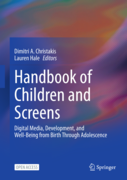
Handbook of Children and Screens
Deep Insights
Cham: Springer Nature (2024), 657 pp.
"This open access handbook synthesizes the current research about the impacts of digital media on children across development. Drawing on the expertise of scientists and researchers as well as clinicians and practitioners, the book summarizes research through interdisciplinary expert reviews. First,
...

Mirrored Spaces: Social Inequality in the Digital Age
Wiesbaden: Palgrave Macmillan (2024), xvii, 166 pp.
"Contrary to the prevailing narratives of "digital empowerment" and opportunities for every individual, this book argues that digitalisation massively curtails social advancement opportunities, consolidating existing social relations. From a spatial perspective, Scheffer demonstrates how socially di
...


Discussing the Role of TikTok Sharing Practices in Everyday Social Life
International Journal of Communication, volume 18 (2024), pp. 909-926
"A crucial element of TikTok consumption is the act of sharing TikTok videos with others, such as friends. In this article, I draw on ethnographic fieldwork with young adult TikTok users based in the United Kingdom to investigate this practice. I show how people use TikTok’s “For You” page as
...


Parenting Cyber-Risk: Opportunities and Challenges Raising Children with Digital Environments
Oxford: Routledge (2024), 181 pp.
"Utilizing 70 original interviews from rural and urban area Canadian parents, the book provides an overview of research on “digital parenting” and illuminates the modern parental experience of managing children’s access to internet-connected technologies. The book explores parents’ experienc
...

Self-Deprecating Cyberculture on TikTok: Experiences of Young Indonesians
International Journal of Communication, volume 18 (2024), pp. 2201-2223
"The TikTok self-deprecating (SD) cyberculture is built on the exchange of SD memes among users who deprecate aspects of themselves on a daily basis. Predominantly composed of young people, SD memes on Indonesian TikTok reflect discourses on the daily struggles faced by young Indonesians. To explore
...
Collective victimhood narratives in far-right communities on Telegram
Information, Communication & Society, volume 28, issue 8 (2024), pp. 1407-1424
"Feelings of collective victimhood have been demonstrated to have a strong effect on ingroup bias, outgroup hostility and support for violence. The use of narratives stirring these feelings in far-right communications is especially concerning given their inclusion in the manifestos of several mass k
...

Nutzung digitaler Medien im Kindes- und Jugendalter
DAK-Gesundheit (2024), 42 slides
Contesting personalized recommender systems: A cross-country analysis of user preferences
Information, Communication & Society (2024), 20 pp.
"Very Large Online Platforms (VLOPs) such as Instagram, TikTok, and YouTube wield substantial influence over digital information flows using sophisticated algorithmic recommender systems (RS). As these systems curate personalized content, concerns have emerged about their propensity to amplify polar
...

Mediensucht nach der Pandemie
DAK-Gesundheit (2024), 39 pp.
"Die neuesten Studienergebnisse zeigen, dass
• sich die Social-Media-Sucht bei Kindern und Jugendlichen seit 2019 fast verdoppelt hat. Sechs Prozent der 10- bis 17-Jährigen erfüllen derzeit die Kriterien einer Sucht.
• jedes vierte Kind soziale Medien riskant nutzt. Das sind hochgerechnet r
...
Measuring Exposure and Attention to Media and Communication: Solutions to Wicked Problems
Amsterdam: Amsterdam University Press (2024), 164 pp.
"Valid and reliable measurement of media and communication exposure is crucial for communication science, psychology, political science, sociology, pedagogy, economics, and law, and the practitioners in media, communication, and information. At the same time, this is a wicked problem for which there
...
