
Filter
752
Featured
663
45
19
Topics
384
205
80
72
58
57
56
53
44
41
40
33
31
31
28
26
25
22
21
19
19
18
18
17
17
16
15
15
14
11
10
10
10
10
9
9
9
9
8
8
8
8
8
8
8
8
8
8
8
7
7
7
7
7
7
7
6
6
6
6
6
6
5
5
5
5
5
5
5
5
5
4
4
4
4
4
4
4
4
4
4
4
4
4
4
4
4
4
3
3
3
3
3
3
3
3
3
3
3
3
3
3
3
3
3
3
3
3
3
3
3
3
3
3
3
2
2
2
2
2
2
2
2
2
2
2
2
2
2
2
2
2
2
2
2
2
2
2
2
2
2
2
2
2
2
2
2
2
2
2
2
2
2
2
2
2
2
2
2
2
2
2
2
2
2
2
1
1
1
1
1
1
1
1
1
1
1
1
1
1
1
1
1
1
1
1
1
1
1
1
1
1
1
1
1
1
1
1
1
1
1
1
1
1
1
1
1
1
1
1
1
1
1
1
1
1
1
1
1
1
1
1
1
1
1
1
1
1
1
1
1
1
1
1
1
1
1
1
1
1
1
1
1
1
1
1
1
1
1
1
1
1
1
1
1
1
1
1
1
1
1
1
1
1
1
1
1
1
1
1
1
1
1
1
1
1
1
1
1
1
1
1
1
1
1
1
1
1
1
1
1
1
1
1
1
1
1
1
1
1
1
1
1
1
1
1
1
1
1
1
1
1
1
1
1
1
1
1
1
1
1
1
1
1
1
1
1
1
1
1
1
1
1
1
1
1
1
1
1
1
1
1
1
1
1
1
1
1
Language
Document type
75
63
49
44
25
8
6
6
5
4
2
2
1
1
1
1
1
1
Countries
Authors & Publishers
Media focus
Publication Years
Methods applied
Journals
Output Type

"Only 8% of respondents stated that the media in Moldova exhibit, to a very large extent, a responsible behavior toward their audiences. The majority of respondents or 56% stated they were dissatisfied with the lack of responsibility of the national media. One in ten respondents considered him/herse
...

Resisting Foreign State Propaganda in the New Information Environment: The Case of the EU, Russia, and the Eastern Partnership Countries
Foundation for European Progressive Studies (FEPS) (2016), 293 pp.
"With well-organised and far-reaching weapons of information Russia has succeeded in sowing doubt about the need for democratic values and is therefore also undermining faith in democratic countries, weakening it. Russia government uses lies, concealment, and the manipulation of anything that can se
...

Perils of Perception 2016: A 40-Country Study
Ipsos (2016), 30 slides
"These are the latest findings from the Ipsos Perils of Perception survey. The results highlight how wrong people across 40 countries are about some key issues and features of the population in their country. Perceptions are not reality… Nearly all countries overestimate their Muslim population, a
...

Countering Russian Propaganda
Per Concordiam: Journal of European Security and Defense Issues, issue special issue (2016), 38 pp.
"In this issue we discuss some of the arguments and debates related to the highly charged and topical issue of Russia’s strategic narrative and how it is disseminated. Propaganda, in numerous forms, creates a barrier to more constructive engagement and dialogue. This issue’s contributors find th
...

Distract, Deceive, Destroy: Putin at War in Syria
Washington, DC: Atlantic Council (2016), 24 pp.
"This paper sets out how Russia built up its disinformation campaign, by analyzing what was said and comparing it with what was done. Using open source and social media intelligence (OSSMINT), it exposes the false claims that Russia targeted ISIS or defeated international terrorism. It reveals that,
...
Fake News: The Narrative Battle Over the Ukrainian Conflict
Journalism Practice, volume 10, issue 7 (2016), pp. 891-901
"The crisis in Ukraine has accentuated the position of Russian television as the government’s strongest asset in its information warfare. The internet, however, allows other players to challenge the Kremlin’s narrative by providing counter-narratives and debunking distorted information and fake
...
The Cyberspace War: Propaganda and Trolling as Warfare Tools
European View, volume 15, issue 1 (2015), pp. 121-132
"Russian President Vladimir Putin’s regime has taken control of the traditional media in Russia: TV, radio and newspapers. As Russian Defence Minister Sergei Shoigu has stated, the Kremlin sees the mass media as a ‘weapon’. Now Russia’s leadership is trying to take control of social media to
...


Collective Memory as a Resource in Russian Information Warfare Against Latvia
Journalism Research (Žurnalistikos tyrimai, engl. edition), issue 8 (2015), pp. 92-115
"The paper analyses articles from the Russian language newspaper “Vesti Segodnya”, which are devoted to the war in Ukraine. The paper consists of two parts. The first part of this paper explains how the conceptualization of the information warfare has evolved during the second half of the 20th c
...

Perils of Perception 2015: A 33 Country Study
Ipsos (2015), 30 slides
"These are the latest findings from the Ipsos Perils of Perception survey. The results highlight how wrong people across 33 countries are about some key issues and features of the population in their country. Perceptions are not reality… People generally overestimate the total household wealth tha
...
Zynismus mit journalistischem Antlitz: Russlands Medien, die Macht und die Ukraine
Osteuropa, volume 64, issue 5-6 (2014), pp. 175-191
"Seit Januar 2014 bietet Russlands Fernsehen einen besonderen Blick auf die Ukraine. In ihrer Aggressivität und Demagogie ist die Berichterstattung beispiellos. Sender rücken vermeintliche „Konzentrationslager für prorussische Aktivisten“ ins Bild, sprechen von einem „Genozid“ an den russ
...
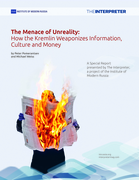
The Menace of Unreality: How the Kremlin Weaponizes Information, Culture, and Money
New York: Institute of Modern Russia; The Interpreter (2014), 44 pp.
"The Kremlin exploits the idea of freedom of information to inject disinformation into society. The effect is not to persuade (as in classic public diplomacy) or earn credibility but to sow confusion via conspiracy theories and proliferate falsehoods. The Kremlin is increasing its “information war
...
