Filter
86
Featured
63
3
Topics
16
14
11
10
9
8
7
7
6
6
5
4
4
4
4
4
3
3
3
3
3
3
3
3
3
3
3
3
2
2
2
2
2
2
2
2
2
2
2
2
2
2
2
2
2
2
2
1
1
1
1
1
1
1
1
1
1
1
1
1
1
1
1
1
1
1
1
1
1
1
1
1
1
1
1
1
1
1
1
1
1
1
1
1
1
1
1
1
1
1
1
1
1
1
1
1
1
1
1
1
1
1
1
1
1
1
1
1
1
1
1
1
1
1
1
1
1
1
1
1
1
1
1
1
1
1
1
1
Language
Document type
25
3
3
2
Countries / Regions
Authors & Publishers
Media focus
Publication Years
Methods applied
Journals
Output Type

Media Ownership Monitor Ghana
Reporters Without Borders; Media Foundation for West Africa (MFWA) (2017), 567 pp.
"The Media Ownership Monitor (MOM) reveals a high level of audience concentration in various media sectors. An almost maximum concentration was found among the printed press, where the top four media companies (Graphic Communications Group Limited, New Times Corporation, Western Publications Limited
...

Losing Trust in Media
Aspen Review Central Europe, issue 1 (2017), pp. 4-43

In the Service of Power: Media Capture and the Threat to Democracy
Deep Insights
Washington, DC: Center for International Media Assistance (CIMA) (2017), 162 pp.
"In this volume of essays edited by Anya Schiffrin, media capture is shown to be a growing phenomenon linked both to the resurgence of authoritarian governments as well as to the structural weaknesses presently afflicting media markets. In this environment, political figures and economic elites are
...

Media Ownership Monitor Brazil
Reporters Without Borders; Intervozes (2017), 925 pp.
"Power in Brazil means family business, both traditionally and to this very day. Dynasties of landowners known as “Colonels” extend their territorial claims to the airwaves, combining economic and political interests with tight control of public opinion. Neither digital technology and the rise o
...

Captured News Media: Bosnia and Herzegovina, Serbia, and Montenegro
Washington, DC: Center for International Media Assistance (CIMA) (2016), 16 pp.
"Political and business elites in the countries that are the subject of this report have acquired control over a large number of public and private media, mostly through non-transparent privatization, advertising and/or budgetary support to loyal media. Consequently, media freedoms and freedom of ex
...

La tutelle politique dans la production de l'information de presse en Afrique francophone: Le cas du Congo-Brazzaville
Paris: L'Harmattan (2016), 189 pp.
"Ce livre traite de l'évolution de la presse africaine francophone dans un contexte de mutations sociopolitiques récurrentes. S'appuyant sur le cas particulier du Congo-Brazzaville, l'analyse démontre clairement comment les mutations sociopolitiques induisent des logiques sociales de la communica
...

The enigma of news media development with multi-pronged ‘capture’: The Afghanistan case
Journalism, volume 18, issue 10 (2016), pp. 1233-1255
"This qualitative study of influences on a purposive sample of Afghan journalists was carried out in the year after the US military mission was declared over. After more than a hundred million dollars of Western government funding had been invested in development of liberal democratic journalism, th
...

Media Ownership and Finances in Turkey: Increasing Concentration and Clientelism
Ljubljana: Peace Institute; South East European Media Observatory (2015), 22 pp.
"The structural problems in the media ownership in Turkey have been embedded in the political system since mid-1980s. With the AKP government’s tenure, the “media pool” of uncritical government support was formed and the major media outlets were pacified by means of financial threats, self-cen
...

Media Ownership and Finances in Kosovo: Legal Vacuum and Lack of Transparency
Ljubljana: Peace Institute; South East European Media Observatory (2015), 23 pp.
"Media ownership and media financing, although both crucially influence the ability of the media in Kosovo to play democratic role and demonstrate integrity of their journalism and business operations, have not been properly addressed through the media legislation in Kosovo. Lack of transparency mad
...
Palestinian Television and Public Participation
International Communication Gazette, volume 77, issue 5 (2015), pp. 519-532
"This article examines the Palestinians perceptions towards the role of Palestine TV and Al-Aqsa TV in providing a platform for open discussion and create an arena for different groups to communicate freely with each other. Focus groups with a range of participants, from university students and huma
...
Im Würgegriff: Russlands Medienlandschaft unter Druck
Osteuropa, volume 65, issue 3 (2015), pp. 141-149
"Unabhängige Medien befinden sich weltweit seit über einem Jahrzehnt in einer tiefen ökonomischen Krise. In Russland kommt massiver politischer Druck hinzu. In den vergangenen zehn Jahren wurden zahlreiche kritische Journalisten und Redakteure entlassen, Fernseh- und Radiosender geschlossen, Zeit
...

State-Media Financial Relations in Macedonia: Media Freedom Curbed with Public Money
Ljubljana: Peace Institute; South East European Media Observatory (2015), 19 pp.
"The government has developed various mechanisms for creating financial dependence on the part of the media, at both the national and the regional level. Owing to these financial relations, the media outlets become servile to the government, thereby seriously undermining own professional integrity a
...
Zwischen Aufklärung und Propaganda: Medien im Südkaukasus
Osteuropa, volume 65, issue 7-10 (2015), pp. 211-229
"Die Medienlandschaften der südkaukasischen Staaten sind so unterschiedlich wie die Länder. In Georgien gibt es eine lebendige Medienszene, in Armenien ist der Markt von politischen und wirtschaftlichen Kartellen geprägt. In Aserbaidschan unterdrückt das autoritäre Regime die unabhängigen Medi
...

Media Ownership and Financing in Montenegro: Weak Regulation Enforcement and Persistence of Media Control
Ljubljana: Peace Institute; South East European Media Observatory (2015), 22 pp.
"Non-transparent ownership of media, particularly those financed by foreign capital, continues to burden Montenegrin media scene. Foreign media owners, as a rule, continue to support pro-government editorial policies. Their overall operations raise doubts of existence of clientelistic relations with
...

State-Media Financial Relations in Bosnia and Herzegovina: Increasingly Dependent and Disciplined Media
Ljubljana: Peace Institute; South East European Media Observatory (2015), 20 pp.
"Particular political and business interests seem to overpower any notion of public interest in the financial relations between government and the media. The public interest that these financial patterns should in theory serve remains under-articulated and unmonitored with a lack of clear criteria,
...

Democracy in Crisis: Corruption, Media, and Power in Turkey
Washington, DC: Freedom House (2014), 20 pp.
"Brasilien hat mehr als einen Berlusconi: Zehn Familien kontrollieren die Medienlandschaft. Politische und wirtschaftliche Interessen sind eng miteinander verzahnt. Alle Versuche, das zu ändern, sind bislang gescheitert." (Einleitung)

"The report analyzes 27 aspects of the media system of Serbia, basing on principles established by the Council of Europe as desirable standards in media legislation and practice. Each of 27 parts of the study describes the legal regulation of the subject matter and then provides available facts abou
...

Investigating the Impact of Media Ownership in African Democracies: A Case Study on Malawi. A Literature Review
London: London Metropolitan University (2009), 33 pp.
"[...] It is clear that the importance of the media in sustenance and development of democracy is well recognised by stakeholders in Africa. This is evidenced by the existence of liberal media laws and regulation in democratic African countries. This then forces the conclusion that there is delibera
...
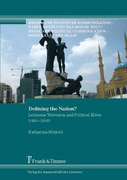
Defining the Nation? Lebanese Television and Political Elites, 1990-2005
Berlin: Frank & Timme (2009), 346 + xxvi pp.
"Katharina Nötzold explores whether and how mass media can contribute to nation-building after civil war. Drawing on the example of Lebanon s audiovisual media organisations, which are mostly privately owned by politicians, she demonstrates how political elites use television to transmit their visi
...