
Filter
91
Featured
90
5
2
Topics
24
19
16
11
10
10
9
7
7
6
6
6
5
5
4
3
3
3
3
3
3
2
2
2
2
2
2
2
2
2
2
2
2
2
2
2
2
2
2
2
1
1
1
1
1
1
1
1
1
1
1
1
1
1
1
1
1
1
1
1
1
1
1
1
1
1
1
1
1
1
1
1
1
1
1
1
1
1
1
1
1
1
1
1
1
1
1
1
1
1
1
1
1
1
1
1
1
1
1
1
1
1
1
1
1
1
1
1
1
1
Language
Document type
20
6
2
2
2
2
1
1
1
1
1
Countries / Regions
Authors & Publishers
Media focus
Publication Years
Methods applied
Journals
Output Type
Las políticas de las grandes plataformas sobre discurso de odio durante el COVID-19
Paris: UNESCO (2020), 32 pp.
Online Community Moderation
Key Guides
Hilversum: RNW Media (2020), 12 pp.
"This knowledge brief showcases RNW Media's experience with online community moderation. It explains what community moderation means, why we believe it is an essential component of our Citizens' Voice programme, and the strategies we have developed together with our moderators to guide them in the w
...

Beyond the “Big Three”: Alternative Platforms for Online Hate Speech
SCAN Specialised Cyber-Activists Network (2019), 13 pp.
"As the ‘big three’ social media platforms Facebook, YouTube and Twitter increasingly lose their relevance for young users, other social media, especially Instagram, step up to fill this space. Our research showed that hate groups and extremists wishing to influence minors or young adults with t
...
Polarisation and Peacebuilding Strategy on Digital Media Platforms: Current Strategies and their Discontents
Tokyo: Toda Peace Institute (2019), 17 pp.
This is the second of two policy briefs on polarisation. The first policy brief, “Polarisation and Peacebuilding Strategy on Digital Media Platforms: The Current Research,” reviewed the research, and concluded by recommending directions for future research. This brief describes interventions: (a
...

Social Media Platforms and Content Exposure: How to Restore Users’ Control
Competition and Regulation in Network Industries, volume 20, issue 1 (2019), pp. 86-110
"Social media platforms have become themain channel for people to communicate, access information and share content. A handful of giant platforms dominate the markets and, through a complex typology of conducts, are able to strongly affect users’ exposure to content, violating their privacy, as we
...
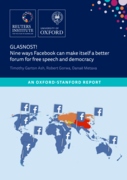
Glasnost! Nine Ways Facebook Can Make Itself a Better Forum for Free Speech and Democracy
Oxford: Reuters Institute for the Study of Journalism (2019), 27 pp.
"Following multiple controversies in the past two years, Facebook is seeking to implement much needed processes for self-regulation and governance to help regain the trust of the public, politicians, and regulatory authorities. Facebook has thus entered a new era of cautious glasnost, inviting resea
...


Self-regulation and ‘hate speech’ on social media platforms
London: Article 19 (2018), 31 pp.
"A number of recent legislative initiatives on ‘hate speech’, including most prominently the 2017 German NetzDG law on social media, make reference to some forms of self-regulation. Voluntary mechanisms between digital companies and various public bodies addressing ‘hate speech’ and other is
...


Human Rights Impact Assessment: Facebook in Myanmar
BSR (2018), 60 pp.
"Facebook commissioned BSR to undertake a human rights impact assessment (HRIA) of the company’s presence in Myanmar. BSR undertook this HRIA between May and September 2018, using a methodology based on the UN Guiding Principles on Business and Human Rights (UNGPs). This assessment identifies and
...

