
Filter
44
Featured
24
5
Topics
8
7
7
6
6
4
4
3
3
3
3
3
3
3
3
3
2
2
2
2
2
2
2
2
2
2
2
2
2
2
2
2
2
2
2
1
1
1
1
1
1
1
1
1
1
1
1
1
1
1
1
1
1
1
1
1
1
1
1
1
1
1
1
1
1
1
1
1
1
1
1
1
1
1
1
1
1
1
1
1
1
1
1
1
1
1
1
1
1
1
1
1
1
1
1
1
1
1
1
1
1
1
1
1
1
1
1
1
1
1
1
1
1
Language
Document type
5
4
4
3
2
1
1
Countries / Regions
Authors & Publishers
Media focus
Publication Years
Methods applied
Journals
Output Type

After Egypt: The Limits and Promise of Online Challenges to the Authoritarian Arab State
Perspectives on Politics, volume 9, issue 2 (2011), pp. 301-310
"The uprisings which swept across the Arab world beginning in December 2010 pose a serious challenge to many of the core findings of the political science literature focused on the durability of the authoritarian Middle Eastern state. The impact of social media on contentious politics represents one
...
The Political Consequences of the Rise of the Internet: Political Beliefs and Practices of Chinese Netizens
Political Communication, volume 28, issue 3 (2011), pp. 291-322
"This article addresses a long-standing question: What are the political consequences of the rise of the Internet and the attendant emergence of netizens in China, particularly in terms of China's democratic prospects? Given the Chinese state's firm control in the realm of traditional media, the Int
...

Internetzensur in China: Aufbau und Grenzen des Chinesischen Kontrollsystems
Wiesbaden: VS Verlag für Sozialwissenschaften (2011), 246 pp.
"Eine Serie von Fallstudien – unter anderem zur Funktion von Blogs und Microblogs als „bottom- up journalism“ und zu Aktivitätsfeldern des chinesischen „hacktivism“ – verdeutlicht, welches Potenzial politischer Mobilisierung auch im chinesischen Kontext in der internetbasierten Kommunik
...

Can it Tweet its Way to Democracy? The Promise of Participatory Media in Africa
Oxford: Reuters Institute for the Study of Journalism (2011), 103 pp.
Offers a policy-focused overview of the state of online political participatory media in Tunisia, Egypt, Ethiopia, Eritrea and Uganda.

The Impact of Information and Communication Technologies in the Middle East and North Africa
Cambridge, UK: RAND Corporation (2011), ix, 70 pp.

Iran und die neuen Medien: Herausforderungen für den Auslandsrundfunk = Iran and the New Media: Challenges for International Broadcasters
Stuttgart: Institut für Auslandsbeziehungen (ifa) (2011), 126 pp.
"Im ersten Block analysieren Vertreter der iranischen Social-Media-Szene die Rolle des Web 2.0 in Iran von seinen Anfängen bis heute. Der iranische Blogger Mehdi Mohseni umreißt die Social-Media-Aktivitäten der Parteien rund um den Präsidentschaftswahlkampf 2009 und die Folgen für die iranische
...
Social Change and the Russian Network Society: Redefining Development Priorities in New Information Environments
Arcata, Calif.; Washington, DC: Internews (2011), 27 pp.
"This paper explores the use of new information technologies in Russia to examine the next generation of media development and to ask how the ability of the “network society” – and the new forms of collective action it allows to contribute to social change can be supported. Building on the ide
...

Vertrauen ist gut, Kontrolle besser: Neue Medien und politischer Widerstand
Südostasien, volume 26, issue 1 (2010), 95 pp.
The Digital Origins of Dictatorship and Democracy: Information Technology and Political Islam
Oxford; New York: Oxford University Press (2010), xii, 285 pp.
"Around the developing world, political leaders face a dilemma: the very information and communication technologies that boost economic fortunes also undermine power structures. Globally, one in ten internet users is a Muslim living in a populous Muslim community. In these countries, young people ar
...
Deep Search: Politik des Suchens jenseits von Google
Bonn: Bundeszentrale für politische Bildung (bpb) (2010), 240 pp.
"Suchmaschinen wie Google stehen im Zentrum unseres digitalen Lebens. Hinter ihrem einfachen Interface verbirgt sich jedoch eine politische Philosophie in Form von komplexen digitalen Codes. Auf dem Spiel steht nichts weniger als die Frage, wie wir individuell und kollektiv etwas über die Welt in E
...
Blogs and Bullets: New Media in Contentious Politics
Washington, DC: United States Institute of Peace (USIP) (2010), 31 pp.
"The impact of new media can be better understood through a framework that considers five levels of analysis: individual transformation, intergroup relations, collective action, regime policies, and external attention. New media have the potential to change how citizens think or act, mitigate or exa
...

The Internet in South Caucasus
Caucasus Analytical Digest, issue 15 (2010), pp. 2-13
Global Information Society Watch 2009: Focus on Access to Online Information and Knowledge – Advancing Human Rights and Democracy
Association for Progressive Communications (APC); Hivos (2009), 231 pp.
"GISWatch has three interrelated goals: surveying the state of the field of information and communications technology (ICT) policy at local and global levels; encouraging critical debate; strengthening networking and advocacy for a just, inclusive information society. Each year the report focuses on
...

Development Through Electronic Networks: Information and Communication Technologies in Africa
Deep Insights
Berlin: German Bundestag, Office of Technology Assessment (2009), 268 pp.
"Following an initiative of the Committee on Economic Co-operation and Development, the Office of Technology Assessment (TAB) at the German Bundestag (i.e. the German parliament) has carried out a project on the relevance of the Internet and other new information and communication technologies (ICTs
...

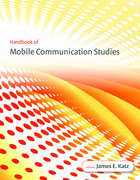
Handbook of Mobile Communication Studies
Cambridge, Mass.; London: MIT Press (2008), ix, 472 pp.
"This book offers a view of the cultural, family, and interpersonal consequences of mobile communication across the globe. Scholars analyze the effect of mobile communication on all parts of life, from the relationship between literacy and the textual features of mobile phones to the use of ringtone
...

Entwicklung durch Vernetzung: Informations- und Kommunikationstechnologien in Afrika
Deep Insights
Berlin: Edition Sigma (2008), 272 pp.
"Entwicklungsländer und moderne Informations- und Kommunikationstechnologien (IKT): Wie geht das zusammen? Dieses oft diskutierte, aber selten detailliert untersuchte Thema wird in diesem Buch vor allem anhand Afrikas südlich der Sahara behandelt, einer Weltregion mit erheblichen Entwicklungshemmn
...
Comunicação e democracia: Problemas e perspectivas
São Paulo: Paulus (2008), 372 pp.
