
Filter
263
Breadcrumb:
Media Use, Media Consumption
Featured
235
7
Topics
67
54
42
28
27
26
16
15
14
13
12
7
7
6
6
6
5
5
5
5
5
4
4
4
4
4
4
3
3
3
3
3
3
3
3
3
3
3
3
3
2
2
2
2
2
2
2
2
2
2
2
2
2
2
2
2
2
2
2
2
2
2
2
2
2
2
2
2
2
2
2
2
2
2
2
2
2
2
2
1
1
1
1
1
1
1
1
1
1
1
1
1
1
1
1
1
1
1
1
1
1
1
1
1
1
1
1
1
1
1
1
1
1
1
1
1
1
1
1
1
1
1
1
1
1
1
1
1
1
1
1
1
1
1
1
1
1
1
1
1
1
1
1
1
1
1
1
1
1
1
1
1
1
1
1
1
1
1
1
1
1
1
1
1
1
1
1
1
1
1
1
1
1
1
1
1
1
1
1
1
1
1
1
1
1
1
1
1
1
1
1
1
1
1
1
1
1
1
1
1
1
1
1
Language
Document type
41
9
7
3
2
2
2
1
1
1
1
Countries
Authors & Publishers
Media focus
Publication Years
Methods applied
Journals
Output Type

Contemporary Media Use in Turkey
Broadcasting Board of Governors (BBG); Gallup (2014), 42 slides
"Turkish media market is highly sophisticated but media outlets are subject to severe political pressure. Young Turks are turning increasingly to the Internet and social media to compensate. Internet already rivals TV as key information source. Kurdish speakers use the same outlets as other Turks, b
...
Face-To-Face Survey Overview Summary Results
London: Balancing Act (2014), 50 pp.
"Mobile ownership in all of the four surveys [in Ghana, Nothern Nigeria, Senegal and Tanzania] was around 90%, making the mobile phone the most widely owned device media device, both used as a media carrier (radio) and a media in its own right (Internet, SMS) [...] Radio remains the dominant medium
...
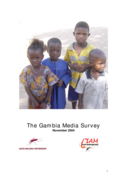
The Gambia Media Survey
Gates Malaria Partnership; Center for Innovation Against Malaria (2014), 56 pp.
"A national survey was completed in November 2004, designed to measure: media access and use; knowledge of Malaria, its prevention and cure; reach of the radio programme Bolongodala. The sample achieved represented the adult (15+) population of the Gambia estimated to be 768,200. Mandinka is the mos
...

Contemporary Media Use in Egypt
Broadcasting Board of Governors (BBG); Gallup (2014), 32 slides

"Just 18.1% of Pakistanis say they follow current events about the country “a lot,” but almost half (47.7%) follow current events “somewhat.” About one-third report being less attentive, following current events “very little” (29.6%) or “not at all” (4.6%). Results trend upward with
...
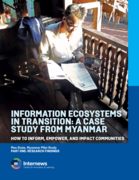
Information Ecosystems in Transition: A Case Study from Myanmar. How to Inform, Empower and Impact Communities. Part One: Research Findings
Internews (2014), 56 pp.
"The research focuses on three themes. Firstly, it identifies and maps the information environment in Mon State in terms of technology and media use across urban, rural, non-conflict, and former conflict geographic areas. Secondly, the flow of news and information is examined to see how individuals
...

Contemporary Media Use in Nigeria
Broadcasting Board of Governors (BBG); Gallup (2014), 36 slides
"Nigeria is a complex country grappling with serious economic, political, and security challenges. New media are an increasingly effective pathway for reaching Nigerian audiences, especially those who are media rich. However, there remain media poor segments of the population who can only be reached
...
Media Survey Findings: Nationwide National Opinion Survey, Wave III, September 2014
Internews (2014), 36 pp.
Key findings include: 35% of people interviewed had family members working outside of Nepal; 86% of households had a working mobile phone (92.5% in urban; 84.3% in rural areas); 49% had a working television (79.5% in urban; 42.3% in rural areas); 45% a working radio (46.1% in urban; 45.3% in rural a
...

"Russians are keen news consumers. Most (79.0%) access some type of news at least daily, and nearly all (95.4%) do this at least weekly. Nearly all Russians (95.5%) are turning to television – which continues to dominate the media market in 2013 – for their news each week. However, as more Russi
...

Cambodia: From Big Screen to Small
Broadcasting Board of Governors (BBG); Gallup (2014), 37 slides
"Cambodia is a country on the cusp of rapid media change. TV and radio remain the top media and main sources of news. Apolitical newcomer Hang Meas is top source with tabloid news, entertainment. But new media is gaining, fueled by widespread mobile use: almost all households have a mobile phone; yo
...
Newsgathering and Policy Perceptions in Ukraine
Broadcasting Board of Governors (BBG); Gallup (2014), 35 slides
"Use of Ukrainian vs. Russian in news content is not important for the vast majority of adults; trust in content is key to reliance on sources. Ukrainian TV channels remain the top news sources for adults across ethnic groups and regions (other than Crimea), and offer news trusted by large majoritie
...

Syria Audience Research
Berlin: Media in Cooperation and Transition (MiCT) (2014), 31 pp.
"The media culture of Syrians is strongly dominated by satellite television which is the most widely accessible type of media for Syrians across the sample. Beyond satellite television, access to media is primarily dependent on location with people in government controlled areas enjoying the best ac
...

"While radio is still in the lead for news consumption in Nigeria, the use of digital media and mobile continues to grow rapidly. The new research also reveals that Nigerian personal mobile phone ownership has increased significantly in 2014 to 83.0%, up from 73.1% in 2012. Mobile web is the leading
...

A Snapshot of Life and Media Use in Vietnam: Findings from the World Poll
Gallup; Broadcasting Board of Governors (BBG) (2013), 53 slides
"Vietnam is changing rapidly: attitudinal, socio-economic and media usage. Traditional media, especially television, is still dominant. New media is pushed forward by young people and those with the most education: urban-rural divides in media use are closing; internet has overtaken radio as key new
...

Media Use in Vietnam 2013
Broadcasting Board of Governors (BBG); Gallup (2013), 2 pp.
"Vietnamese are avid news consumers; nine in 10 (89.8%) say they access news at least daily, while 93.9% do so at least once a week. Weekly access to TV news varies little by gender, education or urban vs. rural residence. This in part reflects the finding that televisions are ubiquitous throughout
...

Media Use in Somalia 2013
Broadcasting Board of Governors (BBG); Gallup (2013), 2 pp.
"The majority of Somalis (65.6%) access news at least once per day. More than one in four Somalis (27.9%) share news daily or most days. Radio is the most popular means for obtaining news in Somalia, with more than four in five (83.9%) reporting they get news via radio at least once per week. More t
...
"This report has eight core sections. In the first three sections we outline the overall purpose of the study, the methodological approach and the overarching insights that emerged from the study. This is followed by a section on key citizen information needs and sources. The fifth section discusses
...

Estudio de actitudes, hábitos y opinión sobre la radio y televisión 2013
Lima: Consejo Consultivo de Radio y Televisión (CONCORTV) (2013), 20 pp.
"Entre ver televisión, escuchar radio, leer diarios/revistas y navegar por Internet, los peruanos le dedican más de 12 horas con treinta minutos al consumo de medios de comunicación." (Página 5)
