Filter
259
Featured
232
7
Topics
66
52
41
27
27
26
16
15
14
13
12
7
7
6
6
6
5
5
5
5
4
4
4
4
4
4
3
3
3
3
3
3
3
3
3
3
3
3
2
2
2
2
2
2
2
2
2
2
2
2
2
2
2
2
2
2
2
2
2
2
2
2
2
2
2
2
2
2
2
2
2
2
2
2
2
2
1
1
1
1
1
1
1
1
1
1
1
1
1
1
1
1
1
1
1
1
1
1
1
1
1
1
1
1
1
1
1
1
1
1
1
1
1
1
1
1
1
1
1
1
1
1
1
1
1
1
1
1
1
1
1
1
1
1
1
1
1
1
1
1
1
1
1
1
1
1
1
1
1
1
1
1
1
1
1
1
1
1
1
1
1
1
1
1
1
1
1
1
1
1
1
1
1
1
1
1
1
1
1
1
1
1
1
1
1
1
1
1
1
1
1
1
1
1
1
1
1
1
1
1
1
1
1
Language
Document type
39
8
7
3
2
2
2
1
1
1
1
Countries / Regions
Authors & Publishers
Media focus
Publication Years
Methods applied
Journals
Output Type

Media Use in Vietnam
Broadcasting Board of Governors (BBG); Gallup (2015), 2 pp.
"Vietnam's government-run VTV television network continues to dominate the country's media landscape. However, the current survey also points to a powerful generational shift in media use toward online news sources and less dependence on state TV. This trend is perhaps more clearly reflected in the
...

"As in much of the Arab World, satellite TV is almost ubiquitous in Iraq, present in 97.3% of households (versus 35.1% with radio and 50.4% with the Internet). Ethnic Kurds and those with a college degree are much more likely t han other Iraqis to have Internet access at home; those living in Anbar
...

The Changing Media Landscape in Vietnam
Broadcasting Board of Governors (BBG); Gallup (2015), 38 slides
"Vietnam has a highly engaged, optimistic and entrepreneurial population and a rapidly changing media environment. Television remains the most used medium and the top source for news and information ¡V especially from official TV. Vietnam severely restricts its news media but Vietnamese want their
...
Afghanistan at a Glance: Findings from the World Poll. Media Use for News in Afghanistan
Gallup; Broadcasting Board of Governors (BBG) (2015), 40 slides
"Afghanistan had the highest rate of suffering in the world for 2013 and 2014. Those with a post-secondary education are the most avid media users for news overall. Highly educated Afghans were more likely to use TV, radio, Internet, SMS, and social media on a daily basis for news than other segment
...

Consumo radial y televisivo 2015
Lima: Consejo Consultivo de Radio y Televisión (CONCORTV) (2015), 18 pp.

Gewichtungsstudie zur Relevanz der Medien für die Meinungsbildung in Deutschland
TNS Infratest; Direktorenkonferenz der Landesmedienanstalten (DLM) (2015), 55 pp.
"Das Fernsehen ist nach wie vor das reichweitenstärkste Medium zur Information und Meinungsbildung. Mit einer „informierenden“ Tagesreichweite von knapp 60% liegt es deutlich vor dem Radio (51%) und der Tageszeitung mit 35% [...] Bei der informierenden Nutzung gestern zeigen sich deutliche Zusa
...
The Gambia Media Survey
Gates Malaria Partnership; Center for Innovation Against Malaria (2014), 56 pp.
"A national survey was completed in November 2004, designed to measure: media access and use; knowledge of Malaria, its prevention and cure; reach of the radio programme Bolongodala. The sample achieved represented the adult (15+) population of the Gambia estimated to be 768,200. Mandinka is the mos
...
Media Survey Findings: Nationwide National Opinion Survey, Wave III, September 2014
Internews (2014), 36 pp.
Key findings include: 35% of people interviewed had family members working outside of Nepal; 86% of households had a working mobile phone (92.5% in urban; 84.3% in rural areas); 49% had a working television (79.5% in urban; 42.3% in rural areas); 45% a working radio (46.1% in urban; 45.3% in rural a
...

Contemporary Media Use in Russia
Broadcasting Board of Governors (BBG); Gallup (2014), 40 slides

"Television viewing is ubiquitous in Egypt and by far the most common source of information for its residents. Nearly all (98.8%) Egyptians have a working television in their home, while just 37.9% of Egyptians have a radio. The percentage of Egyptians with a radio in their household is down signifi
...
Syria Audience Research
Berlin: Media in Cooperation and Transition (MiCT) (2014), 31 pp.
"The media culture of Syrians is strongly dominated by satellite television which is the most widely accessible type of media for Syrians across the sample. Beyond satellite television, access to media is primarily dependent on location with people in government controlled areas enjoying the best ac
...
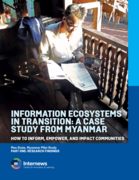
Information Ecosystems in Transition: A Case Study from Myanmar. How to Inform, Empower and Impact Communities. Part One: Research Findings
Internews (2014), 56 pp.
"The research focuses on three themes. Firstly, it identifies and maps the information environment in Mon State in terms of technology and media use across urban, rural, non-conflict, and former conflict geographic areas. Secondly, the flow of news and information is examined to see how individuals
...
Pakistan: Audience Realities in an Unstable Media Landscape
Gallup; Broadcasting Board of Governors (BBG) (2014), 43 slides
"TV is the main information platform by far, but the importance of individual channels varies by region and modes of access. Population is divided between those with access to non-State TV and those without. While most express generic satisfaction with media, actual opinions about specific channels
...

Contemporary Media Use in Nigeria
Broadcasting Board of Governors (BBG); Gallup (2014), 36 slides
"Nigeria is a complex country grappling with serious economic, political, and security challenges. New media are an increasingly effective pathway for reaching Nigerian audiences, especially those who are media rich. However, there remain media poor segments of the population who can only be reached
...

Etude d'auditoire au Burundi: Restitution des résultats
Bujumbura: IMMAR Research and Consultancy; Panos Great Lakes (2014), 62 slides

Pesquisa brasileira de mídia 2014: Hábitos de consumo de mídia pela população brasileira
Brasília: Presidência da República. Secretaria de Comunicação Social (SECOM) (2014), 150 pp.
"A primeira edição da “Pesquisa Brasileira de Mídia” traz um retrato representativo e preciso sobre o uso que os brasileiros declaram fazer, atualmente, dos meios de comunicação social. Continua sendo predominante a presença da TV nos lares do País, apesar do rápido crescimento da intern
...
Face-To-Face Survey Overview Summary Results
London: Balancing Act (2014), 50 pp.
"Mobile ownership in all of the four surveys [in Ghana, Nothern Nigeria, Senegal and Tanzania] was around 90%, making the mobile phone the most widely owned device media device, both used as a media carrier (radio) and a media in its own right (Internet, SMS) [...] Radio remains the dominant medium
...
Contemporary Media Use in Turkey
Broadcasting Board of Governors (BBG); Gallup (2014), 42 slides
"Turkish media market is highly sophisticated but media outlets are subject to severe political pressure. Young Turks are turning increasingly to the Internet and social media to compensate. Internet already rivals TV as key information source. Kurdish speakers use the same outlets as other Turks, b
...