
Filter
102
Featured
92
4
1
Topics
45
27
21
21
19
19
18
18
17
16
15
15
14
14
14
14
11
11
9
9
8
8
6
5
5
5
4
4
4
4
4
4
4
4
4
3
3
3
3
3
3
2
2
2
2
2
2
2
2
2
2
2
2
2
1
1
1
1
1
1
1
1
1
1
1
1
1
1
1
1
1
1
1
1
1
1
1
1
1
1
1
1
1
1
1
1
1
1
1
1
1
1
1
1
1
1
1
1
1
1
1
1
1
1
1
1
1
1
1
1
1
1
Language
Document type
41
39
17
11
9
8
6
4
3
2
1
1
Countries / Regions
Authors & Publishers
Media focus
Publication Years
Methods applied
Output Type
"What are the impacts of expanding mobile broadband coverage on poverty, household consumption and labor market outcomes in developing countries? Who benefits from improved coverage of mobile internet? To respond to these questions, this paper applies a difference-in-differences estimation using pan
...

Telecommunications/ICTs for rural and remote areas. Study period 2018-2021
Geneva: ITU (2021), xiii, 90 pp.
"There is need for further studies focusing on access to broadband services and how emerging technologies can be used to transform rural and remote areas into digital economies.
There is no one-size-fits-all model for financing rural connectivity and engaging all stakeholders, but creating public-pr
...

Plans nationaux pour les télécommunications d’urgence: Catalyseurs et garanties. Guide succinct d'évaluation à l’intention des spécialistes des politiques publiques
London: GSMA (2021), 16 pp.
"Ce guide a pour but d'aider à identifier les lacunes, les opportunités et les faiblesses du système afin de guider la définition d’une stratégie nationale plus cohérente et de positionner la téléphonie mobile comme appui aux activités de préparation, de réponse et de relèvement en cas
...
Connecting humanity: Assessing investment needs of connecting humanity to the Internet by 2030
Geneva: ITU (2020), vi, 25 pp.
"Nearly USD 428 billion is required to achieve universal access to broadband connectivity by 2030 at the global level. This amount includes significant investment in infrastructure, investments to design and implement policy and regulatory frameworks that incentivize and promote growth in broadband
...

Iran: Tightening the Net 2020. After Blood and Shutdowns
London: Article 19 (2020), 63 pp.
"In November 2019, protests broke out across Iran over a fuel price hike; authorities responded with violence and repression. They also disconnected millions of Iranians from the Internet. Iran’s November shutdowns were unprecedented in length and reach. On a vast scale, they cut people off from v
...

"Kenya’s digital ecosystem has significant strengths not yet fully leveraged:
• Political interest in digital technology at national and county level: The Government of Kenya’s
(GoK) digital economy blueprint, ICT Masterplan, and eCitizen (government service platform for
Kenyan citizens and re
...

Digital Ecosystem Country Assessment (DECA): Colombia
USAID, Digital Frontiers Project (2020), 43 pp.
"[...] The DECA is a decision-making tool to help USAID Missions, their partners, and other relevant stakeholders identify the opportunities, maximize the benefits, and manage the risks associated with digital technology. The goal is to help USAID’s partner countries along their journey to self-re
...
The Last-mile Internet Connectivity Solutions Guide: Sustainable Connectivity Options for Unconnected Sites
Geneva: ITU (2020), xviii, 137 pp.
"There are several overarching reasons why billions of people remain offline, ranging from a lack of network infrastructure availability and affordable Internet services to gaps in skills and ability, the availability and cost of personal devices, and a perceived lack of relevancy. For example, over
...

Measuring the Digital Transformation: A Roadmap for the Future
Key Guides
Paris: OECD (2019), 260 pp.
"The aim of Measuring the Digital Transformation: A Roadmap for the Future is not to “rank” countries or develop composite indicators. Instead, its objective is to provide policy makers and analysts with key indicators for each of the dimensions of the Going Digital integrated policy framework b
...

Connecting People. Transforming Nations
USAID (2019), 7 pp.
"Nearly 250 million people live in Indonesia. More than 80 percent of them have no access to the Internet. Access to broadband has the potential to transform individual lives, local communities, and entire nations. The last decade has seen exponential growth in Internet connectivity. Information and
...

The Little Data Book on Information and Communication Technology 2018
Washington, DC; Geneva: World Bank; ITU (2018), vi, 240 pp.
"In 2016, there were more than 7.3 billion mobile-cellular subscriptions worldwide. Globally, 3.5 billion people were using the Internet, of which 2.5 billion were from developing countries. Mobile-broadband subscriptions have risen constantly to reach 3.6 billion, while the number of fixed-broadban
...
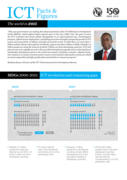
ICT Facts and Figures
Geneva: ITU (2015), 8 pp.
"In 2015 there are more than 7 billion mobile cellular subscriptions worldwide, up from less than 1 billion in 2000. Globally 3.2 billion people are using the Internet of which 2 billion are from developing countries. ICTs will play an even more significant role in the post 2015 development agenda a
...
ICT Facts and Figures
Geneva: ITU (2014), 8 pp.
"The new figures show that, by the end of 2014, there will be almost 3 billion Internet users, two-thirds of them coming from the developing world, and that the number of mobile-broadband subscriptions will reach 2.3 billion globally. Fifty-five per cent of these subscriptions are expected to be in
...

ICT Economic Impact Assessment
Altai Consulting; USAID (2014), 90 pp.
"The ICT sector is one of few undeniable success stories in Afghanistan’s development over the past 12 years. In 2002, telecommunications services were virtually non-existent, restricted to a very small number of fixed-line connections and satellite communications were unaffordable to the general
...

The Global Information Technology Report 2013: Growth and Jobs in a Hyperconnected World
Geneva: World Economic Forum; INSEAD (2013), 413 pp.
"Through the methodological framework of the Networked Readiness Index (NRI), the report measures the extent to which 144 economies, from both the developed and developing worlds, take advantage of ICTs and other new technologies to increase their growth and well-being. The NRI identifies the most r
...

The Little Data Book on Information and Communication Technology 2012
Washington, DC; Geneva: World Bank; ITU (2012), vi, 239 pp.
"This Little Data Book presents tables for over 213 economies showing the most recent national data on key indicators of information and communications technology (ICT), including access, quality, affordability, efficiency, sustainability, and applications." (Abstract)

The Global Information Technology Report 2012: Living in a Hyperconnected World
Geneva: World Economic Forum; INSEAD (2012), 413 pp.
"The Report is composed of four thematic parts. Part 1 describes the conceptual framework and relates the findings of the Networked Readiness Index (NRI) 2012. In addition, Part 1 features selected expert contributions on the general theme of hyperconnectivity. Part 2 includes two case studies showi
...

Information and Communications for Development: Maximizing Mobile
Washington, DC: World Bank (2012), xviii, 221 pp.
"Analyzes the growth and evolution of mobile telephony, including the rise of data-based services delivered to handheld devices through “apps” (applications) and other ways. Summarizing current thinking and seeking to inform the debate on the use of mobile phones to improve livelihoods, the repo
...

Tecnologías de la información y la comunicación en Nicaragua
Washington, DC: Banco Interamericano de Desarrollo (BID) (2012), 27 pp.
"El Gobierno de Nicaragua ha identificado las Tecnologías de la Información y Comunicación (TIC) como un pilar clave de su estrategia para mejorar la gestión pública y aumentar la competitividad; sin embargo, se encuentra en desventaja comparativa en materia de inversión, activos y resultados
...

Les médias arabes: Confluences médiatiques et dynamique sociale
Paris: CNRS (2011), 231 pp.
"La libéralisation spectaculaire de l’espace médiatique arabe n’en finit pas de surprendre. Comment comprendre cette brutale explosion de créativité, ce foisonnement d’initiatives et d’énergie ? En quelques mois, ces sociétés auraient fait l’apprentissage de la liberté d’expressi
...
