
Filter
140
Breadcrumb:
Extremist & Terrorist Digital / Social Media Presence
Featured
95
9
Topics
31
29
27
26
20
19
18
10
9
9
9
8
8
8
7
6
6
6
5
5
5
4
4
4
4
4
3
3
3
3
2
2
2
2
2
2
2
2
2
2
2
2
2
2
2
2
2
2
2
2
2
2
2
2
2
2
2
2
2
2
1
1
1
1
1
1
1
1
1
1
1
1
1
1
1
1
1
1
1
1
1
1
1
1
1
1
1
1
1
1
1
1
1
1
1
1
1
1
1
1
1
1
1
1
1
1
1
1
1
1
1
1
1
1
1
1
1
1
1
1
1
1
1
1
1
1
1
1
1
1
1
1
1
1
1
1
1
1
1
1
1
1
1
1
1
1
1
1
Language
Document type
9
7
6
5
3
3
2
1
1
1
1
1
Countries
Authors & Publishers
Media focus
Publication Years
Methods applied
Journals
Output Type
Ukrainekrieg auf Telegram: Rechtsextremer Knotenpunkt für Desinformationen und Verschwörungserzählungen
Mainz: jugendschutz.net (2022), 9 pp.
"Seit Beginn des russischen Angriffskriegs gegen die Ukraine im Februar 2022 nutzen Rechtsextreme die Ereignisse und Entwicklungen für ihre Propaganda. Dabei lassen sich sowohl pro-ukrainische als auch prorussische Positionierungen beobachten. Insbesondere werden gezielt Desinformationen und Versch
...


Understanding Digital Conflict Drivers
"This chapter explores digital drivers of conflict. We examine how technologies are affecting conflict dynamics and what peacebuilders can do to mitigate these effects. We argue that because digital technologies are fundamentally altering the human experience, they are by extension fundamentally alt
...


Back to the Future? Twenty First Century Extremist and Terrorist Websites
Luxembourg: European Union (2021), 36 pp.

Islamogram: Salafism and Alt-Right Online Subcultures
London: Institute for Strategic Dialogue (ISD) (2021), 38 pp.

Right-Wing Extremism on the Internet: 2020-2021 Report
Mainz: jugendschutz.net (2021), 31 pp.


Radikalisierung im Cyberspace: Die virtuelle Welt des Salafismus im deutschsprachigen Raum - ein Weg zur islamistischen Radikalisierung?
Bonn: Bundeszentrale für politische Bildung (bpb), Sonderausg. (2021), 278 pp.
"Auch die salafistische Szene nutzt den virtuellen Raum zur Propagierung ihrer Ideologie und zur Rekrutierung von Mitgliedern. Gerade für eine jüngere Zielgruppe hat sich in den vergangenen Jahren ein breites Angebot im deutschsprachigen Raum herausgebildet, mit dem Salafisten ihre Glaubensinhalte
...

Counter-Terrorism, Social Media and the Regulation of Extremist Content
"As highlighted above, the development and refinement of counter-terrorism policies and practices by social media and technology companies has come about as a function of the evolving nature of terrorist and extremist entities’ exploitation of said platforms. The challenges highlighted above, name
...
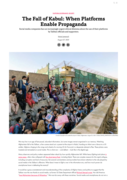
The Fall of Kabul: When Platforms Enable Propaganda
Centre for International Governance Innovation, August 27 (2021)
"Social media companies face an increasingly urgent ethical dilemma about the use of their platforms by Taliban officials and supporters." (Introduction)

External Communication in Social Media During Asymmetric Conflicts: A Theoretical Model and Empirical Case Study of the Conflict in Israel and Palestine
Bielefeld: transcript Verlag (2021), 310 pp.
"Social media increasingly shapes the way in which we perceive conflicts and conflict parties abroad. Conflict parties, therefore, have started using social media strategically to influence public opinion abroad. This book explores the phenomenon by examining, (1) which strategies of external commun
...

Courage Against Hate
Facebook (2021), 128 pp.
"The Courage Against Hate initiative has been brought together by Facebook for the purpose of sparking cross-sector, pan-European dialogue and action to combat hate speech and extremism. This collection of articles unites European academic analysis with practitioners who are actively working on coun
...

Radicalism Online: An Analysis of the Meanings, Ideas, and Values of Violent Extremism in Central Asia
Bishkek: Internews; Centre for Religious Studies of Kyrgyzstan (2021), 136 pp.
"In an effort to help prevent violent extremism in Central Asia, the Research Centre for Religious Studies of Kyrgyzstan conducted an analysis of values, narratives, and online messages created and distributed by banned extremist groups in five countries: Kazakhstan, Kyrgyzstan, Tajikistan, Turkmeni
...

Social Media Impacts on Conflict and Democracy: The Techtonic Shift
London; New York: Routledge (2021), xv, 239 pp.
"Social media technology is having a dramatic impact on social and political dynamics around the world. The contributors to this book document and illustrate this "techtonic" shift on violent conflict and democratic processes. They present vivid examples and case studies from countries in Africa, So
...

Communication in Global Jihad
London; New York: Routledge (2021), xi, 241 pp.
"This book conceptually examines the role of communication in global jihad from multiple perspectives. The main premise is that communication is so vital to the global jihadist movement today that jihadists will use any communicative tool, tactic, or approach to impact or transform people and the pu
...

Propaganda des „Islamischen Staats“: Formen und Formate
Wiesbaden: Springer VS (2020), vi, 411 pp.
"Die Propaganda der terroristischen Miliz "Islamischer Staat" hat für Aufsehen gesorgt und die Debatte um das Internet und vor allem das "Social Web" als Risikotechnologie oder Gefahrenraum mitbestimmt. Dabei setzt der IS auf ein breites Spektrum medialer und gestalterischer Formen und Formate eine
...

ISIS Propaganda: A Full-Spectrum Extremist Message
New York: Oxford University Press (2020), xii, 287 pp.
"This book offers a comprehensive overview and analysis of the Islamic State's use of propaganda. Combining a range of different theoretical perspectives from across the social sciences, and using rigorous methods, the authors trace the origins of the Islamic State's message, laying bare the strateg
...

Deplatforming: Following Extreme Internet Celebrities to Telegram and Alternative Social Media
European Journal of Communication, volume 35, issue 3 (2020), pp. 213-229
"Extreme, anti-establishment actors are being characterized increasingly as ‘dangerous individuals’ by the social media platforms that once aided in making them into ‘Internet celebrities’. These individuals (and sometimes groups) are being ‘deplatformed’ by the leading social media comp
...
