
Filter
99
Featured
59
1
1
Topics
20
15
10
9
8
7
7
7
6
6
5
5
4
4
4
4
4
3
3
3
3
3
3
3
3
2
2
2
2
2
2
2
2
2
2
2
2
2
2
2
2
2
2
2
1
1
1
1
1
1
1
1
1
1
1
1
1
1
1
1
1
1
1
1
1
1
1
1
1
1
1
1
1
1
1
1
1
1
1
1
1
1
1
1
1
1
1
1
1
1
1
1
1
1
1
1
1
1
1
1
1
1
1
1
1
1
1
1
1
1
1
1
1
1
1
1
1
1
1
1
1
1
1
1
1
1
1
1
1
1
1
1
1
1
1
Language
Document type
16
6
4
2
1
Countries / Regions
Authors & Publishers
Media focus
Publication Years
Methods applied
Journals
Output Type
Decentralization of Political Design in China
Pacific Affairs: an International Review of Asia and the Pacific, volume 93, issue 4 (2020), pp. 709-734
"Political posters, banners, and similar objects are extremely common in China. This article uses political design from contemporary China, particularly emphasising the government’s Chinese Dream campaign, to analyze what at first appears to be a paradox. The subjects of the campaigns and the lang
...
Media Capture
Russian Analytical Digest, issue 258 (2020), 16 pp.
I Know What You Mean: Information Compensation in an Authoritarian Country
International Journal of Press/Politics, volume 26, issue 3 (2020), pp. 587-608
"How do people address information deficiency caused by rigid control of information in authoritarian regimes? We argue that there exists an internally oriented information compensation approach through which people can glean extra information from official messages domestically. This approach does
...
Subversion im Cyberraum: Sicherheit, Freiheit und Resilienz gegen Angriffe im Netz
Stuttgart: Institut für Auslandsbeziehungen (ifa) (2020), 59 pp.
"Die technischen Möglichkeiten der Cyberwelt haben gänzlich neue Potenziale zur Beeinflussung von politischen Präferenzen in anderen Staaten eröffnet. Die Meinungsbildung in offenen Gesellschaften wird zunehmend durch subversive Maßnahmen autoritärer Regime im Internet beeinflusst, wodurch der
...
Censorship, the Media, and the Market in China
Journal of Chinese Political Science, volume 25 (2020), pp. 285–309
"Pervasive media censorship in China is often seen as a strictly political issue. Although in past years reporters have had leeway to report on economic issues, the Chinese Party/state has moved to tamp down economic journalism, even arresting those who report on bad economic news. This shift brings
...

From repression to oppression: News journalism in Turkey 2013–2018
Media, Culture & Society, volume 42, issue 7-8 (2020), pp. 1443-1460
"The political context for practicing free and independent journalism has always been challenging in Turkey and ever more so after the failed coup d’état of 2016. This article examines and analyzes the changes brought about by this failed coup d’état in terms of their civil, legal, and politic
...

Pillars of Russia's Disinformation and Propaganda Ecosystem
Washington, DC: U.S. Department of State (2020), 76 pp.
"Russia has operationalized the concept of perpetual adversarial competition in the information environment by encouraging the development of a disinformation and propaganda ecosystem that allows for varied and overlapping approaches that reinforce each other even when individual messages within the
...
The Psychology of State-Sponsored Disinformation Campaigns and Implications for Public Diplomacy
The Hague Journal of Diplomacy, volume 14, issue 1/2 (2019), pp. 65-82
"Policy discourse about disinformation focuses heavily on the technological dimensions of state-sponsored disinformation campaigns. Unfortunately, this myopic focus on technology has led to insufficient attention being paid to the underlying human factors driving the success of state-sponsored disin
...
China's Pursuit of a New World Media Order
Deep Insights
Paris: Reporters Without Borders (2019), 51 pp.
Venezuela’s 21st Century Authoritarianism in the Digital Sphere
Tokyo: Toda Peace Institute (2019), 14 pp.
"This policy brief summarises extensive information on digital rights violations and politically motivated information disorders affecting Venezuelans, principally social media users. The brief focuses on the conflict dynamic between an authoritarian government and those fighting for re-democratisat
...

Citizens and Condemnation: Strategic Uses of International Human Rights Pressure in Authoritarian States
Comparative Political Studies, volume 52, issue 4 (2019), pp. 579-612
"Governments with strict control over the information that their citizens hear from foreign sources are regular targets of human rights pressure, but we know little about how this information matters in the domestic realm. I argue that authoritarian regimes strategically pass on certain types of ext
...

Social Media in Egypt: Impacts on Civil Society, Violent Extremism & Government Control
Tokyo: Toda Peace Institute (2019), 7 pp.
"Throughout this policy brief, we vet the use of social media in a major Middle Eastern country - Egypt - where the youth took to the streets to express frustrations that lasted almost a lifetime. While social media helped topple autocratic dictator, Hosni Mubarak, it played the role of Pandora’s
...
Social Media in China
Singapore: Palgrave Macmillan (2018), xxii, 293 pp.
"Redefining the concept of new media in China, this cutting edge book discusses the impact of social media on Chinese public life. Examining its characteristics and the different forms of social media, such as internet and mobile phone media, weibo, wechat and micro-blogging, it considers how public
...
Cyber China: Upgrading Propaganda, Public Opinion Work and Social Management for the Twenty-First Century
Journal of Contemporary China, volume 26, issue 103 (2017), pp. 85-100
"The first two years of the Xi Jinping administration saw a thorough reconfiguration of Internet governance. This reconfiguration created a centralized and integrated institutional framework for information technologies, in support of an ambitious agenda to place digital technologies at the heart of
...

Anticipating the Struggle against Everyday Impunity in Myanmar through Accounts from Bangladesh and Thailand
Asia & The Pacific Policy Studies, volume 3, issue 1 (2016), pp. 48-61
"Work done internationally to address impunity concentrates on removing blanket amnesties and establishing commissions of inquiry into past atrocities. Everyday impunity—the impossibility of bringing state officers to account for routinized violent crimes against other individuals—gets less atte
...
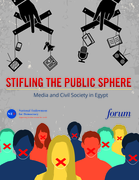
Stifling the Public Sphere: Media and Civil Society in Egypt
Washington, DC: National Endowment for Democracy (NED); International Forum for Democratic Studies (2015), 16 pp.
"Egypt’s plummeting press freedom is in part a result of the many ways in which the state can put pressure on independent media under Egyptian law. While the January 2014 constitution contains clear protections for the media (including, under Article 71, bans on censorship and surveillance), many
...
Press Censorship in Turkey: Networks of State Power, Commercial Pressures, and Self-Censorship
Communication, Culture & Critique, volume 7, issue 2 (2014), pp. 154-173
"This article explores the suppression of press freedoms in Turkey under the AKP (Justice and Development Party) government in the late 2000s. Drawing upon analyses of laws and legislation, surveys, reports, and interviews with journalists, it demonstrates how press censorship in Turkey has been act
...

Out of Control: Palestinian News Satire and Government Power in the Age of Social Media
Popular Communication, volume 10, issue 1-2 (2012), pp. 106-118
"This article analyzes the Palestinian sketch comedy show Watan Ala Watar, placing the groundbreaking program in the context of theories of satire, government control, and popular resistance. Detailing the show’s tumultuous relationship with the Palestinian Authority, the article argues that despi
...
Media Policy Paradigm Shift in Turkey: Rethinking Neo-Authoritarian Media Systems in the Age of Neo Liberalism
Acta Universitatis Danubius. Communicatio, volume 5, issue 1 (2011), pp. 40-69
"This article has aimed to open a discussion on the rethinking a neo authoritarian media system in the age of neo liberalism as a case of Turkey’s media experiences. In this context, this study deals with the media policy paradigm shift in the Republic of Turkey since 1980s. According to a recent
...
Totalitarian Communication: Hierarchies, Codes and Messages
Bielefeld: transcript Verlag (2010), 316 pp.
