
Filter
695
Breadcrumb:
Audience & User Surveys
Featured
597
20
Topics
213
128
114
69
65
54
40
39
35
35
31
30
25
21
21
21
17
17
17
15
13
12
12
12
12
11
11
10
10
10
10
10
10
9
9
9
9
9
9
8
8
8
7
7
7
7
7
7
7
7
7
7
6
6
6
6
6
6
6
6
6
6
6
5
5
5
5
5
5
5
5
5
5
5
5
4
4
4
4
4
4
4
4
4
4
4
4
4
4
4
4
4
4
4
4
4
4
4
4
4
4
4
4
4
4
4
4
4
4
4
4
4
4
4
3
3
3
3
3
3
3
3
3
3
3
3
3
3
3
3
3
3
3
3
3
3
3
3
3
3
3
3
3
3
3
3
3
3
3
3
3
3
3
3
3
3
3
3
3
3
3
3
3
3
3
3
2
2
2
2
2
2
2
2
2
2
2
2
2
2
2
2
2
2
2
2
2
2
2
2
2
2
2
2
2
2
2
2
2
2
2
2
2
2
2
2
2
2
2
2
2
2
2
2
2
2
2
2
2
2
2
2
2
2
2
2
2
2
2
2
2
2
2
2
2
2
2
2
2
2
2
2
2
2
2
2
2
2
2
2
2
2
2
2
2
2
2
2
1
1
1
1
1
1
1
1
1
1
1
1
1
1
1
1
1
1
1
1
1
1
1
1
1
1
1
1
1
1
1
1
1
1
1
1
1
1
1
1
1
1
1
1
1
1
1
1
1
1
1
1
1
1
1
1
1
1
1
1
1
1
1
1
1
1
1
1
1
1
1
1
1
1
1
1
1
1
1
1
1
1
1
1
1
1
1
1
1
1
1
1
1
1
1
1
1
1
1
1
1
1
1
1
1
1
1
1
1
1
1
1
1
1
1
1
1
1
1
1
1
1
1
1
1
1
1
1
1
1
1
1
1
1
1
1
1
1
1
1
1
1
1
1
1
1
1
1
1
1
1
1
1
1
1
1
1
1
1
1
1
1
1
1
1
1
1
1
1
1
1
1
1
1
1
1
1
1
1
1
1
1
1
1
1
1
1
1
1
1
1
1
1
1
1
1
1
1
1
1
1
1
1
1
1
1
1
1
1
1
1
1
1
1
1
1
1
1
1
1
1
1
1
1
1
1
1
1
1
1
1
1
1
1
1
1
1
1
1
1
1
1
1
1
1
1
1
1
1
1
1
1
1
1
1
1
1
1
1
1
1
1
1
1
1
1
1
1
1
1
1
1
1
1
1
1
1
1
1
1
1
1
1
1
1
1
1
1
1
1
1
1
1
1
1
1
1
1
1
Language
Document type
45
33
16
13
11
5
4
3
3
2
2
1
1
Countries
Authors & Publishers
Media focus
Publication Years
Methods applied
Journals
Output Type

"Television is the dominant news medium in Ukraine. Almost all Ukrainians (96.8%) watch TV for news at least weekly, including 95.7% of Crimeans. The Internet has overtaken radio and print media as the second most dominant news source in the country, with about half (48.3%) going online for news at
...

After the Revolution: Libyan and Tunisian Media Through the People’s Eyes
London: BBC Media Action (2014), 60 pp.
"Libyans and Tunisians have grown weary of coverage that represents the interests of those who run or fund the channels and consequently place little trust in the media. Perhaps as a result of these limitations, the audiences are savvy and discerning consumers who “shop around” to access informa
...

"Just 18.1% of Pakistanis say they follow current events about the country “a lot,” but almost half (47.7%) follow current events “somewhat.” About one-third report being less attentive, following current events “very little” (29.6%) or “not at all” (4.6%). Results trend upward with
...
Pakistan: Audience Realities in an Unstable Media Landscape
Gallup; Broadcasting Board of Governors (BBG) (2014), 43 slides
"TV is the main information platform by far, but the importance of individual channels varies by region and modes of access. Population is divided between those with access to non-State TV and those without. While most express generic satisfaction with media, actual opinions about specific channels
...

Contemporary Media Use in Russia
Broadcasting Board of Governors (BBG); Gallup (2014), 40 slides

Pesquisa brasileira de mídia 2014: Hábitos de consumo de mídia pela população brasileira
Brasília: Presidência da República. Secretaria de Comunicação Social (SECOM) (2014), 150 pp.
"A primeira edição da “Pesquisa Brasileira de Mídia” traz um retrato representativo e preciso sobre o uso que os brasileiros declaram fazer, atualmente, dos meios de comunicação social. Continua sendo predominante a presença da TV nos lares do País, apesar do rápido crescimento da intern
...

Entertainment Media Use in Qatar: Survey Results
Qatar: Northwestern University in Qatar (2014), 15 pp.
"This publication covers attitudes toward, and behavior pertaining to, entertainment media among residents in Qatar [...] These results suggest notable differences among the nationalities living in Qatar with regard to their attitudes, preferences and behaviors related to entertainment media. In man
...
Views on Children's Media Use in Indonesia: Parents, Children, and Teachers
International Communication Gazette, volume 76, issue 4-5 (2014), pp. 322-339
"This article describes the views of parents, children, and teachers concerning media use by Indonesian children. Survey data of parents (N=462), children (N=589), and teachers (N=104) show that children see themselves as more advanced users of new media than their parents. Their perception of their
...

Etude d'auditoire au Burundi: Restitution des résultats
Bujumbura: IMMAR Research and Consultancy; Panos Great Lakes (2014), 62 slides
Citizen Engagement and Public Services in the Arab World: The Potential of Social Media
Arab Social Media Report (Dubai School of Government), volume 6 (2014), 51 pp.
"The survey administered for this issue measures public attitudes and perceptions towards the adoption of social media by Arab governments for the purpose of public service delivery. Respondents were asked about their usage of government social media pages, their perceptions of benefits and risks in
...

Contemporary Media Use in Nigeria
Broadcasting Board of Governors (BBG); Gallup (2014), 36 slides
"Nigeria is a complex country grappling with serious economic, political, and security challenges. New media are an increasingly effective pathway for reaching Nigerian audiences, especially those who are media rich. However, there remain media poor segments of the population who can only be reached
...

What Was the Role of the Debate Programme Sema Kenya in the 2013 Kenyan Election?
London: BBC Media Action (2014), 62 pp.
"This paper seeks to identify the extent to which the national TV and radio programme Sema Kenya (Kenya Speaks), part of BBC Media Action’s governance work in Kenya, supported accountability, peace and inclusion at the time of the 2013 Kenya election. It shows the specific value placed on Sema Ken
...

Women and Media: Africa in Focus
Broadcasting Board of Governors (BBG); Gallup (2014), 35 slides
"Education and language skills are the main factors that influence which platform women access most frequently. Daily TV use is similar for men and women but women tend to lag men in frequent radio and internet use. Once a country reaches a critical mass in mobile penetration, gaps between both male
...

Cambodia: From Big Screen to Small
Broadcasting Board of Governors (BBG); Gallup (2014), 37 slides
"Cambodia is a country on the cusp of rapid media change. TV and radio remain the top media and main sources of news. Apolitical newcomer Hang Meas is top source with tabloid news, entertainment. But new media is gaining, fueled by widespread mobile use: almost all households have a mobile phone; yo
...
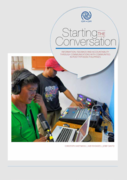
Starting the Conversation: Information, Feedback and Accountability in Post-Typhoon Philippines
Geneva: International Organization for Migration (IOM) (2014), 34 pp.
"The report reviews several communications tools developed and disseminated through collaboration with Tacloban’s Radyo Abante as part of IOM’s Tindog Kita (‘Rise Together’) communications campaign, which included a radio drama, interactive talk show and key message song. Of the communicatio
...

"Television viewing is ubiquitous in Egypt and by far the most common source of information for its residents. Nearly all (98.8%) Egyptians have a working television in their home, while just 37.9% of Egyptians have a radio. The percentage of Egyptians with a radio in their household is down signifi
...

Feature Phone User Survey: Ethiopia, Ghana, Kenya, Nigeria and South Africa
London: Balancing Act (2014), 64 pp.
"Feature phone users are significantly more likely to use the Internet almost as much radio and TV for news and information. This is not an either/or set of choices but the Internet is part of the range of media they use. Internet is in second position in Nigeria, third position in Ethiopia and Keny
...
Institutional Grantees Audience Survey: A Project Report
Dar-es Salaam: Ipsos; Tanzania Media Fund (TMF) (2014), 92 pp.
"Radio was found to be the most frequently used media channel with 46% of the respondents listening to radio on a daily basis and a further 30% listenership on a weekly basis. Newspapers were found to be the least used media with 22% of the respondents reading newspapers less than once a month. The
...

Media Use in Cambodia
Broadcasting Board of Governors (BBG); Gallup (2014), 2 pp.
"A majority (57%) of Cambodians say they watch TV news at least weekly, with urban residents considerably more likely than their rural counterparts to do so. Radio follows, used for news by 42,9% overall and equally prevalent in urban and rural areas. About one in 10 Cambodians overall now say they
...

"In February, 2014, Internews worked with Forcier Consulting to conduct a baseline survey of 612 respondents from the Tong Ping site to identify information needs, sources, and preferences to help guide their intervention strategies, and in April 2014 Internews again teamed up with Forcier Consultin
...
