
Filter
74
Featured
64
2
Topics
17
16
13
10
7
6
5
5
4
4
4
4
4
3
3
3
2
2
2
2
2
2
2
2
2
2
2
2
2
2
2
2
2
1
1
1
1
1
1
1
1
1
1
1
1
1
1
1
1
1
1
1
1
1
1
1
1
1
1
1
1
1
1
1
1
1
1
1
1
1
1
1
1
1
1
1
1
1
1
1
1
1
1
1
1
1
1
1
1
1
1
1
1
1
1
1
1
1
1
1
1
1
1
1
1
1
1
1
1
1
1
1
Language
Document type
4
4
2
1
1
1
1
Countries / Regions
Authors & Publishers
Media focus
Publication Years
Methods applied
Journals
Output Type

Two Years On: An Analysis of Russian State and Pro-Kremlin Information Warfare in the Context of the Invasion of Ukraine
London: Institute for Strategic Dialogue (ISD) (2024), 25 pp.
"This report provides an overview of how Russian state and pro-Kremlin propaganda undermining international support for Ukraine has evolved over the two years since the beginning of the full-scale invasion on 24 February 2022. It outlines a range of semi-covert tactics through which Russian state an
...

Im Krieg: Zwei illustrierte Tagebücher aus Kiew und St. Petersburg
Bonn: Bundeszentrale für politische Bildung (bpb), Sonderausg. (2024), 127 pp.
"Welche Auswirkungen hat der Angriffskrieg, den Russland seit Februar 2022 gegen die gesamte Ukraine führt, auf den Alltag und das Leben Einzelner? Dieser Frage ging die deutsch-amerikanische Illustratorin Nora Krug im Laufe einer einjährigen Korrespondenz mit einer ukrainischen Journalistin und e
...

Der russische Angriffskrieg gegen die Ukraine in den deutschen Medien: Kritik des Maßstabs „ausgewogene Bewertung“ in Inhaltsanalysen
Publizistik, volume 69 (2024), pp. 455-493
"Inhaltsanalysen über die Darstellung von Konflikten in den Medien werden häufig durchgeführt, um den Vorwurf der Einseitigkeit empirisch zu überprüfen. Dies wirft die normative Frage auf, wie die Forderung nach einer ausgewogenen Bewertung, d. h. einer Gleichverteilung positiver und negativer
...

“Voices from the Island”: Informational annexation of Crimea and transformations of journalistic practices
Journalism, volume 25, issue 3 (2024), pp. 528–546
"After the annexation of Crimea by Russia in March 2014, the peninsula experienced a progressive transition of telecommunication and broadcasting infrastructure under Russian influence, followed by a wave of repression of Ukrainian media. Between 2014 and 2015, dozens of Ukrainian media organization
...
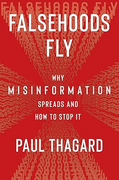
Falsehoods Fly: Why Misinformation Spreads and How to Stop it
New York: Columbia University Press (2024), xii, 357 pp.
"Misinformation is one of the twenty-first century’s greatest challenges, a peril to democracy, peace, science, and public health. Yet we lack a clear understanding of what makes misinformation so potent and why it can spread so rapidly. In Falsehoods Fly, a leading cognitive scientist and philoso
...

Narratives of conflict: Russian media’s evolving treatment of Ukraine (2013–2022)
Media, War & Conflict (2024), 23 pp.
"This article scrutinizes Russian state-run TV narratives over critical junctures – before the 2013 Euromaidan protests, the annexation of Crimea in 2014, and the periods leading up to and following the 2022 invasion – to illuminate how political agendas, historical narratives, and public percep
...
No relief from war: The use of humour in memes by the government of Ukraine and the limitation of laughter
International Journal of Media & Cultural Politics, volume 20, issue 1 (2024), pp. 3-26
"The article is interested in the role of humour employed in memes on X by the government of Ukraine in the war following the invasion by Russia in 2022. It brings insights from cultural and humour studies as well as psychology into politics and shows how and what kind of humour the government aroun
...


War Discourse on TV: A Glimpse into Russian Political Talk Shows (2014 and 2022)
Zeitschrift für Slawistik, volume 68, issue 3 (2023), pp. 375-397
"This article examines the war discourse on Russian television, particularly in political talk show broadcasts aired after Russia’s invasion of Ukraine on February 24, 2022. The question of how the two conflicting parties, Russia and Ukraine, are portrayed verbally and visually in these shows is s
...
Der regionale Blick. Medien in Tatarstan und Baschkortostan und Russlands Krieg gegen die Ukraine
Russland-Analysen, issue 441 (2023), pp. 13-18
"Der Beitrag analysiert die Berichterstattung über den Angriffskrieg gegen die Ukraine in den russischen Teilrepubliken Tatarstan und Baschkortostan, welche sich beide durch die starke Präsenz von turksprachigen Bevölkerungsgruppen auszeichnen. Die Medienanalyse ergab, dass die Berichterstattung
...

Digital Warfare and Peace: Learning from Ukraine’s Response to the Russian Invasion
Tokyo: Toda Peace Institute (2023), 15 pp.
"Before launching a full-scale invasion of Ukraine on February 24, 2022, Russia had maintained a low-scale war with Ukraine since early 2014. That conflict, which culminated in the annexation of the Crimean peninsula and the ongoing Donbas war, received less international attention than the 2022 ful
...
Fabricating a war? Russian (dis)information on Ukraine
International Affairs, volume 99, issue 5 (2023), pp. 2015-2036
"Propaganda has been an age-old part of warmongering. It is thus no surprise that the Russian invasion of Ukraine was preceded by, and continues to be fuelled by, propaganda transmitted by state-controlled Russian media. What is more unusual about the Russian (dis)information campaigns is the sheer
...

Bilder gegen den Krieg: Politische Karikaturen und Illustrationen aus der Ukraine
Bonn: Bundeszentrale für politische Bildung (bpb), Sonderausg. (2023), 125 pp.
"Neun Illustratorinnen und ein Illustrator der ukrainischen Organisation Pictoric zeigen in diesem Band politische Karikaturen und Illustrationen, in denen sie ihre Kriegseindrücke verarbeiten. Dabei überführen sie mit der Stärke ihres Berufsstandes anspruchsvolle Themen und Gefühle in eine lei
...
Truth with a Z: Disinformation, war in Ukraine, and Russia’s contradictory discourse of imperial identity
Post-Soviet Affairs, volume 39, issue 5 (2023), pp. 347-365
"This article offers a qualitative analysis of how, by adopting identity-related discourses whose meanings resonate within a given culture, Russian state propaganda strives to bolster “the truth status” of its Ukraine war claims. These discourses, we argue, have long historical lineages and thus
...

The War of Narratives: Ukraine’s Image in the Media
Kyiv: LLC «Vistka»; Friedrich-Ebert-Stiftung (FES) (2023), 146 pp.
"In order to spread Russian narratives about Ukraine that create a false impression of the country among external and internal audiences, the Russian Federation uses a whole complex of information and communication channels. Their main task is to replace the target audience's existing ideas about th
...
Shielding Democracy: Civil Society Adaptations to Kremlin Disinformation About Ukraine
Washington, DC: National Endowment for Democracy (NED) (2023), 30 pp.
"This report highlights adaptations and innovations by Ukrainians in their struggle against Moscow’s disinformation machine. As part of the project, the International Forum on Democratic Studies conducted more than fifty expert interviews and hosted a series of convenings with experts from Ukraine
...


Humour as a Strategic Tool Against Disinformation: Ukraine’s Response to Russia
Oxford: Reuters Institute for the Study of Journalism (2023), 35 pp.
"Ukraine has been building its capacity to use humour as a strategic communications tool since Russian first invasion in 2014. After Russia launched the full-scale war in February 2022, this often grassroots effort was multiplied by many new actors joining it. Foreign supporters of Ukraine stepped i
...
Hate Speech on Social Media: A Global Approach
Covilhã (PO); Qutio (EC): LabCom; University of Beira Interior; PUCE Publications Centre (2023), 302 pp.
"Hate speech is more complex and diverse on social media. It spreads at high speed and can impact behaviors beyond the borders where it originates. Hate is ubiquitous, interactive, and multimedia. It is available 24/7, reaching a much larger audience. On social media, haters can be anonymous and fin
...
