
Filter
78
Featured
35
1
Topics
27
24
16
10
10
6
4
4
3
3
3
3
2
2
2
2
2
2
2
2
2
2
2
2
2
2
2
2
1
1
1
1
1
1
1
1
1
1
1
1
1
1
1
1
1
1
1
1
1
1
1
1
1
1
1
1
1
1
1
1
1
1
1
1
1
1
1
1
1
1
1
1
1
1
1
1
1
1
1
1
1
1
1
1
1
1
1
1
1
1
1
1
1
1
1
1
1
1
1
1
1
1
1
Language
Document type
5
3
3
1
Countries / Regions
Authors & Publishers
Media focus
Publication Years
Methods applied
Journals
Output Type

Chilling or cosy effects? Zimbabwean journalists’ experiences and the struggle for definition of self-censorship
"The definition of censorship denotes direct or overt restriction on free expression or freedom of the media. The popular understanding of self-censorship involves a person’s involuntary self-silencing. A journalist’s wilful, personal, intentional self-censorship, at times motivated by selfish m
...
Freedom of Expression in Times of Covid-19: Chilling Effect in Hungary and Serbia
Journal of Liberty and International Affairs, volume 6, issue 2 (2020), pp. 14-29
"New technologies have opened several risks to safety of journalists. More importantly, in the state of emergency caused by the Covid-19 outbreak, journalists and media actors have shifted their activities online more than ever, which also made them more prone to digital threats and attacks. In some
...

Journalism and self-censorship in the insecure democracies of Central America
"This chapter focuses on the context of violence and political polarization in three Central American countries: Guatemala, Honduras and El Salvador, and analyses how these conditions negatively affect press freedom and the practice of journalism. The author argues that the notion of “insecure dem
...
The State of Journalism and Press Freedom in Postgenocide Rwanda
Journalism & Mass Communication Quarterly, volume 96, issue 2 (2019), pp. 558-578
"News media played a prominent role in perpetuating the 1994 Rwandan genocide. Since then, Rwanda has undergone impressive social and economic growth, but the media landscape during this redevelopment remains understudied. Qualitative interviews with Rwandan journalists reveal that reporters censor
...

Surrendering to Silence: An Account of Self-Censorship Among Pakistani Journalists
Media Matters for Democracy (2018), 55 pp.
"The following are the ve key takeaways from the study: Pakistani journalists work in an environment that makes self-Censorship diffcult to avoid [...] 2. Pakistani journalists exercise self-Censorship in personal settings [...] 3. Journalists perceive the policies of their own news organizations a
...

Examining the Practices That Mexican Journalists Employ to Reduce Risk in a Context of Violence
International Journal of Communication, volume 11 (2017), pp. 499-521
"Research on journalists working in contexts of risk has examined either war correspondents on temporary assignments or the psychological effects of covering traumatic events, usually after the events have ended. Although these studies are important, they fail to account for the growing importance o
...
Trouble in paradise? Self-censorship, outside interference and harassment of journalists in Finland
Media Asia, volume 44, issue 1 (2017), pp. 66-70
"Contrary to popular belief, being at or near the top of media freedom rankings doesn’t mean a country is free from interference and threats to journalists’ safety, Ilmari Hiltunen observes. When talking about censorship and journalism the attention has usually been focused on explicit violence
...
Unwarranted Interference, Fear and Self-censorship among Journalists in Council of Europe Member States
In: The Assault on Journalism. Building Knowledge to Protect Freedom of Expression
Göteborg: Nordicom (2017), pp. 221-226
"Journalists may be exposed to a number of risk factors for unwarranted interference. This is often compounded by a culture of impunity. The extent of unwarranted interference, the experience of fear associated with such interference, and the consequent possibility of self-censorship among journalis
...
Journalistic Role Performance: A New Research Agenda in a Digital and Global Media Environment
"Global press freedom declined to its lowest point in 12 years in 2015, mainly due to political, criminal, and terrorist forces that sought to co-opt or silence the media in their struggle for power (Freedom House, 2016). As of 2015, only one in seven people around the world lived in a country that
...
Journalism Under Threat: Intimidation and Harassment of Swedish journalists
Journalism Practice, volume 10, issue 7 (2016), pp. 880-890
"Previous studies of intimidation and harassment of journalists have (rightly) focused on non-democratic and authoritarian nations and/or transitional/emerging democracies. In this article, we examine the situation in Sweden, a country with strong de facto and de jure safeguards of journalistic free
...
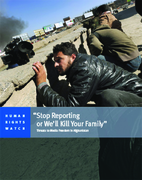
"Stop Reporting or We'll Kill Your Family": Threats to Media Freedom in Afghanistan
New York: Human Rights Watch (2015), 45 pp.
"Afghan journalists face threats from all sides: government officials exploiting weak legal protections to intimidate reporters and editors to compel them not to cover controversial topics; the Taliban and other insurgent groups using threats and violence to compel reporting they consider favorable;
...

Press Censorship in Turkey: Networks of State Power, Commercial Pressures, and Self-Censorship
Communication, Culture & Critique, volume 7, issue 2 (2014), pp. 154-173
"This article explores the suppression of press freedoms in Turkey under the AKP (Justice and Development Party) government in the late 2000s. Drawing upon analyses of laws and legislation, surveys, reports, and interviews with journalists, it demonstrates how press censorship in Turkey has been act
...
Killing Me Softly with His Words: Censorship and Self-Censorship from the Perspective of Turkish Journalists
Turkish Studies, volume 14, issue 3 (2013), pp. 447-462
"Turkey is a country where democratization process has been repeatedly interrupted by military interventions in the past 50 years. Censorship and self-censorship have become ordinary practices in the media, mainly due to weak parliamentary representations followed by oppressive coup periods. Yet eve
...
Concentration and self-censorship in commercial media
Journal of Public Economics, volume 97 (2013), pp. 117-130
"Given that over half the revenues of global newspaper publishing come from advertising (80% in the US and 57% in OECD countries, OECD, 2010), we study how media firms internalize the effect of their own coverage on advertisers' sales and hence on their own advertising revenues. We show, within a fr
...

Censura y autocensura periodística en Bolivia: Una perspectiva desde la profesión misma
La Paz: Fundación UNIR (2012), 80 pp.
"A partir de una encuesta anónima y grupos focales en las tres ciudades del eje, La Paz, Santa Cruz y Cochabamba, se buscó analizar la problemática desde la profesión misma. El propósito de la investigación fue conocer la percepción y evaluar el grado de (auto) censura de los periodistas al r
...

Medios de comunicación en el estado plurinacional: Una reflexión desde el gremio de los periodistas sobre las relaciones expuestas y subyacentes del poder político constituido y los medios de comunicación en su función informativa
La Paz: Asociación de Periodistas de La Paz (APLP); Konrad-Adenauer-Stiftung (KAS) (2012), 85 pp.
Old Tricks in a New Era: Self-Censorship in Indonesian Journalism
Asian Studies Review, volume 36, issue 2 (2012), pp. 227-245
"Even though Indonesia has entered a new era of democracy and press freedom, self-censorship still exists in the professional practice of many Indonesian newspaper journalists. Indonesia has a long history of censorship, particularly pressure from the government encouraging journalists to self-censo
...
Ohne Zensur und doch nicht frei: Russlands Medienlandschaft

Justifying Self-Censorship: A Perspective from Ethiopia
Westminster Papers in Communication and Culture, volume 7, issue 2 (2010), pp. 98-121
"This study investigates self-Censorship practices in Ethiopian state media institutions. Through indepth interviews with 61 journalists, the study discloses extensive use of self-Censorship on the part of journalists who try to conform to the expected reporting style of the state media. The journal
...
