
Filter
112
Featured
66
3
1
Topics
25
21
18
17
13
10
10
9
9
8
6
6
5
5
4
4
4
4
4
4
4
3
3
3
3
2
2
2
2
2
2
2
2
2
2
2
2
2
2
2
2
2
2
2
2
2
2
2
2
2
1
1
1
1
1
1
1
1
1
1
1
1
1
1
1
1
1
1
1
1
1
1
1
1
1
1
1
1
1
1
1
1
1
1
1
1
1
1
1
1
1
1
1
1
1
1
1
1
1
1
1
1
1
1
1
1
1
1
1
1
1
1
1
1
1
1
1
1
1
1
1
1
1
1
1
1
1
1
1
1
1
1
1
1
1
1
1
1
1
1
1
1
1
1
1
1
1
1
1
1
1
1
1
1
1
1
1
1
Language
Document type
5
4
3
3
2
1
1
1
Countries / Regions
Authors & Publishers
Media focus
Publication Years
Methods applied
Journals
Output Type
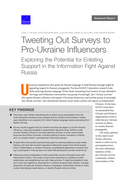
Tweeting Out Surveys to Pro-Ukraine Influencers: Exploring the Potential for Enlisting Support in the Information Fight Against Russia
RAND Corporation (2021), 23 pp.
"This study used Twitter advertisements to solicit survey participation from the most-influential members of pro-Ukraine and pro-Russia communities of Twitter users identified in an analysis of 25 million Russian language tweets emanating from Eastern Europe. Survey results suggest that pro-Ukraine
...
Theorizing Social Media and Activism: Where is Community Development?
Community Development Journal, volume 56, issue 2 (2021), pp. 318-337
"There is a growing public and academic debate on the societal impacts of the internet and, in particular, social media. For its proponents, social media is a force for change, which can challenge entrenched hierarchies, redistribute power, democratize information, support mass mobilization and cont
...

Bloggen gegen Rassismus: Holen wir uns das Netz zurück!
Key Guides
Bonn: Bundeszentrale für politische Bildung (bpb) (2021), 203 pp.
"Fake News, Hate Speech und Rassismus im Netz: Soziale Medien bieten Menschen und Organisationen auch dafür eine Plattform. Wie kann man gegensteuern und selbst aktiv für Demokratie, Meinungsvielfalt und die Entgiftung des gesellschaftlichen Klimas eintreten? Said Rezek, Politikwissenschaftler und
...

The role of (social) media in political polarization: A systematic review
Annals of the International Communication Association, volume 45, issue 3 (2021), pp. 188-206
"Rising political polarization is, in part, attributed to the fragmentation of news media and the spread of misinformation on social media. Previous reviews have yet to assess the full breadth of research on media and polarization. We systematically examine 94 articles (121 studies) that assess the
...

Disinformation in Iraqi Media
London: LSE Middle East Centre; Conflict Research Programme (CRP) (2021), 21 pp.
"This paper examines the key narratives of disinformation that are prevalent in Iraqi media. It provides an analysis of the messages, agents, intentions and impact of the spread of disinformation. Focusing particularly on the period during which planned national elections were postponed, it identifi
...

From Grassroots Activism to Disinformation: Social Media in Southeast Asia
Singapore: ISEAS (2021), 277 pp.
"This book reflects on the role of social media in the past two decades in Southeast Asia. It traces the emergence of social media discourse in Southeast Asia, and its potential as a "liberation technology" in both democratizing and authoritarian states. It explains the growing decline in internet f
...

The Growing Salience of Online Vietnamese Nationalism
Singapore: ISEAS (2021), 41 pp.
"Vietnamese nationalism has a strong undercurrent of anti-China sentiments, and Vietnam’s leaders have regularly tapped into such sentiments to shore up their legitimacy and boost Vietnamese nationalism. Over the last decade, the helter-skelter growth of social media has bred new popular actors in
...

Schluss mit lustig? TikTok als Plattform für politische Kommunikation
Berlin: Rosa-Luxemburg-Stiftung (2021), 22 pp.
"Verständnis der technischen und kulturellen Besonderheiten der algorithmusgetriebenen App, die vorhandene Bestandteile bereits bekannter Social-Media-Plattformen kombiniert und weiterentwickelt. Statt Reichweitenaufbau geht es bei TikTok um Vertrauensaufbau. Mithilfe eines Analyserasters werden im
...

Understanding Viral Communism: A Thematic Analysis of Twitter During Brazil’s 2018 Elections
Westminster Papers in Communication and Culture, volume 15, issue 1 (2020), pp. 19-36
"This research performs a thematic analysis on tweets published during Brazil’s 2018 elections that mentioned communism. The idea was to identify the linkages to other underlying themes that emerged during what we saw as the Twitter ‘virality of communism’ and interpret them considering the ba
...

"[This study] aims at giving an overview of media platforms / citizen media platforms in Lebanon producing quality public interest journalism in print, radio, television, or digital formats. It encompasses profiling information about various existing alternative media platforms and provides informat
...

Retooling Politics: How Digital Media are Shaping Democracy
Cambridge; New York et al.: Cambridge University Press (2020), ix, 326 pp.
"Donald Trump, the Arab Spring, Brexit: Digital media have provided political actors and citizens with new tools to engage in politics. These tools are now routinely used by activists, candidates, nongovernmental organizations, and parties to inform, mobilize, and persuade people. But what are the e
...
Media Capture
Russian Analytical Digest, issue 258 (2020), 16 pp.

Searching for a New Kenya: Politics and Social Media on the Streets of Mombasa
Cambridge: University of Cambridge (2020), xi, 270 pp.
"Searching for a New Kenya analyses public discussion in urban Kenya, focusing on the gatherings of citizens, both in-person and online, where people discuss issues of common concern to shed light on the role public discussion plays in politics and how social media affects political movements. Throu
...

Social Media and Elections in Africa. Vol. 1: Theoretical Perspectives and Election Campaigns
Basingstoke: Palgrave Macmillan (2020), xv, 237 pp.
"This book brings together fresh evidence and new theoretical frameworks in a unique analysis of the increasing role of social media in political campaigns and electoral processes across Africa. Supported by contemporary and historical cases studies, it engages with the main drives behind the variou
...

Political migration discourses on social media: A comparative perspective on visibility and sentiment across political Facebook accounts in Europe
Journal of Ethnic and Migration Studies, volume 46, issue 7 (2020), pp. 1261-1280
"Migration has been dominating media and political discourses in Europe in recent years. Previous studies have mainly mapped migration discourses in traditional media or conventional channels of party communication, often in a single country. Migrationrelated party communication on social network si
...
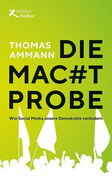
Die Machtprobe: Wie Social Media unsere Demokratie verändern
Hamburg: Edition Körber, Sonderdruck für die Zentralen für politische Bildung (2020), 349 pp.
"Ammann hat den Aufstieg der sozialen Medien von Anfang an begleitet und zieht Bilanz: Sie bieten auf der einen Seite große Chancen für die Demokratie. Die effektive Nachbarschaftshilfe während der Pandemie oder der immense Erfolg von #fridaysforfuture und #blacklivesmatter basieren auf der Reich
...

Images and Misinformation in Political Groups: Evidence from WhatsApp in India
Harvard Kennedy School Misinformation Review, volume 1, issue 5 (2020), 12 pp.
"WhatsApp is a key medium for the spread of news and rumors, often shared as images. We study a large collection of politically-oriented WhatsApp groups in India, focusing on the period leading up to the 2019 Indian national elections. By labeling samples of random and popular images, we find that a
...

Comunicação política digital
Freiburg: KoBra Kooperation Brasilien (2020), 5 pp.

Social Media and Polarization in the 'New Malaysia'
Singapore: ISEAS (2020), 9 pp.
"Malaysia’s Pakatan Harapan government fell rapidly in late February 2020 as a result of coalition infighting and power struggles among the political elite. A major factor in the government’s sudden collapse was rising ethnoreligious tension between Muslim-Malay nationalists in the opposition an
...

Social Media and Thailand's Struggle Over Public Space
Singapore: ISEAS (2020), 10 pp.
"Political divisions, the economic downturn after 2006, and technological disruptions have enabled Thai authorities to limit public space for political discussion and expression. People in Thailand have turned to social media instead. At present, the hashtag (#) is a growing tool for all kinds of po
...
