
Filter
112
Featured
66
3
1
Topics
25
21
18
17
13
10
10
9
9
8
6
6
5
5
4
4
4
4
4
4
4
3
3
3
3
2
2
2
2
2
2
2
2
2
2
2
2
2
2
2
2
2
2
2
2
2
2
2
2
2
1
1
1
1
1
1
1
1
1
1
1
1
1
1
1
1
1
1
1
1
1
1
1
1
1
1
1
1
1
1
1
1
1
1
1
1
1
1
1
1
1
1
1
1
1
1
1
1
1
1
1
1
1
1
1
1
1
1
1
1
1
1
1
1
1
1
1
1
1
1
1
1
1
1
1
1
1
1
1
1
1
1
1
1
1
1
1
1
1
1
1
1
1
1
1
1
1
1
1
1
1
1
1
1
1
1
1
1
Language
Document type
5
4
3
3
2
1
1
1
Countries / Regions
Authors & Publishers
Media focus
Publication Years
Methods applied
Journals
Output Type

Gesellschaftliche Teilhabe und Meinungsbildung auf Twitch: Von einer reinen Gaming-Plattform zum Ort für politischen Austausch?
Media Perspektiven, issue 15 (2025), 16 pp.
"42 Prozent der 14- bis 40-Jährigen in Deutschland nutzen Twitch mindestens selten. Die Twitch-User sind überwiegend männlich und zum größten Teil zwischen 21 und 30 Jahren alt. Gaming ist meist der erste Berührungspunkt mit Twitch. Auf der Plattform stehen Content-Creator und ihre Livestreams
...
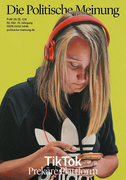
TikTok: Prekäre Plattform
Die Politische Meinung, volume 70, issue 592 (2025), pp. 20-89
"Mit rund 1,5 Milliarden monatlichen Nutzern ist TikTok ein globaler Kommunikationsraum – und ein geopolitisches Machtinstrument. Die Plattform steht mit im Zentrum der Rivalität zwischen den USA und China. Washington drängt auf eine Abspaltung vom chinesischen Mutterkonzern ByteDance, während
...
How to enhance constructive public dialogue on social media in Uganda: Recommendations from a multi-stakeholder consultation workshop, in Kampala, Uganda, in November 2023
Bonn: Deutsche Welle DW Akademie (2024), 16 pp.
"In November 2023, DW Akademie brought together journalists, civil society organizations, digital rights experts, and media influencers for a consultation workshop in Kampala, Uganda. In the two-day event, hosted by Media Challenge Initiative (MCI), the diverse group collaboratively developed recomm
...

Discourses on Electoral Law Reform in Tanzania’s Social Media: A Case of Two Selected Twitter(X) Accounts, JamiiForums and Maria Sarungi
Nyegezi-Malimbe: St Augustine University of Tanzania, Master Thesis (2024), vii, v, 185 pp.
"This research examines the political discourse surrounding electoral law and constitutional reforms in Tanzania, utilizing Jürgen Habermas's Public Sphere Theory as the theoretical lens. Employing critical discourse analysis (CDA), the study analyzes social media discussions, particularly on Twitt
...

The party-on-the-Net: The digital face of partisan organization and activism
Information, Communication & Society, volume 26, issue 16 (2024), pp. 3257-3274
"In this article we theorize a new organizational face of political parties that we term the ‘party-on-the-net’, defined as a set of digital partisan activist roles enabled by the affordances of digital technologies. We first explain the conceptual advantages of understanding parties’ media hy
...
Unpacking Affective Polarization in Afghanistan: Ethnic Politics, Elite Competition, and Online Divisive Content
Tokyo: Toda Peace Institute (2024), 25 pp.
"Affective polarization has been a persistent feature of Afghanistan’s society and politics in the past decades. However, with the instantaneous collapse of the republic’s government and the return of the Taliban, the country has witnessed heightened affective polarization along ethnic and ideol
...

Image-centrism in Africa’s political communication: A social semiotic analysis of self-presentation practices by women political candidates in Kenya’s social media space
Information, Communication & Society, volume 27, issue 8 (2024), pp. 1687-1711
"This study explores self-visual presentation practices by female political candidates on Facebook during Kenya’s political campaigns that culminated in the national elections of 2022. The unit of analysis is the Facebook profile image of the women leaders. Image-centrism is operationalized as the
...
Populism Fuels Hate Speech and Disinformation: Evidence From Political Discourse on X (Formerly Twitter) in India and Pakistan
International Journal of Communication, volume 18 (2024), pp. 5694-5713
"This study discusses the relationship among the various dimensions of populism, hate speech, and disinformation within the political discourse on X (formerly Twitter) in India and Pakistan. Employing manual content analysis, we examined 7,141 posts from both populist and non-populist political lead
...

Media, Governance and Accountability in Nigeria
Ibadan: Evans Brothers (Nigeria Publishers) (2023), xiii, 280 pp.
Impacts of Social Media on Public Policy Development in pre-Taliban Afghanistan
Global Media Journal - German Edition, volume 13, issue 2 (2023), 19 pp.
"The impacts of media, mainly social media, have attracted greater scholarly attention. However, their effects on public policy development and the decision-making procedure of a government have not been examined so far. Thus, this study examines such effects in pre-Taliban Afghanistan before August
...
‘Keeping news alive in Venezuela’: Using social media as tactical media
Global Media and Communication, volume 19, issue 1 (2023), pp. 101-117
"Venezuela leads Latin America with the largest number of imprisoned journalists and extreme government-led media censorship. Our in-depth interviews with 25 Venezuelan journalists reveal that assisting journalists to combat government control are social media and technology platforms like WhatsApp,
...

Konnektiver Zynismus: Politik und Kultur im digitalen Zeitalter
Bielefeld: transcript Verlag (2023), 128 pp.
"Der politische Diskurs verroht, in den sozialen Medien toben Trolle und grenzüberschreitende Witze haben Hochkonjunktur. Rechtspopulist*innen und fragwürdige Influencer*innen nutzen bewusst sprachliche Unschärfen und ironische Zwischentöne, um das Gesagte im Nachhinein relativieren zu können.
...

Cryptopolitics: Exposure, Concealment, and Digital Media
New York: Berghahn (2023), vii, 245 pp.
"Hidden information, double meanings, double-crossing, and the constant processes of encoding and decoding messages have always been important techniques in negotiating social and political power dynamics. Yet these tools, "cryptopolitics," are transformed when used within digital media. Focusing on
...

Weaponizing John 8:32: The Complex Interconnections Between Religion and Politics on Brazilian Twitter
Social Media + Society, volume 9, issue 4 (2023), 13 pp.
"Politics and religion are traditionally connected in large democracies, with many examples in the Global South. Recently in Brazil, a specific Bible verse has been assimilated into political expression and amplified by social media: John 8:32 (“And you shall know the truth, and the truth will set
...

Desinformación y conflictividad en Bolivia 2019-2021
La Paz: Fundación UNIR (2022), 77 pp.
"Este estudio aborda el modo cómo la desinformación propalada principalmente a través de las redes sociales digitales, pero también en sitios web y medios periodísticos, ha contribuido a alimentar los conflictos y cómo éstos han dado lugar a más desinformación. Asimismo desentraña los prop
...

Zwischen Partizipationsversprechen und Algorithmenmacht: Wie soziale Medien politisches Handeln prägen
Erfurt: Landeszentrale für politische Bildung Thüringen (2022), 88 pp.
"Soziale Medien wie Facebook, YouTube, Instagram oder Twitter sind wichtige Werkzeuge der politischen Kommunikation geworden. Politikerinnen und Politiker genauso wie ehrenamtlich Engagierte nutzen sie, um über ihre Ziele zu informieren und Unterstützung zu mobilisieren. Bürgerinnen und Bürger k
...
Philippine Digital Cultures: Brokerage Dynamics on YouTube
Amsterdam: Amsterdam University Press (2022), 240 pp.
"Amid the proliferation of a range of new and ubiquitous online platforms, YouTube, a video-based platform, remains a key driver in the democratisation of creative, playful, vernacular, intimate, as well as political expressions. As a critical node of contemporary communication and digital cultures,
...
Beyond Incivility: Understanding Patterns of Uncivil and Intolerant Discourse in Online Political Talk
Communication Research, volume 49, issue 3 (2022), pp. 399-425
"This article takes up the popular argument that much online discussion is toxic and hence harmful to democracy, and argues that the pervasiveness of incivility is not incompatible with democratically relevant political talk. Instead of focusing on the tone of political talk, scholars interested in
...

Social Media Behavior During Uprisings: Selective Sharing and Avoidance in the China (Hong Kong), Iran, Iraq, and Lebanon Protests
Online Media and Global Communication, volume 1, issue 4 (2022), pp. 723-748
"This study examines the use of social media by individuals during protests in China (Hong Kong), Iraq, Iran, and Lebanon. Method: Surveys in the four countries assess the relationship between people's attitudes toward the protests and their selection bias on social media, manifested through selecti
...
Tweeting Out Surveys to Pro-Ukraine Influencers: Exploring the Potential for Enlisting Support in the Information Fight Against Russia
RAND Corporation (2021), 23 pp.
"This study used Twitter advertisements to solicit survey participation from the most-influential members of pro-Ukraine and pro-Russia communities of Twitter users identified in an analysis of 25 million Russian language tweets emanating from Eastern Europe. Survey results suggest that pro-Ukraine
...
