
Filter
56
Featured
49
1
Topics
16
11
10
6
5
5
5
5
4
4
3
2
2
2
2
2
2
2
1
1
1
1
1
1
1
1
1
1
1
1
1
1
1
1
1
1
1
1
1
1
1
1
1
1
1
1
1
1
1
1
1
1
1
1
1
1
1
1
1
1
1
1
Language
Document type
6
5
3
1
1
Countries / Regions
Authors & Publishers
Media focus
Publication Years
Methods applied
Journals
Output Type

Digitale Diplomatie
Russland-Analysen, issue 398 (2021), pp. 1-18

Media Environment Before and After 2021 Elections: Threats and Supportive Instruments
Tbilisi: Media and Communication Educational and Research Center (MCERC) (2021), 65 pp.
"The study revealed the macro and micro media threats that come to light in the digital and physical media environments prior to and following elections. The media environment observed during the 2021 self-government elections was representative of the reality seen through the eyes of media workers,
...

Tackling Kremlin's Media Capture in Southeast Europe: Shared Patterns, Specific Vulnerabilities and Responses to Russian Disinformation
Deep Insights
Sofia: Center for the Study of Democracy (CSD) (2021), 124 pp.
"The current report illuminates the scope, means, and reach of Russia’s sharp power influence through the phenomenon of media capture. It traces the regime’s malign impact on good governance and democratic development in eight Southeast European countries (EU members: Bulgaria and Croatia, as we
...

How to lose the information war: Russia, fake news, and the future of conflict
London: Tauris (2020), xxvii, 259 pp.
"Since the start of the Trump era, the United States and the Western world has finally begun to wake up to the threat of online warfare and the attacks from Russia. The question no one seems to be able to answer is: what can the West do about it? Central and Eastern European states, however, have be
...

More-Troll Kombat: French and Russian Influence Operations Go Head to Head Targeting Audiences in Africa
Graphika (2020), 83 pp.
"On December 15, Facebook announced that it had taken down three separate networks that it had discovered for “coordinated inauthentic behavior” that targeted communities across Africa. One, centered on the Central African Republic (CAR) and Mali, was linked to individuals associated with the Fr
...

"Due to its Soviet past, the Russian influence in the Republic of Moldova is still very significant. The country is divided between European integration and Russian convergence. After the government of the pro-European coalition ACUM leaded by Maia Sandu and the pro-Russian Party of Socialists (PSRM
...

The Dark Double: US Media, Russia, and the Politics of Values
Oxford: Oxford University Press (2019), xv, 160 pp.
"In Dark Double, Andrei P. Tsygankov focuses on the driving power of values and media, in addition to political and economic interests, in structuring US-Russia relations. By analyzing mainstream US newspapers and other media sources, Tsygankov identifies five media narratives involving Russia since
...

Panorama de la presse centafricaine: Entre pauvreté et politique d'influence
Paris: Ifri (2019), 21 pp.

Opinion-Formation and Issue-Framing Effects of Russian News in Kyrgyzstan
International Studies Quarterly, volume 63, issue 3 (2019), pp. 756-769
"Powerful countries use foreign media broadcasts to enhance their soft power, yet there is scant empirical evidence as to whether such efforts actually sway public opinion abroad. Moreover, researchers have not specified conditions that may shape variations in the influence of foreign broadcasts and
...

"As many as 1,967 anti-Western comments were detected in the 17 monitored media outlets in 2017. In contrast to 2016 and 2015, when negative messages targeted human identity and rights, in 2017, a dominant topic was the foreign policy with the messages aimed at increasing the polarization on the for
...

Soviet Subversion, Disinformation and Propaganda: How the West Fought Against it. An Analytic History, with Lessons for the Present
London: London School of Economics and Political Science (LSE) (2017), 7 pp.
"What were Soviet influence and disinformation campaigns? What did the West do about them? This study answers these questions, explaining the Cold War strategies followed by the USSR, as well as the Western response. Eleven case studies follow, each one examining a counter-disinformation tactic in d
...

Distract, Deceive, Destroy: Putin at War in Syria
Washington, DC: Atlantic Council (2016), 24 pp.
"This paper sets out how Russia built up its disinformation campaign, by analyzing what was said and comparing it with what was done. Using open source and social media intelligence (OSSMINT), it exposes the false claims that Russia targeted ISIS or defeated international terrorism. It reveals that,
...
Fake News: The Narrative Battle Over the Ukrainian Conflict
Journalism Practice, volume 10, issue 7 (2016), pp. 891-901
"The crisis in Ukraine has accentuated the position of Russian television as the government’s strongest asset in its information warfare. The internet, however, allows other players to challenge the Kremlin’s narrative by providing counter-narratives and debunking distorted information and fake
...
The Cyberspace War: Propaganda and Trolling as Warfare Tools
European View, volume 15, issue 1 (2015), pp. 121-132
"Russian President Vladimir Putin’s regime has taken control of the traditional media in Russia: TV, radio and newspapers. As Russian Defence Minister Sergei Shoigu has stated, the Kremlin sees the mass media as a ‘weapon’. Now Russia’s leadership is trying to take control of social media to
...
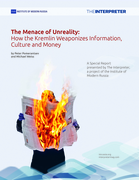
The Menace of Unreality: How the Kremlin Weaponizes Information, Culture, and Money
New York: Institute of Modern Russia; The Interpreter (2014), 44 pp.
"The Kremlin exploits the idea of freedom of information to inject disinformation into society. The effect is not to persuade (as in classic public diplomacy) or earn credibility but to sow confusion via conspiracy theories and proliferate falsehoods. The Kremlin is increasing its “information war
...
Renforçons notre unité et solidarité
Le Journaliste Démocratique (Prague), volume 10, issue 3 (1962), pp. 55-57
"Après un aperçu sur la presse en U.R.S.S., l'auteur développe les thèmes suivants: Contacts entre les journalistes de tous les pays — Renforcer la solidarité de tous les journalistes progressistes — La part menée par les journalistes démocratiques dans divers pays, maintenus sous l'oppre
...
