
Filter
56
Breadcrumb:
Afrobarometer
Featured
56
3
Topics
29
29
26
16
13
8
8
8
6
5
4
3
3
2
2
2
2
1
1
1
1
1
1
1
1
1
1
1
1
1
1
1
Language
Document type
5
3
Countries
Authors & Publishers
Media focus
Publication Years
Methods applied
Output Type
"The survey data show that most Zimbabweans treasure a media that is free from the shackles of government interference and that acts as a watchdog over government, investigating and reporting on its mistakes and corruption. Despite this dominant preference, only a minority think the country currentl
...

Os Angolanos rejeitam as restrições governamentais sobre o direito à informação
Afrobarometer (2023), 11 pp.
"De acordo com a mais recente pesquisa do Afrobarometer, os Angolanos concordam amplamente que a imprensa deve agir como um fiscalizador do governo, investigando os seus erros e os casos de corrupção para os reportar. Os cidadãos valorizam a liberdade de imprensa e rejeitam a noção de que a inf
...

Angolans reject government restrictions on information, say media should report freely
Afrobarometer (2023), 11 pp.
"According to the most recent Afrobarometer survey, Angolans broadly agree that the media should act as a watchdog over the government, constantly investigating and reporting on government mistakes and corruption. Citizens value media freedom and reject the notion that public information should be t
...

Promise and peril: In changing media landscape, Africans are concerned about social media but opposed to restricting access
Afrobarometer (2022), 22 pp.
"Radio remains overwhelmingly the most common source for news in Africa. On average across 34 surveyed countries, two-thirds (68%) of respondents tune in at least a few times a week. Digital media use for news is growing quickly. Between 2014/2015 and 2019/2021, the share of Africans who get news fr
...
Lack of trust in government, reliance on social media may drive vaccine hesitancy in Zimbabwe
Afrobarometer (2022), 8 pp.
"Findings from the most recent Afrobarometer survey in Zimbabwe show that about half of citizens are reluctant to take the vaccine, an attitude that is particularly prevalent among the most highly educated and among supporters of the opposition MDC-Chamisa party. Fewer than half of adults trust the
...


Digital Divide: Who in Africa is Connected and Who is Not
Deep Insights
Afrobarometer (2022), 22 pp.
"Afrobarometer finds that most Africans own a mobile phone and have access to a mobile phone network. However, fewer than half own a mobile phone with Internet access, and even fewer have access to a computer. This translates to low levels of Internet use in many countries. Lack of Internet access a
...

Les politiciens et les usagers des réseaux sociaux sont les plus susceptibles de diffuser des nouvelles qu'ils savents fausses, selon les Nigériens
Afrobarometer (2022), 5 pp.
"Les Nigériens sont majoritaires à penser que les politiciens et les partis politiques (63%) et les usagers des réseaux sociaux (57%) diffusent "souvent" ou "quelque fois" des informations qu'ils savent fausses. Des grandes majorites des citoyens nigeriens estiment que le gouvernement devrait pou
...

Confronting threats to civic spaces
Afrobarometer (2022), 86 pp.



Ugandans See Social Media as Beneficial and Want Unrestricted Access, But Are Wary of its Use to Spread Fake News
Afrobarometer (2021), 11 pp.
"Daily news consumption via social media (11%) and the Internet (9%) has doubled in Uganda since 2015, though these platforms still lag far behind television (27%) and radio (54%) as daily news sources. Six in 10 Ugandans (60%) say they are aware of social media. Awareness is less widespread among w
...

Ethiopians Support Media’s Watchdog Role But Want Regulated Access to Internet, Social Media
Afrobarometer (2021), 13 pp.
"Six in 10 adult Ethiopians (59%) own a mobile phone. But only 16% own a phone with Internet access. One in three (34%) own a radio, while 14% have a television set and only 2 % have a computer. The most common source of regular news (“every day” or “a few times a week”) for Ethiopians is th
...

Though Alert to its Dangers, Zimbabweans Embrace Social Media and Demand Unrestricted Access
Afrobarometer (2021), 10 pp.
"Eight in 10 adult Zimbabweans (80%) say they have heard about social media. More than four in 10 (42%) citizens say they get news from social media “every day” or “a few times a week.” Among those who have heard about social media the vast majority (91%) say social media helps keep people i
...

Liberians Want a Free Media – Within Limits – and Unrestricted Access to Social Media
Afrobarometer (2021), 12 pp.
"Radio is the dominant news source in Liberia, tuned in “every day” or “a few times a week” by 87% of adults. Almost four in 10 citizens (38%) say they regularly get news from the Internet and social media, while only about one in five are regular consumers of news via television (21%) and n
...
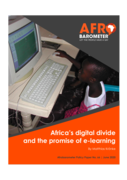
Africa’s Digital Divide and the Promise of E-Learning
Deep Insights
Afrobarometer (2020), 18 pp.
"On average across 34 countries, one in five adults (20%) have access to both a smartphone and a computer, while 43% only have access to a basic cell phone. In 15 out of 34 countries, at least half of adults have access to a smartphone or a computer or both. About three in 10 respondents (31%) use t
...

Face à l’hégémonie de la télévision et la radio, l’Internet et les médias sociaux continuent leur popularité grandissante en Côte d’Ivoire
Afrobarometer (2020), 11 pp.
"L’utilisation de la mesure d’audience par les médias est faible en Côte d’Ivoire. Selon une étude du Ministère de la Communication, de l’Économie Numérique et de la Poste (2017), la plupart des médias ivoiriens naviguent à vue sans une véritable connaissance et maîtrise du marché
...

Access to Remote-Education Tools Unequal in Kenya: Radio Best Way to Reach Most
Afrobarometer (2020), 11 pp.
"As the COVID-19 pandemic continues to spread across Africa, educators, policy makers, parents, and pupils face uncertainty about the path forward. In Kenya, the government has halted all in-person teaching at the primary and secondary levels and moved to remote teaching. Survey findings show, howev
...

Crisis Communication: Radio Tops Zimbabweans’ News Sources – Except for ‘other People’
Afrobarometer (2020), 13 pp.
"Radio remains the leading source of media news for adult Zimbabweans. Six out of 10 citizens (59%) said they get news regularly (“every day” or “a few times a week”) via the radio, compared to 33% for television and 17% for newspapers. About one in five citizens get news regularly from soci
...
Ghana’s E-Learning Program During Pandemic Presents Access Challenges for Many Students
Afrobarometer (2020), 9 pp.
"Afrobarometer findings show that radio and television are the most widely accessible platforms for students seeking to participate in MoE/GES e-learning programs, although rural and poor households are at a disadvantage when it comes to owning these devices. The data show relatively low rates of ac
...
