
Filter
547
Featured
401
12
12
Topics
206
54
54
44
43
41
32
29
23
21
21
18
17
17
14
12
12
12
12
11
11
9
9
9
8
8
8
7
7
7
7
7
7
7
6
6
6
6
6
6
5
5
5
5
5
5
5
5
4
4
4
4
4
4
4
4
4
4
4
4
4
3
3
3
3
3
3
3
3
3
3
3
3
3
3
3
3
3
3
3
3
3
3
3
3
3
3
3
3
3
3
3
3
3
3
3
2
2
2
2
2
2
2
2
2
2
2
2
2
2
2
2
2
2
2
2
2
2
2
2
2
2
2
2
2
2
2
2
2
2
2
2
2
2
2
2
2
2
2
2
2
2
2
2
2
2
2
2
2
2
2
2
2
2
2
2
2
2
2
2
2
2
2
2
2
2
2
2
2
2
2
2
2
2
2
2
2
2
2
1
1
1
1
1
1
1
1
1
1
1
1
1
1
1
1
1
1
1
1
1
1
1
1
1
1
1
1
1
1
1
1
1
1
1
1
1
1
1
1
1
1
1
1
1
1
1
1
1
1
1
1
1
1
1
1
1
1
1
1
1
1
1
1
1
1
1
1
1
1
1
1
1
1
1
1
1
1
1
1
1
1
1
1
1
1
1
1
1
1
1
1
1
1
1
1
1
1
1
1
1
1
1
1
1
1
1
1
1
1
1
1
1
1
1
1
1
1
1
1
1
1
1
1
1
1
1
1
1
1
1
1
1
1
1
1
1
1
1
1
1
1
1
1
1
1
1
1
1
1
1
1
1
1
1
1
1
1
1
1
1
1
1
1
1
1
1
1
1
1
1
1
1
1
1
1
1
1
1
1
1
1
1
1
1
1
1
1
1
1
1
1
1
1
1
1
1
1
1
1
1
1
1
1
1
1
1
1
1
1
1
1
1
1
1
1
1
1
1
1
1
1
1
1
1
1
1
1
1
1
1
1
1
1
1
1
1
1
1
1
1
1
1
1
1
1
1
1
1
1
1
1
Language
Document type
54
31
17
17
12
11
8
7
7
7
2
2
2
1
1
1
1
1
1
Countries
Authors & Publishers
Media focus
Publication Years
Methods applied
Journals
Output Type


Digital Passages: Migrant Youth 2.0. Diaspora, Gender and Youth Cultural Intersections
Amsterdam: Amsterdam University Press (2015), 319 pp.
"This book considers how Moroccan-Dutch youth, mostly born in the Netherlands, navigate digital spaces to articulate their politicized identities in a time when claims over the failure of multiculturalism, anti-immigration sentiments and Islamophobia sweep across Europe. Digital Passages: Migrant Yo
...
Social Media Use in Religious Communication: The Christian Migrants of Kerala, India
Religion and Social Communication, volume 13, issue 1 (2015), pp. 65-81
"The paper focuses on the social media use in religious communication by Kerala Christians who largely migrated after India's independence to Ahmedabat, Gujarat, India. Further, the paper attempts to analyze the way digital and social media are accessed and utilized by the migrant Kerala Christians
...

Journalism, Audiences and Diaspora
Basingstoke: Palgrave Macmillan (2015), xix, 256 pp.
"This collection takes the study of diasporic communication beyond the level of simply praising its existence, to offering critical engagements and analysis with the systems of journalistic production, process and consumption practices as they relate to people who are living outside the borders of t
...

Xenophobie und Medien in Südafrika: Eine Analyse über die Berichterstattung im April und Mai 2015
Konrad-Adenauer-Stiftung (KAS) (2015), 12 pp.
"Die südafrikanischen Tageszeitungen Daily Sun, Sowetan, The Citizen und The Star repräsentieren die vier dominierenden Medienverlage in Südafrika und berichteten im April und Mai 2015 alle über Fremdenfeindlichkeit und Migration. Die meisten Artikel in der Stichprobe stammten von der Zeitung St
...
On the Liveness of Mobile Phone Mediation: Youth Expectations of Remittances and Narratives of Discontent in the Cameroonian Transnational Family
Mobile Media & Communication, volume 3, issue 1 (2015), pp. 20-35
"Drawn from multisited fieldwork conducted among Cameroonians in Germany and Cameroon, the article reveals that the liveness of mobile phone communication influences expectations and narratives of remittances in Cameroonian transnational social relationships. These expectations are meaningful within
...

"The manual has been structured so as to enable you to understand migrants as a unique and critical audience within your station’s larger listenership. Often, out-migration is seen as desertion by people who stay behind in the villages, and there is a general negative public opinion about internal
...

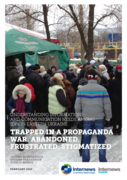
Trapped in a Propaganda War. Abandoned. Frustrated. Stigmatized: Understanding Information and Communication Needs Among IDPs in Eastern Ukraine
Arcata, Calif.; Washington, DC: Internews (2015), 20 pp.
"As information among internally displaced people (IDPs) spreads mostly through word-of-mouth and social media, rumors and misinformation are rife. Citizens in eastern Ukraine have low trust in traditional media, and Ukrainian TV is largely not perceived as a credible source of information. IDPs do
...


Owning the issues of crime and immigration: The relation between immigration and crime news and anti-immigrant voting in 11 countries
Electoral Studies, volume 38 (2015), pp. 59-69
"It is still not well understood how the media affect anti-immigrant party voting. In this paper, we argue and demonstrate empirically that mere exposure to immigration- and crime-related news is positively related to the likelihood that a voter casts a vote for an anti-immigrant party. On the basis
...

Türkisches Fernsehen in Deutschland: Narrenfreiheit und mangelnde Medienaufsicht
Würzburg: Königshausen & Neumann (2014), 205 pp.
"Ethnische Medien in Deutschland befinden sich in einer Nischenökonomie und sind aufgrund der mangelnden Einbindung in den deutschen Medienmarkt informellen Strukturen unterworfen. Die Schattenwirtschaft der ethnischen Medien in Deutschland mündet demzufolge in einen Schlamassel. Diese Studie befa
...
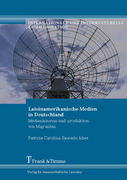
Lateinamerikanische Medien in Deutschland: Medienkonsum und -produktion von Migranten
Berlin: Frank & Timme (2014), 207 pp.
"Das vorliegende Buch beschäftigt sich empirisch mit der Produktion und Nutzung lateinamerikanischer Medien durch Migranten in Deutschland sowie mit der Rolle der Medien für die Konstruktion einer lateinamerikanischen Gemeinschaft bzw. Identität im migratorischen Kontext. Anhand quantitativer und
...
The Re-Emergence of Diasporic Radio in Independent Zimbabwe
African Journalism Studies, volume 35, issue 3 (2014), pp. 54-72
"The article uses Short Wave Radio Africa and other diasporic radio stations domiciled outside Zimbabwe to examine how diasporic radio has re-emerged in independent Zimbabwe, where it manages to utilise affordable communication technologies to link with the population, providing the people with an a
...

Medien, Migration, Partizipation: Eine Studie am Beispiel iranischer Fernsehproduktion im Offenen Kanal
Bielefeld: transcript Verlag (2014), 481 pp.
"Die Rolle der Medien für die Integration von Migrantinnen und Migranten wird in kommunikationswissenschaftlichen Studien oft thematisiert. Doch welche Möglichkeiten haben sie in Deutschland überhaupt, aktiv an der Medienproduktion zu partizipieren? Christine Horz untersucht am Beispiel deutsch-i
...
Perception Management: Deterring Potential Migrants Through Information Campaigns
Global Media and Communication, volume 10, issue 3 (2014), pp. 303-318
"How are images used in the aim of governing migration? This article probes this question through the example of the International Organization for Migration’s (IOM) information campaigns (ICs) in Cameroon, through which it seeks to ‘manage the perception’ of potential illegal(ized) migrants t
...
Beyond State-Centric Frameworks: Transversal Media and the Stateless in the Burmese Borderlands
In: Global Communication: New Agendas in Communication
New York; London: Routledge (2014), pp. 142-162
"Transversal dissent by communities whose actions and identities are no longer primarily state centric but, rather, have shifted to cross identity boundaries is one of the most important developments for understanding how politics is being transformed today. Burmese media groups, political activists
...

"The key finding of this rapid assessment is that displaced people in northern Iraq live in an information vacuum which is hindering their ability to cope with the catastrophe in which they find themselves. This vacuum has two main origins: lack of access to reliable news and information from the lo
...
Performing Patriotic Citizenship: Zimbabwean Diaspora and Their Online Newspaper Reading Practices
Journal of African Media Studies, volume 6, issue 1 (2014), pp. 91-110
"This article focuses on the psycho-social dimension of the diaspora through an examination of the online news consumption practices of the Zimbabwean diaspora. The objective is to contribute on theoretical debates about the way in which the diaspora imagine their citizenship in the digital age. Dat
...
