
Filter
17
Topics
Media Assistance
3
Government Communication Strategies
2
Social Media in Political Communication
2
Disinformation, Misinformation, Fake News
2
Media Assistance: Transition Countries & Defective Democracies
2
National Identity & Media, Nationalism & Communication
2
Political Transition and Media
2
Taliban
2
Civic Engagement, Citizen Participation, Civil Society & Media
1
Audience Research in Media Assistance
1
Audience Research: Concepts & Experiences
1
Cinema
1
Crime Films
1
Documentaries, Television Documentaries, Web Documentaries
1
War & Political Violence in Cinema
1
Press Freedom & Communication Rights Violations
1
Violence Against Journalists & Media Personnel
1
Self-Censorship
1
Conflicts and Media
1
Dealing With the Past
1
Foreign Conflict Reporting, International War Reporting
1
Hate Speech, Hate Speech in Social Media
1
Media Assistance in Conflict Regions & Fragile Countries
1
Theatre for Development
1
Development Communication Projects: Case Studies
1
Edutainment Television Programmes
1
Social Change & Media / Communication
1
Content Moderation & Regulation: Social Media
1
Foreign News, International News
1
Transnational Journalism Cooperation & News Exchange
1
Safety of Journalists, Safety Risks of Media Workers
1
Court Reporting & Media Representation of Judicial System
1
Asian Languages
1
Media Assistance: Radio
1
Radio Television Afghanistan (RTA)
1
Migration & Refugees Reporting & (Social) Media Representation
1
Polarization, Political Polarization
1
Influence of Media on Politics
1
Public Service Broadcasting
1
Radio Dramas, Radio Soap Operas, Radio Fiction
1
Islamist Communications & Media
1
Muslim Press
1
Ethnocentrism
1
Urban Issues: Media Representation & Reporting
1
Language
Document type
Countries / Regions
Authors & Publishers
Media focus
Publication Years
Methods applied
Journals
Output Type

Unpacking Affective Polarization in Afghanistan: Ethnic Politics, Elite Competition, and Online Divisive Content
Tokyo: Toda Peace Institute (2024), 25 pp.
"Affective polarization has been a persistent feature of Afghanistan’s society and politics in the past decades. However, with the instantaneous collapse of the republic’s government and the return of the Taliban, the country has witnessed heightened affective polarization along ethnic and ideol
...
Understanding and Addressing Mis-/Disinformation in the Afghan Media Ecosystem
Internews (2024), 21 pp.
"This report summarizes Internews’ six-month social media monitoring research conducted in 2023 that aimed to better understand the online mis- and disinformation environment in Afghanistan. [...] The first phase of the study revealed key aspects of Afghanistan's digital information landscape. The
...

Impacts of Social Media on Public Policy Development in pre-Taliban Afghanistan
Global Media Journal - German Edition, volume 13, issue 2 (2023), 19 pp.
"The impacts of media, mainly social media, have attracted greater scholarly attention. However, their effects on public policy development and the decision-making procedure of a government have not been examined so far. Thus, this study examines such effects in pre-Taliban Afghanistan before August
...
Policy Paper: Unpacking Content Moderation in Pashto and Dari
Meedan; Digital Rights Foundation (DRF) (2022), 25 pp.
"Content moderation at scale is an extremely complicated issue, however by looking at specific examples such as the case studies and data highlighted in this study, the conversation can start to take into account more diverse experiences and context that is normally overlooked. Emerging from these e
...

"When the Battle's Lost and Won:" Narratives of Peace in the Afghan Film 'A War'
Peace & Change, volume 45, issue 1 (2020), pp. 101-125
"This article examines the ways in which cinematic film underscores the latency of structural violence in its visualization of peace, specifically through the juxtaposition of the life world of the two main protagonists in the Danish film A War (2016): Captain Claus Pedersen who serves as a Danish s
...
Afghanistan-Pakistan Media Affairs: Challenges and Opportunities
Islamabad: Friedrich-Ebert-Stiftung (FES) (2019), 34 pp.
"The media in Afghanistan and Pakistan has never been so large, vibrant and independent. It has attained unimaginable power and become a key player in politics and other walks of life. Media is the fourth pillar of the state and democracy in both Afghanistan and Pakistan in the true sense of the wor
...

Das Theater der Unterdrückten und Vergangenheitsaufarbeitung in Afghanistan: Kollektive Ermächtigung und neue Dependenzen
Peripherie, volume 37, issue 1 (2017), pp. 52-75
"Seit März 2007 organisieren lokale und internationale Aktivist*innen in verschiedenen Teilen Afghanistans beinah täglich Aktivitäten mit den unterschiedlichen Techniken des Theaters der Unterdrückten (TdU) des Brasilianers Augusto Boal (1931-2009) sowie anderen emanzipatorischen Theatermethoden
...

Implicit Counterinsurgency: Media, Development and Security in Afghanistan
Master Thesis George Washington University (2016), iv, 69 pp.
"This paper focuses on post-September 11, 2001 media assistance in Afghanistan at the confluence of the development and defense sectors, otherwise known as the security-development nexus. It is out of this nexus that a burgeoning press-state system developed amid an ongoing conflict between the Gove
...
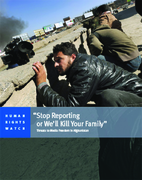
"Stop Reporting or We'll Kill Your Family": Threats to Media Freedom in Afghanistan
New York: Human Rights Watch (2015), 45 pp.
"Afghan journalists face threats from all sides: government officials exploiting weak legal protections to intimidate reporters and editors to compel them not to cover controversial topics; the Taliban and other insurgent groups using threats and violence to compel reporting they consider favorable;
...
Ein Fall für Kommissar Amanullah. Justizaufbau mit Fernsehkrimis: Westliche Entwicklungsfachleute rümpfen die Nase, doch in den Wohnzimmern in Kabul kommt die Botschaft an
welt-sichten, 26. Juni (2014)
"Seit einigen Jahren zeigt das afghanische Fernsehen zahlreiche Krimis und Dokumentationen von Gerichtsprozessen. Sie werden von Afghanen produziert, aber aus dem Ausland finanziert, unter anderem von der Europäischen Kommission, den Vereinten Nationen und der US-amerikanischen Entwicklungsagentur
...

On Media, Social Movements, and Uprisings: Lessons from Afghanistan, Its Neighbors, and Beyond
Signs: Journal of Women in Culture and Society, volume 39, issue 4 (2014), pp. 874-887
"From Tehran to Tahrir Square to Gezi Park-to mention only three key sites of protest made prominent in 2013-social media has been lauded as one of the key factors enabling popular uprisings and social movements. This has provided further hype for new or digital media, which were already being toute
...
Medien und Öffentlichkeit im Demokratisierungsprozess in Afghanistan: Die Transformation des Staatssenders Radio Television Afghanistan in einen öffentlichen Sender
Berlin; Münster: Lit (2013), 365 pp.
"Der Fokus ist auf die angestrebte Umwandlung des Staatssenders Radio Television Afghanistan in einen öffentlichen Sender gerichtet. In Experteninterviews mit Vertretern dreier relevanter Akteursgruppen und einer schriftlichen Rezipientenbefragung wurde unter anderem herausgefunden, dass RTA eine h
...

Strategic Communications in Afghanistan’s Transition Context
Swansea: Thesis Swansea University (2012), v, 64 pp.
"Following a decade of extensive international involvement and arduous fighting, Afghanistan is currently going through a significant Transition intended to enable Afghans to assume responsibility for their own security, development and governance. In addition to opportunities, this process provides
...

Designs, Devices and Development: Audience Research as Creative Resource in the Making of an Afghan Radio Drama
Participations: Journal of Audience & Reception Studies, volume 8, issue 1 (2011), pp. 132-153
"This essay analyses the role of audience research as a change agent in media development interventions in Afghanistan. It analyses how audience research in transnational contexts involves a complex set of intercultural negotiations and translations that contribute to the enduring relevance and sust
...
Media and Peacebuilding in Afghanistan
Washington, DC: United States Institute of Peace (USIP) (2010), 5 pp.
"Since the fall of the Taliban in 2001, the Afghan media sector has experienced dramatic growth in all areas: television, radio, print, internet, mobile phones. As such, the sector holds tremendous potential for making significant contributions to peacebuilding in the country. However, the media sec
...
Kabul, Teheran 1979ff: Filmlandschaften, Städte unter Stress und Migration
Berlin: b_books (2006), 395 pp.
"1979: Im Iran wird der Schah gestürzt, die islamische Republik entsteht; parallel eskaliert mit dem sowjetischen Einmarsch der Bürgerkrieg in Afghanistan. Bilder über Afghanistan waren seither zumeist Bilder der Zerstörung. Diesen Außenansichten setzt ›Kabul/ Teheran 1979 ff‹ Perspektiven
...
Print Islam: Media and Religious Revolution in Afghanistan
Anthropological Quarterly, volume 68, issue 3 (1995), pp. 171-184
"This article considers the role of three forms of print media in the development of radical Islamic political ideology and organization in Afghanistan. Through an examination of newspapers, pamphlets, and magazines, the article considers the way in which textual forms have supplemented ideological
...
