
Filter
55
Featured
Free Access
48
Key Guidance
1
Top Insights
3
Topics
Ecological Footprint & Sustainability of Digitalization, E-Waste & Recycling
43
Digitalization, Environment & Sustainable Development
13
Artificial Intelligence
8
Mobile Phones, Smartphones
6
Energy Supply, Electricity
4
Green Tech
3
Digitalization, Digital Transformation
3
Climate Change Communication, Climate Journalism
3
Computers
3
Sustainable Development Goals (SDG)
2
Big Digital Platforms, Big Tech Companies
2
Digital Entrepreneurs, Tech Entrepreneurs
2
Digital Labour, Digital Work
2
Ecological Footprint, Sustainability & Recycling of Media Products
2
Alternative Economy, Solidarity Economy, Social Economy Businesses, Fair Trade
2
Commodities, Raw Materials, Extractive Industries, Mining
2
Climate, Climate Change, Climate Change Adaptation
2
Sustainable Development
2
Buen Vivir / Good Living
2
Forestry, Deforestation, Forest Protection
1
Film Production
1
Data Protection: Law & Regulation
1
Surveillance, Surveillance Technologies, Spyware
1
Data
1
Digital Criticism
1
AI Criticism
1
AI & Democracy / Democratization
1
AI & Social Justice
1
ICT Economics
1
ICT Policies
1
ICT Regulation
1
Data Economics
1
Prices
1
Solar Energy, Renewable Energy
1
Small Enterprises, Micro Businesses, Small & Medium Enterprises (SME)
1
Labour, Labour Markets, Labour Laws, Working Conditions
1
Environmental Communication
1
Communication for Sustainable Development
1
Wastes & Recycling
1
Feminism & Communication
1
Colonial Legacies
1
Internet Governance, Internet Policies
1
Starting Media Outlets, Creation of Digital Businesses
1
Capitalism
1
Data Collection, Data Collection Methods
1
Informatics
1
Satellite Communication & Information Services
1
Telecommunication Infrastructure
1
Language
Document type
Countries / Regions
Authors & Publishers
Media focus
Publication Years
Journals
Output Type
Digitaler Kolonialismus: Wie Tech-Konzerne und Großmächte die Welt unter sich aufteilen
Top Insights
München: Beck (2025), 351 pp.
"Das Versprechen der Digitalen Revolution ist die Heilserzählung unsererZeit. Dieses Buch erzählt eine andere Geschichte: Die des digitalen Kolonialismus. Statt physisches Land einzunehmen, erobern die heutigen Kolonialherren den digitalen Raum. Statt nach Gold und Diamanten lassen sie unter mensc
...
Power Hungry: How AI Will Drive Energy Demand
Washington, DC: International Monetary Fund (IMF) (2025), 28 pp.
"The development and deployment of large language models like ChatGPT across the world requires expanding data centers that consume vast amounts of electricity. Using descriptive statistics and a multi-country computable general equilibrium model (IMF-ENV), we examine how AI-driven data center growt
...

Measuring what matters: How to assess AI’s environmental impact
Geneva: ITU (2025), viii, 21 pp.
This report synthesizes key findings from a diverse range of sources, including academic literature, corporate sustainability initiatives, and emerging environmental tracking tools. Collectively, these documents provide a thorough overview of current methodologies for evaluating the environmental im
...
Greening digital companies 2025: Monitoring emissions and climate commitments
Geneva; Amsterdam: ITU; World Benchmarking Alliance (2025), 90 pp.
"The fourth edition of the Greening Digital Companies: Monitoring Emissions and Climate Commitments report continues to track greenhouse gas (GHG) emissions, energy use and climate commitments of 200 digital companies. It provides a critical foundation for setting science-based targets (SBTs), measu
...

Nature Guidance for the Mobile Industry
London: GSMA (2025), 76 pp.
Atlas der KI: Die materielle Wahrheit hinter den neuen Datenimperien
Bonn: Bundeszentrale für politische Bildung (bpb), Sonderausg. (2025), 336 pp.
"Ist Künstliche Intelligenz nur eine weitere Entwicklung der Digitalisierung des Alltags, eine effiziente Software in einer „Cloud“? Die KI-Forscherin Kate Crawford entlarvt diese verharmlosende Vorstellung und beleuchtet die konkreten Auswirkungen der Technologie auf die physische Welt. Ihre R
...
Metastudie "Nachhaltigkeitseffekte der Digitalisierung": Eine Auswertung aktueller Studien zur (quantitativen) Bemessung der Umwelteffekte durch die Digitalisierung
Berlin: Technopolis; Institut für ökologische Wirtschaftsforschung (2024), ix, 96 pp.
"In dieser Studie werden auf Basis der Literaturanalyse eine Vielzahl an Anwendungsfällen mit besonders hohen Potenzialen für positive Umwelteffekte identifiziert. Insbesondere im Energiebereich gibt es eine Vielzahl von vergleichsweise gut erforschten Anwendungsfällen. Hierzu zählt beispielswei
...
AI and the Environment: International Standards for AI and the Environment
Geneva: ITU (2024), vi, 43 pp.
"International standards provide the guidelines and benchmarks needed to measure and improve the environmental impact of AI. Codifying established best practices, standards help mitigate risks such as high energy consumption and lifecycle emissions. They also provide measurement methodologies to ass
...
Smarter, greener extractivism: Digital infrastructures and the harnessing of new resources
Information, Communication & Society (2024), 20 pp.
"The past several years have seen increased scholarly attention to the concept of ‘extraction’ and ‘extractivism’ as critical frameworks in the humanities and social sciences. These are not only concepts and processes through which to understand material extraction but also expanded formatio
...
The Global E-Waste Monitor 2024
Top Insights
Bonn; Geneva: United Nations Institute for Training and Research (UNITAR); ITU (2024), 148 pp.
In 2022, a record 62 billion kg of e-waste was generated globally (equivalent to an average of 7.8 kg per capita per year); 22.3 per cent of this e-waste mass was documented as formally collected and recycled in an environmentally sound manner. In 2010, the world generated 34 billion kg of e-waste,
...
Measuring the Emissions & Energy Footprint of the ICT Sector: Implications for Climate Action
Washington, DC; Geneva: World Bank; ITU (2024), vi, 45 pp.
"The objective of this report is two-fold. First, the report breaks down the energy and emissions profile of the sector and assesses the 30 highest emitting countries for telecommunications while providing global estimates for other ICT sector segments. The report uses a key framework for categorizi
...
Cero emisiones netas en el sector móvil: América Latina. La acción por el clima en la región 2024
London: GSMA (2024), 26 pp.
Mobile Net Zero 2024: State of the Industry on Climate Action
London: GSMA (2024), 50 pp.
"Climate action continues to be a key priority for the mobile industry. In 2019, the mobile industry set a goal to reach net zero by 2050, becoming one of the first sectors in the world to set such an ambitious target. This report is the fourth annual assessment of the industry’s progress towards
...
Digital Entrepreneurship in Vietnam’s Green Tech Sector: An Analysis of Challenges and Implications
Berlin: Alexander von Humboldt Institute for Internet and Society (HIIG) (2023), 18 pp.

Preparing, Responding or Restoring? How Technology is Currently Used in Relation to Climate Change and Rainforest Protection in Indonesia
Berlin: Alexander von Humboldt Institute for Internet and Society (HIIG) (2023), 46 pp.
Digital Entrepreneurship for Climate in Mexico
Berlin: Alexander von Humboldt Institute for Internet and Society (HIIG) (2023), 17 pp.
"This report presents various economic, institutional, social and technological challenges that inhibit digital entrepreneurs in Mexico from developing solutions for climate action. As the startup market keeps growing in the country, special consideration must be given to sustainable and digital tec
...
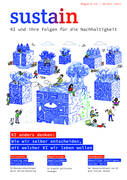
KI anders denken: Wie wir selber entscheiden, mit welcher KI wir leben wollen
Berlin: Algorithm Watch (2023), 34 pp.
"KI verschlingt viele Ressourcen und hat oft negative Folgen für unsere Gesellschaft und unsere Umwelt. Um KI nachhaltig und sinnvoll einzusetzen, sind wir alle gefragt: Wir sollten gemeinsam entscheiden, wozu wir KI brauchen – und wozu nicht. Ob in Zukunft KI-Systeme entwickelt werden, die uns a
...

Regional E-Waste Monitor for the Western Balkans
ITU; United Nations Environment Programme (UNEP); United Nations Institute for Training and Research (UNITAR); (2023), 177 pp.
"The amount of Electrical and Electronic Equipment (EEE) Placed on Market (POM) in the Western Balkans region increased from 0.16 Mt (9 kg/inhabitant) in 2010 to 0.21 Mt (13 kg/inhabitant) in 2021. Likewise, the regional e-waste generated nearly doubled from 0.09 Mt (5.3 kg/inhabitant) in 2010 to 0.
...
Towards the harmonization of data collection: A baseline study for e-waste in East Africa
Geneva: ITU (2023), x, 38 pp.
"This study enabled countries in East Africa to produce national statistics on e-waste generated that are harmonized and comparable across countries because the same methods and tools have been used in the assessment. In addition, households and businesses surveys were piloted in Kenya and Burundi t
...
