
Filter
13
Text search:
Stetka
Vaclav
Topics
Media Law & Regulation
6
Media Landscapes, Media Systems, Media Situation in General
5
Media Freedom, Press Freedom
4
Journalism Concepts & Cultures
4
Political Transition and Media
3
COVID-19 Communication
2
Democracy / Democratization and Media
2
News Consumption & Information Sources of Media Users
1
Trust in the Media, Credibility of Media
1
Editorial Independence: Influence of Media Owners
1
Community Media
1
Internet / Social Media Law & Regulation
1
Social Media in Political Communication
1
Democratization & Digital Media / Social Media
1
Health Disinformation & Misinformation
1
Media Concentration
1
Political Economy of Media
1
Media Law & Regulation: International Standards & Practices
1
European Union (EU)
1
Investigative Journalism
1
COVID-19 Pandemic: Effects on Journalism, Media & Communication
1
Diversity & Pluralism in Media / Communication
1
Media & Communication Policies
1
Media System Analyses & Typologies
1
Post-Socialist Media Systems & Landscapes
1
Television Law & Regulation
1
Polarization, Political Polarization
1
Election Campaigns: Social Media
1
Political Communication
1
Public Service Broadcasting
1
Ethnic Groups, Ethnic Minorities
1
Language
Document type
Countries / Regions
Authors & Publishers
Media focus
Publication Years
Methods applied
Journals
Output Type
Have people ‘had enough of experts’? The impact of populism and pandemic misinformation on institutional trust in comparative perspective
Information, Communication & Society (2024), 22 pp.
"Public trust in institutions is a key prerequisite for effective crisis management. However, the rise of populism and misinformation in recent years made it increasingly difficult to maintain institutional trust. Despite this recognition, we still lack a systematic understanding of how exposure to
...

A Media Repertoires Approach to Selective Exposure: News Consumption and Political Polarization in Eastern Europe
International Journal of Press/Politics, volume 28, issue 4 (2023), pp. 884-908
"In recent years, links between selective news exposure and political polarisation have attracted considerable attention among communication scholars. However, while the existence of selective exposure has been documented in both offline and online environments, the evidence of its extent and its im
...
Does a Crisis Change News Habits? A Comparative Study of the Effects of COVID-19 on News Media Use in 17 European Countries
Digital Journalism, volume 9, issue 9 (2021), pp. 1208-1238
"Exogenous shocks like the COVID-19 pandemic unleashes multiple fundamental questions about society beyond public health. Based on the classical concept of ‘need for orientation’ and the literature on the role of the media in times of crisis, we investigate to what extent the COVID-19 pandemic a
...
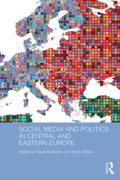
Social Media and Politics in Central and Eastern Europe
London; New York: Routledge (2018), xvi, 207 pp.
"This book surveys current developments in social media and politics in a range of Central and Eastern European countries, including Ukraine and Russia. It explores the process of adoption of social media by politicians, journalists and civic activists, examines the impact of the different social an
...
Media and Politics in New Democracies: Europe in a Comparative Perspective
Oxford et al.: Oxford University Press (2015), xiv, 322 pp.

Investigative Journalism in Central and Eastern Europe: Autonomy, Business Models, and Democratic Roles
International Journal of Press/Politics, volume 18, issue 4 (2013), pp. 413-435
"This article presents a comparative study of investigative journalism in nine countries in the Central and Eastern European region (Bulgaria, the Czech Republic, Estonia, Hungary, Latvia, Lithuania, Poland, Romania, and Slovakia). The purpose is descriptive and analytical. Descriptively, the articl
...
Media and Democratisation: What is Known About the Role of Mass Media in Transitions to Democracy
Oxford: Reuters Institute for the Study of Journalism (2013), 51 pp.
"The review starts by elucidating the potential role of the media as a democratising agent. We then explore the relationship between media reform and institutional change during democratisation periods, and move to review the literature on the contribution of media to institution building and due pe
...
Central and Eastern European Media in Comparative Perspective: Politics, Economy and Culture
Surrey; Burlington, Vt.: Ashgate (2012), xii, 199 pp.
The Czech Republic
Oxford; London: Department of Politics and International Relations University of Oxford; Department of Media and Communications London School of Economics and Political Science (2011), 27 pp.
Slovakia
Oxford; London: Department of Politics and International Relations University of Oxford; Department of Media and Communications London School of Economics and Political Science (2011), 23 pp.
Bulgaria
Oxford; London: Department of Politics and International Relations University of Oxford; Department of Media and Communications London School of Economics and Political Science (2011), 26 pp.
"This paper offers an overview of Bulgaria’s media landscape, putting it into its demographic, economic and political context. It gives a basic overview of the country’s media structure, including details on media markets; media regulation and regulatory authorities; and journalism culture." (Pa
...
Poland
Oxford; London: Department of Politics and International Relations University of Oxford; Department of Media and Communications London School of Economics and Political Science (2011), 30 pp.
Media Freedom and Pluralism: Media Policy Challenges in the Enlarged Europe
Budapest; New York: Central European University Press (2010), xxvi, 336 pp.
