
Filter
12
Text search:
Basyouni
Hamada
Featured
Free Access
4
Top Insights
3
Topics
Journalists: Professional Identity & Values
5
Editorial Independence
3
Journalists: Trust in Public Institutions
3
Journalism Ethics
2
Journalism Concepts & Cultures
2
Safety of Journalists, Safety Risks of Media Workers
2
Democracy / Democratization and Media
2
Islamic Cultures: Role of Media
2
Non-Western Communication Approaches
2
Audiences & Users
1
Harassment & Intimidation of Journalists
1
Media Freedom, Press Freedom
1
Public Diplomacy, Cultural Diplomacy
1
Collective Memory & Media, Media Representation of History
1
Western Approaches
1
Digital Journalism, Online Journalism
1
AI in Journalism & Media
1
Audio Archives, Visual Archives, Media Archives
1
Media Ownership
1
Climate Change Communication, Climate Journalism
1
Bribery & Corruption in Journalism
1
Transnational & Comparative Communication Research
1
Transnational Journalism Cooperation & News Exchange
1
Investigative Journalism
1
Journalism Education & Training
1
Journalists Dealing with Risks & Threats, Resilience & Wellbeing of Media Workers
1
Labour Market for Journalists
1
Corruption Reporting & Role of Media in Curbing Corruption
1
Working Conditions of Journalists & Media Personnel
1
Media Landscapes, Media Systems, Media Situation in General
1
Media Capture, Vested Political & Other Interests in the Media
1
National Identity & Media, Nationalism & Communication
1
Watchdog Role of the Media
1
Public Media, State Media
1
Language
Document type
Countries / Regions
Authors & Publishers
Media focus
Publication Years
Methods applied
Journals
Output Type
Determinants of watchdog journalism: A global empirical approach
International Communication Gazette, volume 87, issue 3 (2025), pp. 191-216
"This article introduces and examines a hierarchical model of influences that identifies the variables affecting the watchdog role of journalists at three levels: the societal (press freedom and democracy), the organizational (media ownership), and the individual (editorial autonomy and perceived in
...
Journalism under Duress: Worlds of Journalism Study Report (Wave 3: 2021–2025)
Top Insights
Munich: WJS Center Ludwig-Maximilian Universität (LMU) (2025), 371 pp.
"This report presents findings from the third wave of the Worlds of Journalism Study (WJS3), conducted between 2021 and 2025. In this iteration, we focused on journalists’ perceptions of risk and uncertainty in their profession and sought to identify key factors that shape how journalists navigate
...
Journalism Practices in Western and Muslim Majority Countries: Culture Matters
International Journal of Press/Politics (2024), ?? pp.
"In this article, we suggest that the ideological cultural forces explain the differences in journalism practices in Western and Muslim majority countries (MMC). It is argued that the norms, values, and the deep political culture of the West and MMC have been materialized leading to different types
...
The Palgrave Handbook of Cross-Border Journalism
Top Insights
Cham: Palgrave Macmillan (2024), xxv, 618 pp.
"This handbook critically analyzes cross-border news production and "transnational journalism cultures" in the evolving field of cross-border journalism. As the era of the internet hasfurther expanded the border-transcending production, dissemination and reception of news, and with transnational co-
...
Determinants of Journalists’ Trust in Public Institutions: A Macro and Micro Analysis Across 67 Countries
Journalism Practice (2023), 22 pp.
"Scholars have repeatedly expressed concern about the societal consequences of negative media coverage toward public institutions and political actors. Yet, there remains a lack of systemic understanding about the determinants of this cynical attitude. To examine this issue, we combine aggregate dat
...
Conceptualizing Journalists’ Safety around the Globe
Digital Journalism, volume 11, issue 7 (2023), pp. 1211-1229
"Killings, as the most extreme form of violence against journalists, receive considerable attention, but journalists experience a variety of threats from surveillance to gendered cyber targeting and hate speech, or even the intentional deprivation of their financial basis. This article provides a co
...
Determinants of Journalists' Autonomy and Safety: Evidence from the Worlds of Journalism Study
Journalism Practice, volume 16, issue 8 (2022), pp. 1715-1735
"The present study is an attempt to examine how objective structural political forces and subjective perception of political influences determine journalists' autonomy and safety. The evidence is based on responses representing journalists from 65 countries, which adds to the cross-cultural robustne
...
Off and Online Journalism and Corruption: International Comparative Analysis
London: Intech Open (2020), various pag.
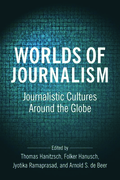
Worlds of Journalism: Journalistic Cultures Around the Globe
Top Insights
New York: Columbia University Press (2019), xi, 434 pp.
"How do journalists around the world view their own function and role in society? Based on a landmark study that has collected data from more than 25,000 journalists in 66 countries between 2012 and 2015, Worlds of Journalism examines the different ways journalists conceive of their responsibilities
...

Journalists in Egypt
Worlds of Journalism Study (2017), 5 pp.
"Egyptian journalists' most important role orientations are to be a detached observer, to report things as they are, to provide information people need to make political decisions, to let people express their views, to motivate people to participate in political activity, and to provide analysis for
...
Journalism and the Islamic Worldview: Journalistic Roles in Muslim-Majority Countries
Journalism Studies, volume 18, issue 5 (2017), pp. 555-575
"This paper looks at the extent to which journalistic culture in Muslim-majority countries is shaped by a distinctive Islamic worldview. We identified four principles of an Islamic perspective to journalism: truth and truth-telling (siddiq and haqq), pedagogy (tabligh), seeking the best for the publ
...
Télévision, mémoire et identités nationales
Paris: L'Harmattan; Institut National de l'Audiovisuel (INA) (2003), 198 pp.
"Dans quelle mesure la télévision a-t-elle contribué, et contribue-t-elle encore, à forger la mémoire nationale et l'identité nationale dans chaque pays ? Y a-t-il eu une politique volontariste en ce domaine ? Quels sont les effets du statut des chaînes de télévision, privées ou publiques
...
