
Filter
9
Text search:
Barbie
Zelizer
Featured
Free Access
0
Top Insights
1
Topics
War Reporting
2
Collective Memory & Media, Media Representation of History
2
Journalism Ethics
2
Journalism
2
Journalists Dealing with Risks & Threats, Resilience & Wellbeing of Media Workers
2
Photojournalism
2
Conflict & War Photography
2
Advocacy
1
Crisis Communication
1
Military: Communication Strategies & Practices
1
Citizen Journalism, Community Journalism
1
Holocaust
1
Terrorism
1
Iraq-Kuwait Gulf War (1990-1991)
1
Iraq War (2003)
1
Conflict Reporting, Armed Conflict Reporting
1
Information Warfare, Psychological Warfare
1
Violence in the Media
1
Culture and Communication, Culture and Media
1
Collective Memory: Violent Conflicts & Wars
1
Development Journalism & Media Representation of Development Issues
1
Digital Journalism, Online Journalism
1
Ethics in Media & Communication
1
Image Ethics, Ethics in Photojournalism
1
Foreign Countries: Reporting & Media Representation
1
Journalism Studies & Research
1
Journalists: Professional Identity & Values
1
News
1
News Values, News Selection Criteria
1
News Agencies
1
Stereotypes in Media & Communication
1
Documentary Photography
1
Agenda Setting
1
Democracy / Democratization and Media
1
Framing
1
Public Media, State Media
1
Comparative Approaches & Methods in Communication Research
1
Al-Jazeera
1
Non-Western Communication Approaches
1
Language
Document type
Countries / Regions
Authors & Publishers
Media focus
Publication Years
Methods applied
Journals
Output Type
Terms of Choice: Uncertainty, Journalism, and Crisis
Journal of Communication, volume 65 (2015), pp. 888-908
"This article considers whether thinking about journalism's present set of challenges is best served by the notion of “crisis.” It argues that adopting such a notion to explain a diverse set of technological, political, economic, social, occupational, moral, and legal circumstances misses an opp
...
Journalism and Memory
Basingstoke et al.: Palgrave Macmillan (2014), xv, 282 pp.
"Tracking the ways in which journalism and memory mutually support, undermine, repair and challenge each other, this fascinating collection brings together leading scholars in journalism and memory studies to investigate the complicated role that journalism plays in relation to the past." (Publisher
...
Ethics of Media
Houndmills, Basingstoke, Hampshire; New York: Palgrave Macmillan (2013), xi, 298 pp.
"Ethics of Media reopens the question of media ethics. Taking an exploratory rather than prescriptive approach, an esteemed collection of contributors tackle the diverse areas of moral questioning at work within various broadcasting practices, accommodating the plurality and complexity of present-da
...
Picturing Atrocity: Photography in Crisis
London: Reaktion Books (2012), 319 pp.
"From the massacre of the Sioux Indians at Wounded Knee to the torture of prisoners at Abu Ghraib, from famine in China to apartheid in South Africa, Picturing Atrocity examines a broad spectrum of photographs. Each of the essays focuses specifically on an iconic image, offering a distinct approach
...
On Media Memory: Collective Memory in a New Media Age
Basingstoke, Hampshire; New York: Palgrave Macmillan (2011), xvi, 300 pp.
"This volume offers a comprehensive discussion of Media Memory and brings Media and Mediation to the forefront of Collective Memory research. The essays explore a diversity of media technologies (television, radio, film and new media), genres (news, fiction, documentaries) and contexts (US, UK, Spai
...
The Handbook of Journalism Studies
Top Insights
New York: Routledge (2009), xx, 446 pp.
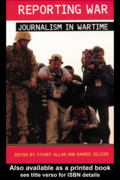
Reporting War: Journalism in Wartime
Abingdon: Routledge (2004), 374 pp.
"Reporting War explores the social responsibilities of the journalist during times of military conflict. News media treatments of international crises, especially the one underway in Iraq, are increasingly becoming the subject of public controversy, and discussion is urgently needed. Each of this bo
...
Photography, Journalism and Trauma
In: Journalism After September 11
Barbie Zelizer, Stuart Allan (eds.)
London; New York: Routledge (2002), 21 pp.
"Not long after the September 11 attacks on the World Trade Center and the Pentagon, a memo from the American Press Institute went out to US news editors and reporters, advising them on the “correct” way to utilize photographs in crisis reporting. In part the directive said, “our backs are to
...
Reporting under fire: The physical safety and emotional welfare of journalists
In: Journalism After September 11
Barbie Zelizer, Stuart Allan (eds.)
London; New York: Routledge (2002), 16 pp.
"The September 11 attack on the twin towers and the subsequent anthrax incidents have created a growing debate and subsequent concern with what is now termed urban war corresponding. A realization is emerging that those correspondents who covered September 11 (who may not be war correspondents) may
...
