
Filter
43
Featured
Free Access
23
Top Insights
4
Topics
Digital Media Censorship, Control & Filtering, Internet & Social Media Censorship
8
Social Media
7
ICTs and Development
7
Digital Activism, Cyber Advocacy
6
Civil Society
6
Democratization & Digital Media / Social Media
4
Economic Development: Role of ICTs & Media
4
Hate Speech, Hate Speech in Social Media
3
E-Governance, E-Democracy
3
Internet / Social Media Law & Regulation
3
Blogging, Blogs
3
Educational Use of ICTs / Internet
3
ICT Development Assistance
3
Disinformation, Misinformation, Fake News
3
Democracy / Democratization and Media
3
Access to Media & Information
2
Communication Rights
2
Surveillance, Surveillance Technologies, Spyware
2
Millenium Development Goals (MDG)
2
Big Digital Platforms, Big Tech Companies
2
Digital Platform & Intermediaries Regulation
2
Internet
2
Internet and Politics
2
Internet / ICTs and Social Change
2
Electronic Commerce
2
Digital Political Communication
2
Political Blogging
2
Filter Bubbles & Echo Chambers
2
Ethnic / Minority Online Communities & Websites
2
Countering Hate Speech, Disinformation & Propaganda
2
Media Monopolies & Oligopolies
2
Transnational Broadcasting, International Broadcasting
2
Mobile Phones, Smartphones
2
Access to Information Laws, Right to Information Regulation
1
Civic Engagement, Citizen Participation, Civil Society & Digital Communication
1
Civic Engagement, Citizen Participation, Civil Society & Media
1
Digital & Social Media Use, Internet Use
1
Media & ICT Use in Authoritarian Regimes / Dictatorships
1
Media Use: Lower Classes & Poor Population
1
Mobile Phone Use
1
Authoritarian Regimes, Dictatorships
1
Media Literacy: Children
1
Intellectual Property
1
Copyright Law
1
Censorship Circumvention Tools & Strategies
1
Internet Censorship Circumvention Tools & Strategies
1
Government Communication Strategies
1
Alternative Communication & Media
1
Citizen Journalism, Community Journalism
1
Conflicts & Wars: Roles of Digital Technologies & Conflict Narratives in Social Media
1
Extremist & Terrorist Digital / Social Media Presence
1
Information Warfare, Psychological Warfare
1
Anthropology of Media & Communication
1
Digital Anthropology, Cyberanthropology
1
ICT / Internet Projects (Development Aid)
1
Social Change & Media / Communication
1
Algorithms & Big Data
1
Digital Ethics, AI Ethics, Social Media Ethics, Data & Information Ethics
1
Digital Healthcare & Information, Mobile Health, E-Health, Telemedicine
1
Digital Inclusion
1
Google
1
Media Assistance: Digital Journalism & Social Media
1
Political Websites & Online Communities
1
Open Access Publishing
1
Search Engines
1
YouTube
1
Digital Economies, Digital Societies
1
Digitalization, Digital Transformation
1
Digitalization, Environment & Sustainable Development
1
ICTs and Poverty Reduction
1
ICT Effects & Impact
1
Diaspora Media
1
Small Enterprises, Micro Businesses, Small & Medium Enterprises (SME)
1
Labour, Labour Markets, Labour Laws, Working Conditions
1
Social Capital
1
Literacy, Literacy Campaigns, Postliteracy, Alphabetisation Policies
1
Gaming, Video Games
1
International Communication
1
Globalisation of Media
1
International Radio Broadcasting, Foreign Radio Broadcasting
1
Satellite Television
1
Transnational Television, International Television
1
Transnational / International Civil Society Communication Networks & Strategies
1
Media Literacy: Youth
1
Internet Governance, Internet Policies
1
Music
1
Habermas, Jürgen
1
Putnam, Robert
1
Civic Engagement, Citizen & Community Participation
1
Influence of Media on Politics
1
Political Communication
1
Political Parties: Communication Strategies
1
Propaganda
1
Public Spheres
1
Youth Radio Programmes, Youth Radio Stations, School Radios
1
Media Effects
1
Islam and Communication
1
Islamist Communications & Media
1
Networks & Networking
1
Inequalities
1
Robots, Robotics
1
Language
Document type
Countries / Regions
Authors & Publishers
Media focus
Publication Years
Methods applied
Journals
Output Type

Big Tech Must Go! Digital Giants are Destroying our Democracies and Economies. We will stop them
Top Insights
Frankfurt; Chicago: Campus Verlag; University of Chicago Press (2025), 285 pp.
"Digital monopolies shape ever larger parts of our lives. The platforms are increasingly controlling the public formation of political opinion and at the same time abolishing our free market economy. Digital expert Martin Andree shows in detail how far the hostile takeover of our society by the tech
...
Big Tech muss weg! Die Digitalkonzerne zerstören Demokratie und Wirtschaft. Wir werden sie stoppen
Frankfurt; New York: Campus Verlag (2023), 287 pp.
"Digitale Monopole bringen immer größere Teile unserer Lebenswelt unter ihre Kontrolle. Die Plattformen dominieren zunehmend die politische Meinungsbildung und schaffen zugleich unsere freie Marktwirtschaft ab. Man fragt sich: Ist das überhaupt noch legal? Warum sollten wir uns das noch länger g
...
Menschliche Gesellschaft 4.0: (christliche) Beiträge zum digitalen Wandel
Freiburg: Herder (2020), 141 pp.
"Grundlage für die im Buch enthaltenen Aufsätze ist eine Fachtagung, die im Juli 2019 vom Caritasverband für die Diözese Osnabrück e. V. und dem Ludwig-Windhorst-Haus, der Katholischen Sozialen Akademie des Bistums Osnabrück, initiiert wurde. Dabei sollte das Zentrum der Tagung (und damit des
...

Assessing Digital Threats to Democracy, and Workable Solutions: A Review of the Recent Literature
International Journal of Communication, volume 14 (2020), pp. 2589-2610
"Concerns surrounding the threats that digital platforms pose to the functioning of Western liberal democracies have grown since the 2016 U.S. election. Yet despite a preponderance of academic work in this area, the precise nature of these threats, empirical solutions for their redress, and their re
...
Misinformation, Disinformation, Malinformation: Causes, Trends, and Their Influence on Democracy
Sarajevo: Heinrich Böll Stiftung (2020), 38 pp.
"The aim of this paper is to investigate the phenomena of misinformation, disinformation, and malinformation, as well as their impact on the political sphere. In addition, the paper attempts to explain the harmful influence of misinformation, disinformation, and malinformation on public debates, dem
...
Digital Threats to Democracy
The Workshop; Law Foundation; Luminate Foundation (2019), 244 pp.
"At the heart of the challenges to democracy posed by digital media are three core problems: 1. Platform monopolies: two or three corporations control not only our means of communication, but also the content which is distributed, both of which are core aspects of our democracy. Whilst the market po
...
Angriff der Algorithmen: Wie sie Wahlen manipulieren, Berufschancen zerstören und unsere Gesundheit gefährden
Bonn: Bundeszentrale für politische Bildung (bpb), Sonderausg. (2018), 345 pp.

Action Steps: A Decade of Civil Society Advocacy in the Information Society. A Baseline Review of the Global Information Society Watch Country Reports (2007-2017)
Association for Progressive Communications (APC); International Development Research Centre (IDRC) (2018), 80 pp.
"This review looks back over 11 years of civil society advocacy in the information society – a total of 510 country reports published in Global Information Society Watch (GISWatch) from 2007 to 2017. It covers a period of important global shifts, from the exponential growth and influence of social
...
Can the Internet Strengthen Democracy?
Cambridge, UK; Malden, MA: Polity (2017), viii, 142 pp.
"In this short book, internationally renowned scholar of political communication, Stephen Coleman, argues that the best way to strengthen democracy is to re-invent it for the twenty-first century. Governments and global institutions have failed to seize the opportunity to democratise their ways of o
...
The Internet and Democracy
In: The Oxford Handbook of Internet Studies
William H. Dutton (ed.)
Oxford: Oxford University Press (2014), pp. 421-437
"To conclude, it is helpful to consider the work reviewed here under the headings provided by Beetham (2002)'s definition of democracy: popular control, and political equality. With respect to popular control, it seems to be the case that the Internet facilitates a "way in" for citizens in a democra
...

Spider Stories 2012
Kista; Stockholm: Spider – The Swedish Program for ICT in Developing Regions; Stockholm University (2013), 99 pp.
"In Spider Stories 2012 you will get an overview of results from Spider projects initiated in 2011-2012 in collaboration with project partners in Cambodia, Kenya, Rwanda, Tanzania and Uganda. In partnership with local organizations, we have supported innovative projects in democracy, education, and
...

Tunisia: From Revolutions to Institutions
Washington, DC: infoDev Information for Development Program (2012), 121 pp.
"The study “Tunisia: from revolutions to institutions” stresses how technology-oriented small and medium-sized companies (SMEs) can generate economic expansion and job growth, including in the economically-isolated interior provinces. Tunisian ICT companies are likely to find an attractive marke
...
Internet und Demokratie
Wien: Mandelbaum (2012), 124 pp.
The Democratic Impact of ICT in Africa
Africa Spectrum, volume 47, issue 1 (2012), pp. 73-88
"This paper takes a critical look at the view that the Internet can serve as a laboratory of political experimentation for reconfiguring the repertories of political actions. The overall discourses on information and communications technology (ICT) are too often focused on technology and infrastruct
...
Syria’s Cyber Wars
Open Society Foundation (2012), 25 pp.
"The government in Syria came to differentiate between political dissent and the civil society activism in which the new generation plays a vital role thanks to the use of social media. Unable to control the burst of online activity, Damascus was forced to focus on monitoring key dissenters and huma
...
Revolution 2.0? Die Bedeutung digitaler Medien für politische Mobilisierung und Protest
In: Globale Trends 2013: Frieden, Entwicklung, Umwelt
Stiftung Entwicklung und Frieden (ed.)
Frankfurt am Main: Fischer Taschenbuch Verlag (2012), pp. 157-172
The Tunisian diaspora: Between “digital riots” and web activism
Paris: Fondation Maison des Sciences de l’Homme (2012), 21 pp.
"This article deals with the increasing connections among the Tunisian diaspora and its homeland provided by a widespread use of the social Web. The main aim is to evaluate to what extent the Tunisian diaspora has contributed to a wider diffusion of cyberactivism concerning legitimate claims for dem
...
Forecasting and Observing: A Cross-Methodological Consideration of Internet and Mobile Phone Diffusion in the Egyptian Revolt
International Communication Gazette, volume 74, issue 8 (2012), pp. 750-768
"This study examines the Egyptian revolt of January/February 2011 from two discrete perspectives. The first perspective is a contextual marker that takes into account long-term and forecast trends in democracy from 1952 through 2011. The second perspective reports the opinions and viewpoints of Egyp
...

After Egypt: The Limits and Promise of Online Challenges to the Authoritarian Arab State
Perspectives on Politics, volume 9, issue 2 (2011), pp. 301-310
"The uprisings which swept across the Arab world beginning in December 2010 pose a serious challenge to many of the core findings of the political science literature focused on the durability of the authoritarian Middle Eastern state. The impact of social media on contentious politics represents one
...
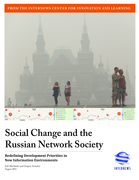
Social Change and the Russian Network Society: Redefining Development Priorities in New Information Environments
Arcata, Calif.; Washington, DC: Internews (2011), 27 pp.
"This paper explores the use of new information technologies in Russia to examine the next generation of media development and to ask how the ability of the “network society” – and the new forms of collective action it allows to contribute to social change can be supported. Building on the ide
...
