Filter
12
Featured
Free Access
10
Top Insights
1
Topics
Defamation Law & Regulation
4
Press Freedom & Communication Rights Violations
3
Freedom of Expression
2
Harassment & Intimidation of Journalists
2
Media Freedom, Press Freedom
2
Strategic Lawsuits Against Public Participation (SLAPP)
2
Government Advertising, State Advertising
1
Local Advertising & Local Advertising Markets
1
Data Protection: Law & Regulation
1
Indirect Censorship, Soft Censorship
1
Self-Censorship
1
Surveillance, Surveillance Technologies, Spyware
1
Disinformation & Misinformation Law & Regulation
1
Female Journalists & Media Workers
1
Gender-Based Online Harassment & Sexual Threats
1
Media Law & Regulation: International Standards & Practices
1
Safety of Journalists, Safety Risks of Media Workers
1
COVID-19 Pandemic: Effects on Journalism, Media & Communication
1
Public Funding & Support Policies for Media
1
Law Enforcement, Litigations, Legal Practice, Case Law, Jurisdiction
1
Language
Document type
Countries / Regions
Authors & Publishers
Media focus
Publication Years
Methods applied
Journals
Output Type
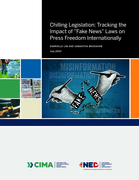
Chilling Legislation: Tracking the Impact of “Fake News” Laws on Press Freedom Internationally
Washington, DC: Center for International Media Assistance (CIMA) (2023), 20 pp.
"The proliferation of misinformation, disinformation, and mal-information (MDM) poses serious challenges to democracy, public safety, and national security. Conversely, these very worries could be used as a front for unjustified ends. There is a global trend toward legislation that may risk infringi
...
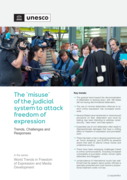
The "misuse" of the judicial system to attack freedom of expression: Trends, challenges and responses
Paris: UNESCO (2022), 16 pp.
"The gradual trend toward the decriminalization of defamation is slowing down, with 160 states still not having decriminalized defamation. The use of criminal defamation offences to restrict online expression has increased worldwide. Several States have harshened or reintroduced provisions on libel,
...
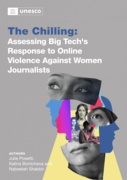
The Chilling: Assessing Big Tech's Response to Online Violence Against Women Journalists
UNESCO (2021), 35 pp.
"This is an extracted chapter of a wider UNESCO-commissioned global study on online violence against women journalists produced by the Inter-national Center for Journalists (ICFJ). The full-length study will published in 2022. The chapter identifies the role of big tech companies and especially soci
...
Burundi: Entrenched Repression of Civil Society, Media
Human Rights Watch (2021)
"Burundi’s scrutiny and control of media and nongovernmental organizations, and the conviction after deeply flawed proceedings of 12 journalists and activists in exile have a continued chilling effect on their work, Human Rights Watch said today. Almost one year after President Évariste Ndayishim
...
The Concept of Chilling Effect: Its Untapped Potential to Better Protect Democracy, the Rule of Law, and Fundamental Rights in the EU
Open Society Foundations (2021), 33 pp.
"From a legal point of view, chilling effect may be defined as the negative effect any state action has on natural and/or legal persons, and which results in pre-emptively dissuading them from exercising their rights or fulfilling their professional obligations, for fear of being subject to formal s
...
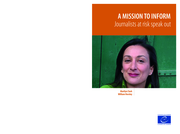
A Mission to Inform: Journalists at Risk Speak Out
Strasbourg: Concil of Europe (2020), 149 pp.
"The present study brings together a unique collection of open testimonies from 20 journalists working in different member states of the Council of Europe. Each of these journalists spoke about the risks and pressures they perceived and experienced in exercising their profession, as well as their st
...
Freedom of Expression in Times of Covid-19: Chilling Effect in Hungary and Serbia
Journal of Liberty and International Affairs, volume 6, issue 2 (2020), pp. 14-29
"New technologies have opened several risks to safety of journalists. More importantly, in the state of emergency caused by the Covid-19 outbreak, journalists and media actors have shifted their activities online more than ever, which also made them more prone to digital threats and attacks. In some
...
Big Brother is Watching: Surveillance Regulation and its Effects on Journalistic Practices in Zimbabwe
African Journalism Studies, volume 40, issue 3 (2019), pp. 26-41
"In many African countries, including Zimbabwe, journalists have been subjected to various policy regulations that have widely been criticised for making the practice of journalism difficult. Part of the reason has been the advent of competitive politics that have left the ruling regimes scrambling
...
Freedom of Expression and Defamation
Onur Andreotti (ed.)
Strasbourg: Council of Europe (2016), 77 pp.
"This study examines the voluminous case law of the European Court of Human Rights (“The Court”) relating to freedom of expression and defamation. It starts by clarifying the concept of defamation and positioning it in relation to freedom of expression and public debate. It explains how defamati
...
Libel Tourism: Silencing the Press Through Transnational Legal Threats
Washington, DC: Center for International Media Assistance (CIMA) (2010), 41 pp.
"This report by Drew Sullivan, a journalist, editor, and media development specialist, explains how lawsuits can force media organizations to censor themselves or limit the distribution of their news content, restricting freedom of expression and thus threatening one of the foundations of democracy.
...
The Price of Silence: The Growing Threat of Soft Censorship in Latin America
Top Insights
Buenos Aires; New York: Asociación por los Derechos Civiles (ADC); Open Society Institute (2008), 179 pp.
"The Price of Silence exposes a growing trend across several countries in Latin America: behind-the-scenes government interference with media freedom and editorial independence. This “soft censorship” and its pervasive chilling effects have not received the attention they deserve. By conducting
...
Ending the Chilling Effect: Working to Repeal Criminal Libel and Insult Laws. Proceedings of the Roundtable “What Can be Done to Decriminalize Libel and Repeal Insult Laws”, Paris, 24-25 November 2003
Vienna: OSCE Representative on Freedom of the Media (2004), 103 pp.