
Filter
31
Featured
Free Access
27
Top Insights
1
Topics
People with Disabilities: Tailored ICT & Media Products
9
People with Disabilities: Reporting & Media Representation
4
Women with Disabilities & Media
3
Deaf & Hard of Hearing People
3
Mobile Phone Use: Minorities
2
Mobile Phone Use: People with Disabilities
2
People with Disabilities & Communication / Media
2
Access to Media & Information: Disadvantaged Groups and Minorities
1
Access to Media & Information: Indigenous Populations
1
Access to Public Information, Freedom of Information, Right to Information
1
Digital Divide, Digital Inequalities
1
Advocacy & Empowerment: Disadvantaged & Vulnerable Groups
1
People with Disabilities: Advocacy & Empowerment
1
Digital & Social Media Use, Internet Use
1
Digital & Social Media Use: Youth
1
Health Information Access & Use
1
Media Use, Media Consumption
1
Mobile Phone Use: Women
1
Mobile Phone Use: Youth
1
Trust in the Media, Credibility of Media
1
Children's Rights
1
Celebrities, Idols, Stars
1
Cybersecurity, Digital Safety, Privacy, Right to Privacy
1
Digital Inclusion
1
Digital & Information Literacy
1
Facebook
1
Educational Use of ICTs / Internet
1
Online Learning, E-Learning
1
Disinformation, Misinformation, Fake News
1
Open Educational Resources (OER)
1
Soap Operas & Telenovelas
1
Cancer Prevention, Cancer Communication
1
Information Ecosystems
1
Digital Literacy: Youth
1
Media Literacy: Producing Participatory Videos
1
Media Literacy: Radio
1
Media Literacy: Youth
1
Media Landscapes, Media Systems, Media Situation in General
1
Digital Media Use: Migrants & Diasporas
1
Blind & Visually Impaired People
1
Internet & ICTs in Rural Areas
1
Robots, Robotics
1
Open Source Software
1
Youth, Adolescents
1
Language
Document type
Countries / Regions
Authors & Publishers
Media focus
Publication Years
Methods applied
Journals
Output Type
Scorecard: Accessibility of Government Websites to Persons with Disabilities
Nairobi: Kenya ICT Action Network (KICTANet) (2023), 32 pp.
Revised Guidelines on the Inclusion of Learners with Disabilities in Open and Distance Learning (ODL)
Paris: UNESCO (2023), 39 pp.
"These Guidelines recognize the value of ODL as one of the most sustainable methods for overcoming the educational barriers faced by persons with disabilities. They also highlight and illustrate the facets of an ODL- facilitated education system using open educational resources (OER), free and open-
...
Technology in Disability-Inclusive Education
Paris: UNESCO; Global Education Monitoring Report Team (2023), 43 pp.
"This report outlines the actions driven towards inclusive education, including skill-based training, online learning and classroom settings, and low-tech to high-tech assistive technology (AT). Skill-based training, one of the most important skills for Persons with Disabilities (PWDs), covers life
...
Information Ecosystem Assessment: Jordan
Internews (2023), 63 pp.
"This report provides an assessment of the media landscape in Jordan from the perspective of its audiences. Based on audience research, it examines the key issues emerging around media usage, trust, content, and literacy. It is based on data that was collected throughout June and July 2023; the medi
...
Transforming Quality and Reliable Access to Information into Reality for Youth with Disabilities in Namibia
Windhoek: Namibia Media Trust (2022), 19 pp.

ICT accessibility overview: Assessment for the Africa region
Geneva: ITU (2022), vi, 50 pp.
"The aim of this report is to support ITU members and stakeholders from the Africa region in their efforts to achieve inclusive digital communities by assessing ICT accessibility as a key driver in achieving digital inclusion within the digital transformation process. The report provides an overview
...
Evaluación de los sistemas de acceso a la televisión para personas con discapacidad auditiva. Resumen ejecutivo
Bogotá: Comisión de Regulación de Comunicaciones (CRCOM) (2022), 43 pp.
"Este documento está dividido en seis secciones, entre las cuales está la presente introducción, que incluye la matriz de consistencia que permitió establecer los objetivos orientadores del estudio, y continúa con la sección de análisis de los estándares e implementación de sistemas de acce
...
Handbook of Digital Inequality
Cheltenham; Northampton, MA: Edward Elgar Publishing (2022), xii, 386 pp.
"International contributors assess a variety of key contexts that impact access to digital technologies, including contextual variations related to geography and infrastructure, as well as individual differences related to age, income, health and disability status. Chapters explore how variations em
...
Hör- und sehbeeinträchtigte Menschen: Nutzungsmotive und Erwartungen an die Medien. Ergebnisse einer Mehr-Methoden-Studie in Nordrhein-Westfalen
Media Perspektiven, issue 2 (2021), pp. 109-116
"Mittels einer Onlineumfrage und Publikumsgesprächen wurde bei seh- und hörbeeinträchtigten Personen ermittelt, welche Medienangebote sie nutzen und wie sie diese beurteilen. Die barrierefreien Angebote im öffentlich-rechtlichen Rundfunk werden grundsätzlich sehr geschätzt. Es wird aber auch V
...
Access to Telecommunication/ICT Services by Persons with Disabilities and Other Persons with Specific Needs
Geneva: ITU (2021), xiii, 57 pp.
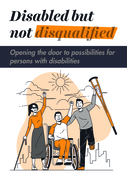
Disabled But Not Disqualified: Opening the Door to Possibilities for Persons with Disabilities
Kampala: Pollicy; NUDIPU (2021), 17 pp.
Assessing the Barriers to Accessing ICT by People with Disability in Kenya
Kampala: CIPESA (2021), 24 pp.
Assessing the Barriers to Accessing ICT by People with Disability in Uganda
Kampala: CIPESA (2021), 16 pp.
Assessing the Barriers to Accessing ICT by People with Disability in Tanzania
Kampala: CIPESA (2021), 19 pp.

The Mobile Disability Gap Report 2020
London: GSMA (2020), 31 pp.
Access Denied: How Telecom Operators in Africa Are Failing Persons with Disabilities
Kampala: CIPESA (2020), 22 pp.
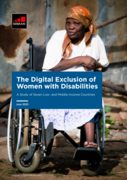
The Digital Exclusion of Women with Disabilities: A Study of Seven Low- and Middle-Income Countries
London: GSMA (2020), 43 pp.
"1. Women with disabilities have among the lowest rates of mobile and smartphone ownership. In most countries, ownership gaps are widest between men without disabilities and women with disabilities. Even in countries where the mobile gender gap is small or nonexistent, there is still a disability ga
...
Are We Leaving Anyone Behind? Access & Usage of ICTs and Assistive Technologies by Persons with Disabilities in Uganda
Deutsche Gesellschaft für Internationale Zusammenarbeit (GIZ) (2020), 23 pp.
