
Filter
133
Featured
Free Access
99
Key Guidance
2
Top Insights
6
Topics
Facebook
36
Digital Activism, Cyber Advocacy
19
Disinformation, Misinformation, Fake News
17
Election Campaigns: Social Media
14
Social Media in Political Communication
12
COVID-19 Communication
10
Digital & Social Media Use, Internet Use
8
Hate Speech, Hate Speech in Social Media
7
YouTube
7
Countering Hate Speech, Disinformation & Propaganda
7
Extremist & Terrorist Digital / Social Media Presence
6
Social Media
6
Instagram
6
Government Communication Strategies
5
Conflicts & Wars: Roles of Digital Technologies & Conflict Narratives in Social Media
5
Digital Research Methods
5
Digital Political Communication
5
Content Moderation & Regulation: Social Media
5
Democratization & Digital Media / Social Media
5
Protests, Protest Movements, Protest Reporting & Media Representation
5
Civic Engagement, Citizen Participation, Civil Society & Digital Communication
4
Civic Engagement, Citizen Participation, Civil Society & Media
4
Audience Feedback, Interaction & Participation
4
Algorithms & Big Data
4
Google
4
Digital Journalism, Online Journalism
4
Blogging, Blogs
4
TikTok
4
Conspiracy Narratives, Conspiracy Theories
4
Health Disinformation & Misinformation
4
Catholic Digital Media Presence & Online Communities
3
Citizen Journalism, Community Journalism
3
Conflict-Sensitive & Peace Journalism
3
Digital Communication, Digital Media
3
Big Digital Platforms, Big Tech Companies
3
Political Blogging
3
Bots
3
Racism in Social Media & Digital Communication
3
Fact-Checking & Verification of Sources
3
Feminism & Communication
3
Gender Representation & Stereotypes in the Media
3
Political Communication
3
Political Transition and Media
3
Network Analysis
3
Social Movements: Communication Strategies & Practices
2
Authoritarian Regimes: Government Communication Strategies
2
Campaigning: Planning & Implementation
2
Christian Social Media Presence & Online Communities
2
Cybersecurity, Digital Safety, Privacy, Right to Privacy
2
Digital Media Censorship, Control & Filtering, Internet & Social Media Censorship
2
Surveillance, Surveillance Technologies, Spyware
2
Social Media Marketing & Digital Public Relations
2
Community Radios
2
Islamic State (Political-Religious Extremist Organization)
2
Conflict-Sensitive Digital Technology Use & Social Media in Prevention & Transformation
2
Information Warfare, Psychological Warfare
2
War Propaganda, Propaganda in Conflicts
2
Content Analysis (Research Method)
2
Digital Ethics, AI Ethics, Social Media Ethics, Data & Information Ethics
2
Religious Digital & Social Media Practices
2
Digital Media Research, Digital Communication Research
2
Online Dating
2
LinkedIn
2
Social / Digital Media and ICTs in Disaster & Humanitarian Crisis Management & Prevention
2
Telegram
2
LGBT & Communication / Media
2
Infectious Diseases' Outbreak Communication
2
Sports Reporting
2
Gender-Based Online Harassment & Sexual Threats
2
Health Campaigns: Experiences
2
Foreign Countries: Reporting & Media Representation
2
Islam: Media Representation & Reporting
2
Migration & Refugees Reporting & (Social) Media Representation
2
Polarization, Political Polarization
2
Propaganda
2
Public Opinion
2
Taliban
2
Islamophobia
2
Muslim Digital Media & Online Communities
2
Antisemitism
2
User-Generated Contents
2
Access to Internet & Digital Communications
1
Advertising
1
Celebrity Humanitarianism
1
Gender Advocacy & Empowerment, Gender Mainstreaming
1
Disinformation Consumption & Perception
1
Media Diaries
1
News Consumption & Information Sources of Media Users
1
Television Consumption, Televison Use, Television Audiences
1
Authoritarian Regimes, Dictatorships
1
Authoritarian Discourse
1
Election Campaigns
1
Catholic Church and Communication
1
Catholic Media
1
Francis (Pope)
1
Popes & Papacy: Media Representation & Communication Strategies
1
Synods
1
Digital Theologies
1
Freedom of Expression
1
Freedom of Expression Online, Internet Freedom
1
Censorship Circumvention Tools & Strategies
1
Harassment & Intimidation of Journalists
1
Violence Against Journalists & Media Personnel
1
Development Organizations: Communication Strategies & Media Representation
1
Foreign Government Communication Interventions
1
Government Propaganda
1
Public Diplomacy, Cultural Diplomacy
1
International Organizations: Communication Strategies & Practices
1
Nonprofit Public Relations: Design & Implementation
1
Alternative Communication & Media
1
Community Newspapers, Community Press
1
Street Papers
1
Groups, Group Communication, Group Development
1
Participatory Communication
1
Storytelling
1
Conflicts, Conflict Prevention & Management, Mediation, Peacebuilding
1
Conflicts: Victims' Perspectives
1
Holocaust
1
Civil Wars
1
Russia-Ukraine War <2014-
1
Conflict Prevention, Mediation & Reconciliation: Role of Media
1
Conflict Reporting, Armed Conflict Reporting
1
Conflict-Sensitive / Peace Communication
1
Extremism & Terrorism Reporting
1
Extremist & Terrorist Communication Strategies and Media
1
Foreign Conflict Reporting, International War Reporting
1
Hate Speech Legislation & Regulation
1
Internet / ICTs and Conflicts
1
Transitional Justice Reporting
1
Trauma: Media Representation & Reporting
1
Wars & Political Violence in Arts & Literature
1
Computational Content Analysis
1
Countering Misinformation & Rumours
1
Discourse & Discourse Analysis
1
Media Monitoring, Media Observatories
1
Digital Anthropology, Cyberanthropology
1
Religious Functions & Messages of Digital Media
1
Collective Memory & Media, Media Representation of History
1
United States Agency for International Development (USAID)
1
Cyberbullying, Cyberharassment
1
Digital Media, Internet & Religion
1
Cyberfaith / Virtual Spirituality
1
Digital & Information Literacy
1
E-Governance, E-Democracy
1
Internet / ICTs and Social Change
1
Digital Financial Services, Mobile Banking, Mobile Payphone Business
1
Online News
1
Influencers (Social Media)
1
Weibo (Microblogging Website, China)
1
WhatsApp
1
Wikipedia
1
Wikis
1
Ethnic / Minority Online Communities & Websites
1
Educational Use of ICTs / Internet
1
Gender and ICTs / Internet
1
Virtual Reality
1
Minorities & Disadvantaged Groups: Reporting & Media Representation
1
Romani People
1
Xenophobia
1
Disaster & Humanitarian Crisis Communication
1
Disaster & Humanitarian Crisis Information Management
1
Disaster Risk & Preparedness Communication, Disaster Prevention Communication
1
Early Warning: Disasters
1
Earthquakes, Floods, Tsunamis, Natural Disasters
1
Election Campaigns: Disinformation & Misinformation
1
Foreign Disinformation, Foreign Information Manipulation Operations, Foreign Propaganda
1
Identifying & Researching Disinformation
1
Digital Economies & Markets
1
Microcredits, Microfinance, Small-Scale Loans
1
Massive Open Online Courses (MOOC)
1
Political Parody and Satire
1
Soap Operas & Telenovelas
1
Communication for Sustainable Development
1
Environmental Communication in Social Media, User-Generated Contents
1
Accountability & Transparency of the Media
1
Countering Defamation & Harassment
1
Defamation of Religion (Blasphemy)
1
Codes of Journalistic Ethics
1
Bias in News Media
1
Evaluation Methods, Evaluation Tools
1
Evaluation Methods: Using Communication Tools
1
Female Journalists & Media Workers
1
Female Opinion Leaders, Politicians, Decision Makers
1
Gender-Based Harassment, Intimidation & Violence: Media Representation & Reporting
1
Gender Issues: Media Coverage
1
Gatekeepers
1
Good Practice Examples
1
Health Campaigns: Effects & Effectiveness
1
Vaccination Campaigns & Vaccine Hesitancy
1
Nazism
1
Ethnicity in Communication
1
China: Transnational Information Operations, International Broadcasting, Public Diplomacy
1
Russia: Foreign Information Operations, International Broadcasting, Public Diplomacy
1
Investigative Journalism
1
Journalism Education & Training
1
Journalists
1
Safety of Journalists, Safety Risks of Media Workers
1
News
1
Photojournalism
1
Death & Grief: Reporting & Media Representation
1
Drug Trafficking Reporting & Media Representation
1
Election Reporting
1
Religion: Media Representation
1
Sexual Abuse Reporting, Sexual Violence Reporting
1
COVID-19 Pandemic: Effects on Journalism, Media & Communication
1
Crowdsourcing
1
Media Landscapes, Media Systems, Media Situation in General
1
Consumer Protection
1
Internet Governance, Internet Policies
1
Financing Media, Financial Media Management
1
Diasporas
1
Digital Media Use: Migrants & Diasporas
1
People with Disabilities & Communication / Media
1
Blind & Visually Impaired People
1
Photography
1
Civic Engagement, Citizen & Community Participation
1
Elections
1
FARC (Insurgent Group, Colombia)
1
Anticommunism
1
Populism
1
Right-Wing Extremism
1
Democracy / Democratization and Media
1
Governance & Accountability: Role of Media / Communication
1
Public Spheres
1
Alternative Public Spheres
1
Monitoring
1
Everyday Life
1
Religion and Communication
1
Hinduism and Communication
1
Islamist Communications & Media
1
Judaism and Communication
1
Secularization & Atheism
1
Research in Media & Communication
1
Research Methods
1
Quantitative Analysis
1
Discrimination
1
Social Justice
1
Mobile & Wireless Communications Technologies
1
Mobile Phones, Smartphones
1
Mobile Phone Apps
1
Al-Jazeera
1
RT (Russian International Broadcaster, formerly Russia Today)
1
Language
Document type
Countries / Regions
Authors & Publishers
Media focus
Publication Years
Methods applied
Journals
Output Type
Mecodify Tool for Twitter Data Analysis and Visualisation
Conflict and Democratisation (MeCoDEM) Media (2016)
"Mecodify is an open-source tool created as part of the Media Conflict and Democratization Project (http://mecodem.eu) to help gather, analyse and visualise Twitter data for use by social science scholars. The name describes what it does, i.e., Message Codification by converting messages to systemat
...
Using Social Media for Research, Monitoring and Evaluation in the MENA Region: World Food Programme Case Study
London: Department for International Development (DFID) (2016), 42 pp.
"This report presents an evaluation of the utility of social media for conducting research, monitoring and evaluation in the MENA region, using a case study approach. The Twitter based reaction to the reported cancellation/reduction of food provision by World Food Programme (WFP) for Syrian Refuges
...
Stopping Hate: How to Counter Hate Speech on Twitter?
Media Diversity Institute (2016), 6 pp.
"Counter speech is a way of responding to hateful messages. If left unchallenged, the peddling of myths, lies, and the use of hateful rhetoric and abuse can lead to more harm being done - especially when individuals are targeted without knowing there is support out there and ‘haters’ gain more c
...
Social media as a heteroglossic discursive space and Kenya's emergent alternative/citizen experiment
African Journalism Studies, volume 36, issue 4 (2015), pp. 66-81
"This article critically reflects on how social media platforms such as Twitter (read here as a heteroglossic text and space) enable and encourage public participation in wider national conversations. The article explores this through the work of key bloggers/activists and citizen journalists, refle
...
La participación de la audiencia en la televisión: De la audiencia activa a la social
Madrid: Asociación para la Investigación de Medios de Comunicación (AIMC) (2015), 166 pp.
The ISIS Twitter Census: Defining and Describing the Population of ISIS Supporters on Twitter
Washington, DC: Brookings Institution (2015), 65 pp.
"From September through December 2014, we estimate that at least 46,000 Twitter accounts were used by ISIS supporters, although not all of them were active at the same time [...] Typical ISIS supporters were located within the organization’s territories in Syria and Iraq, as well as in regions con
...

Why Does the Archbishop Not Tweet? How Social Media Challenge Church Authorities
Nordicom Review, volume 36, issue 1 (2015), pp. 109-123
"In summer 2012, the Archbishop of the Church of Sweden appeared on Twitter. There was only one problem – it was not the Archbishop himself who was tweeting, but an anonymous person. A discussion then ensued on Twitter and in the blogosphere between those in favor of the Archbishop and his departm
...
India's Gender Digital Divide: Women and Politics on Twitter
New Delhi: Observer Research Foundation (ORF) (2015), 8 pp.
"This study explores the spatial politics of Othering and whether women are marginalized in political conversations online in India. It's methodology consists of an analysis of 23,350 tweets over an eight-day period. It shows a significant underrepresentation of women in Twitter's political conversa
...

Studying Political Microblogging: Parliamentary Candidates on Twitter During the February 2012 Election in Kuwait
International Journal of Communication, volume 9 (2015), pp. 2933-2953
"Kuwait boasts high levels of political and media freedoms compared to many countries in the Middle East, and it enjoys a vibrant social media scene. The Kuwaiti parliamentary election in February 2012 was the first election in which candidates widely utilized Twitter during their campaigns. This ar
...
Mediatization of Religion: Historical and Functional Perspectives
Moscow: Faculty of Journalism Lomonosov Moscow State University (2015), 242 pp.
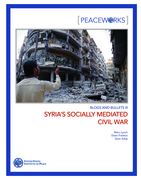
Syria's Socially Mediated Civil War
Washington, DC: United States Institute of Peace (USIP) (2014), 33 pp.
"Analysis of the unprecedented use of social media on Syria points to important findings on the role of new media in conflict zones. In particular, social media create a dangerous illusion of unmediated information flows. Key curation hubs within networks may now play a gatekeeping role as powerful
...
Citizen Engagement and Public Services in the Arab World: The Potential of Social Media
Arab Social Media Report (Dubai School of Government), volume 6 (2014), 51 pp.
"The survey administered for this issue measures public attitudes and perceptions towards the adoption of social media by Arab governments for the purpose of public service delivery. Respondents were asked about their usage of government social media pages, their perceptions of benefits and risks in
...
Hashtag Standards for Emergencies
United Nations Office for the Coordination of Humanitarian Affairs (OCHA) (2014), 15 pp.
"Twitter is the primary social media platform discussed in this Think Brief. However, the use of hashtags has spread to other social media platforms, including Sina Weibo, Facebook, Google+ and Diaspora. As a result, the ideas behind hashtag standardization may have a much larger sphere of influence
...
State of the Newsroom: South Africa 2014. Disruptions Accelerated
Johannesburg: Wits Journalism University of the Witwatersrand (2014), x, 134 pp.

Social Media in Syria's Uprising and Post-Revolution Libya: An Analysis of Activists' and Blogger's Online Engagement
Arab Media & Society, issue 19 (2014), 21 pp.
"Masudul Biswas and Carrie Sipes perform a comparative content analysis of Twitter and Facebook posts from a sample of Syrian and Libyan activist groups. By considering online content in the context of post-revolution Libya and the continuing upheaval in Syria, the authors shed new light on online a
...
The New Gatekeepers: Controlling Information in the Internet Age
Washington, DC: Center for International Media Assistance (CIMA) (2013), 54 pp.
"Internet companies have become the new gatekeepers of information–and their data-parsing algorithms the twenty-first century equivalent of the stereotypical editor with the green eyeshade who filtered the news before passing it along to readers .. As they have expanded globally, these pioneering
...
Microblogs in China: Bringing the State Back In
Hamburg: GIGA German Institute of Global and Area Studies (2013), 26 pp.
"This paper reflects the adaptation and transformation of the Chinese party-state's government strategy in the digital era. Through a discourse analysis of the current Chinese debate on the role of microblogs in China, it argues that China's political elites have revised their social management stra
...
Using Social Media to Gauge Iranian Public Opinion and Mood After the 2009 Election
Santa Monica, Calif. et al.: RAND Corporation (2012), xxi, 86 pp.
"This report presents an analysis of Iranian public opinion and mood as expressed over Twitter in the nine months following the election. The research represents an initial case study of a novel methodology developed to analyze politically oriented social media content. In addition to policy-relevan
...

Netzwerk-Journalismus: Zur veränderten Vermittlerrolle von Journalisten am Beispiel einer Case Study zu Twitter und den Unruhen in Iran
Medien & Kommunikationswissenschaft, volume 60, issue 1 (2012), pp. 102-124
"Partizipative Internettechnologien sorgen für ein verändertes Aufgabenprofil und Rollenbild von Journalisten. Besonders in Krisensituationen oder bei politischen Konflikten können Informationen, die über die sozialen Plattformen des Webs verbreitet werden, wichtige Quellen journalistischer Arbe
...

Political Activism 2.0: Comparing the Role of Social Media in Egypt’s “Facebook Revolution” and Iran’s “Twitter Uprising”
CyberOrient, volume 6, issue 1 (2012), pp. 8-33
"Social media, particularly blogging, Facebook and Twitter, have played a key role in instigating, accelerating and even organizing some of the uprisings and revolutions that have been taking place all over the Middle East. This role has been effective in galvanizing the youth and empowering them in
...
