
Filter
43
Topics
Press Freedom & Communication Rights Violations
21
Media Law & Regulation
10
Violence Against Journalists & Media Personnel
9
Freedom of Expression
8
Media Freedom, Press Freedom
8
Human Rights Violations
5
Digital Media Censorship, Control & Filtering, Internet & Social Media Censorship
3
Media / Communication Control
3
Censorship
3
Cybersecurity, Digital Safety, Privacy, Right to Privacy
2
Killings of Journalists & Media Personnel
2
Surveillance, Surveillance Technologies, Spyware
2
Internet / Social Media Law & Regulation
2
Authoritarian Regimes, Dictatorships
1
Authoritarian Regimes: Government Communication Strategies
1
Authoritarian Regimes: Transnational Repression
1
Chilling Effects (Discouragement of Legitimate Exercise of Legal Rights)
1
Indirect Censorship, Soft Censorship
1
Countering Press Freedom Violations by Legal Actions
1
Harassment & Intimidation of Journalists
1
Self-Censorship
1
Genocides
1
Extremist & Terrorist Digital / Social Media Presence
1
Hate Speech, Hate Speech in Social Media
1
Big Digital Platforms, Big Tech Companies
1
Cybercrimes
1
Digital Ethics, AI Ethics, Social Media Ethics, Data & Information Ethics
1
Internet Shutdowns
1
Facebook
1
Instagram
1
Artificial Intelligence
1
ICT Regulation
1
LGBT & Communication / Media
1
Minorities & Disadavantaged Groups: Oppression
1
Countering Hate Speech, Disinformation & Propaganda
1
Documenting Human Rights Violations
1
Curricula: School Education
1
Defamation, Libel, Slander
1
Safety of Journalists, Safety Risks of Media Workers
1
Legal Status of Journalists
1
Election Reporting
1
Judiciary & Penal System
1
Religious Freedom
1
Shrinking Spaces for Civil Society & Political Actors
1
Election Campaigns: Social Media
1
Buddhism
1
Taliban
1
Religious Discrimination, Persecution of / Violence Against Religious Groups
1
Civil Society
1
Language
Document type
Countries / Regions
Authors & Publishers
Media focus
Publication Years
Methods applied
Output Type
“They’ll Get You no Matter What”: Morocco’s Playbook to Crush Dissent
Human Rights Watch (2022), 134 pp.
"This report examines eight cases of police and/or judicial harassment targeting known Moroccan dissidents, and two cases targeting independent media institutions. The report examines in detail 12 cases tried by Morocco courts." (Methodology)
Trapped in a Web: The Exploitation of Personal Data in Hungary’s 2022 Elections
Human Rights Watch (2022), 94 pp.
"On April 3, 2022, Hungary’s ruling Fidesz party won a fourth term in national elections, cementing its dominance with a two-thirds majority that will allow it to continue traveling what critics of the party and many others would describe as the path of centralizing power and rolling back democrat
...
"Burundi’s scrutiny and control of media and nongovernmental organizations, and the conviction after deeply flawed proceedings of 12 journalists and activists in exile have a continued chilling effect on their work, Human Rights Watch said today. Almost one year after President Évariste Ndayishim
...
"Prosecute Them with Awesome Power": China’s Crackdown on Tengdro Monastery and Restrictions on Communications in Tibet
Human Rights Watch (2021), 63 pp.
"This report provides the first detailed account of the raid on the Tengdro monastery and its consequences, including multiple detentions and a suicide, that has appeared in any media within or outside China. It also provides analysis of what the case shows about conditions in Tibet today and assess
...
"We Might Call You in at Any Time": Free Speech Under Threat in Iraq
New York: Human Rights Watch (2020), 50 pp.
"In this report, Human Rights Watch documents 33 cases between 2016 and 2020 in which authorities in areas controlled by the federal government and the Kurdistan Regional Government (KRG) have arrested, brought charges against, and sentenced journalists, activists, and other dissenting voices under
...
"Video Unavailable": Social Media Platforms Remove Evidence of War Crimes
New York: Human Rights Watch (2020), 94 pp.
"Social media platforms are taking down “terrorist and violent extremist content” more and more quickly, often in response to the demands of governments, but in a way that prevents the content from being used to support investigations into serious crimes, including war crimes. “Video Unavailab
...
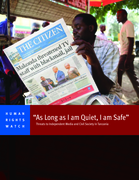
"As Long as I Am Quiet, I Am Safe": Threats to Independent Media and Civil Society in Tanzania
Human Rights Watch (2019), 63 pp.
"This publication documents how authorities have stepped up censorship of the media and arbitrarily arrested and, in some cases, prosecuted journalists and activists perceived to be government critics. They have also exerted tighter control over NGOs and political opposition parties. The repression
...
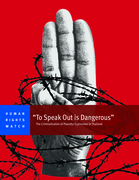
"To Speak Out is Dangerous": The Criminalization of Peaceful Expression in Thailand
Human Rights Watch (2019), 136 pp.
"Focusing on the period between the 2014 coup and flawed elections in March 2019, “To Speak Out is Dangerous” draws on interviews with individuals prosecuted for exercising their rights to speech or assembly, lawyers, journalists, students, and activists, and examination of police charge sheets,
...
Dashed Hopes: The Criminalization of Peaceful Expression in Myanmar
Human Rights Watch (2019), 87 pp.
"This report—based largely on interviews in Myanmar and analysis of legal and policy changes since 2016—assesses the NLD government’s record on freedom of expression and assembly in its more than two years in power. It updates Human Rights Watch’s prior report, “They Can Arrest You at Any
...
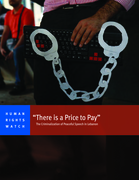
"There is a Price to Pay": The Criminalization of Peaceful Speech in Lebanon
New York: Human Rights Watch (2019), 122 pp.
"Over the past few years, Lebanon has witnessed an alarming increase in attacks on peaceful speech and expression. The country’s criminal defamation laws, which authorize imprisonment up to three years for peaceful speech, have been used against citizens who have written about pressing social issu
...

"You Can’t See Them, But They’re Always There": Censorship and Freedom of the Media in Uzbekistan
Human Rights Watch (2018), 32 pp.
"For more than two decades, Uzbekistan has been a country with severe restrictions on free speech and media and some of the longest-imprisoned journalists in the world. There are now tentative signs of change in Central Asia’s most populous country. Opportunities for more open debate and independe
...
"Since 2013, Bangladesh authorities have used draconian provisions in the Information and Communication Technology Act (ICT Act) to arrest scores of people for political and social commentary critical of the current Awami League government or its leaders. Those targeted have also included journalist
...
The Red Lines Stay Red: Morocco's Reforms of its Speech Laws
New York: Human Rights Watch (2017), 44 pp.
"Morocco’s 2015 Press Code eliminates prison as a punishment for speech offenses. This, on its face, represents progress for freedom of expression in a country where journalists and ordinary citizens have been locked up for “insulting” the king, questioning Morocco’s claim over Western Sahar
...
