
Filter
8
Text search:
Junhao
Hong
Topics
Globalisation of Media
3
Television Consumption, Televison Use, Television Audiences
2
Television Programme & Format Trade
2
Transnational Television, International Television
2
Television Landscapes
2
Transnational Advertising, International Advertising
1
Media Use: Migrants & Diasporas
1
Celebrities, Idols, Stars
1
Documentaries, Television Documentaries, Web Documentaries
1
Public Diplomacy, Cultural Diplomacy
1
State News Agencies, Government News Agencies
1
Creative & Cultural Industries
1
Cultural Identity
1
Development Communication Theories
1
Big Digital Platforms, Big Tech Companies
1
Websites
1
Infectious Diseases' Outbreak Communication
1
Music Industries & Markets
1
Political Economy of Media
1
Health: Media Representation (Factual & Fictional)
1
International Communication
1
China: Transnational Information Operations, International Broadcasting, Public Diplomacy
1
Glocalization of Media
1
International Media & Communication Policies
1
Transnational Media Corporations, International Media Companies
1
News Agencies
1
Xinhua (News Agency, China)
1
Local Television
1
Media & Communication Policies
1
Media & Information Literacy
1
Voice of America
1
Political Change
1
Democracy / Democratization and Media
1
Foreign Language Radio Programmes
1
China Global Television Network, CGTN (formerly China Central Television, CCTV)
1
Television Programmes & Genres
1
Language
Document type
Countries / Regions
Authors & Publishers
Media focus
Publication Years
Journals
Output Type
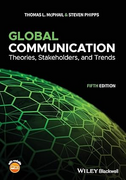
Global Communication: Theories, Stakeholders, and Trends
Hoboken, NJ: Wiley Blackwell, 5th ed. (2020), ix, 311 pp.
"[This book] has been thoroughly updated with new content, trends, and conclusions, all based on the latest data. The book examines broadcasting, mass media, and news services ranging from MSNBC, MTV, and CNN to television sitcoms and Hollywood export markets. It investigates the roles of the major
...
Internationalisation of China’s Television: History, Development and New Trends
In: Routledge Handbook of Chinese Media
Gary D. Rawnsley, Ming-Yeh T. Rawnsley (eds.)
London; New York: Routledge (2018), pp. 427-445
"In general, the internationalisation of China's television in the past several decades can be divided into four intertwined paths. The first is importing media and cultural products from other countries, which initiated the exchange of China's television with the outside world, and so far is still
...
From the World's Largest Propaganda Machine to a Multipurposed Global News Agency: Factors in and Implications of Xinhua's Transformation Since 1978
Political Communication, volume 28, issue 3 (2011), pp. 377-393
"The Xinhua News Agency is China's largest state news agency. It is also the largest news agency among developing countries. This research examines the changes Xinhua has undergone over the past three decades under the backdrop of (a) the end of the Cold War, (b) the trend of globalization and vario
...
Voice of America in the Post-Cold War Era: Opportunities and Challenges to External Media Services Via New Information and Communication Technology
International Communication Gazette, volume 73, issue 4 (2011), pp. 343-358
"This study examines Voice of America’s (VOA) services in the post-Cold War era within the framework of the information revolution and globalization. The use of new information venues has caused VOA to evolve from a pure propaganda machine to a notion of informational soft power. However, this stu
...
TV China
Bloomington, Indiana: Indiana University Press (2009), vi, 259 pp.
"If radio and film were the emblematic media of the Maoist era, television has rapidly established itself as the medium of the "marketized" China and in the diaspora. In less than two decades, television has become the dominant medium across the Chinese cultural world. TV China is the first antholog
...
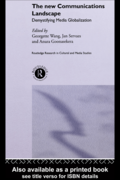
The New Communications Landscape: Demystifying Media Globalization
London; New York: Routledge (2000), xvi, 343 pp.
"The innovative and rapid growth of communication satellites and computer mediated technologies in the late 1980s and early 1990s, combined with the deregulation of national broadcasting, led many media commentators to assume that the age of national media had been lost. But what has become clear is
...
The Internationalization of Television in China: The Evolution of Ideology, Society, and Media Since the Reform
Westport, Conn.: Praeger (1998), xvii, 165 pp.
Democratising Communication? Comparative Perspectives on Information and Power
Cresskill, NJ: Hampton Press (1997), xiv, 450 pp.
