
Filter
9
Featured
Free Access
7
Key Guidance
1
Top Insights
1
Topics
Behaviour Change Communication
4
UNICEF
3
Child Protection Online
2
Children's Rights
2
Development Communication Projects: Case Studies
2
Domestic Violence
2
People with Disabilities: Advocacy & Empowerment
1
Behaviour Change Campaigns
1
Campaigning: Evaluation, Monitoring, Impact Assessment
1
Campaigning: Planning & Implementation
1
Children and Media
1
Child Abuse
1
Child Abuse Reporting
1
Media Literacy: Children
1
Development Communication, Communication for Development (C4D)
1
Development Communication: Design & Implementation
1
Development Communication: Monitoring & Evaluation
1
People with Disabilities: Reporting & Media Representation
1
Language
Document type
Countries / Regions
Authors & Publishers
Media focus
Publication Years
Journals
Output Type

Child Online Safety
End Violence Against Children (2020), 16 pp.
"In September 2019, the End Violence Fund launched a $13 million open call for solutions focused on leveraging new and existing technologies. These technologies include artificial intelligence, machine learning, data science, blockchain, virtual reality and other innovative solutions that have the p
...
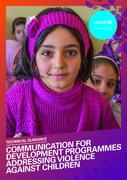
Technical Guidance for Communication for Development Programmes Addressing Violence Against Children
Key Guidance
New York: UNICEF (2019), 104 pp.
"This publication presents the basics of researching, planning, monitoring and evaluating Communication for Development (C4D) interventions, and offers guidance on how such interventions can be used to address violence against children (VAC). It covers the stages of the C4D programme cycle, emphasiz
...

Communication for Development Approaches to Address Violence Against Children: A Systematic Review
New York: UNICEF (2019), 76 pp.
"The number of manuscripts (peer-reviewed articles and grey literature) related to the use of C4D approaches to address VAC has steadily increased each year since 2000. Of the 302 manuscripts that were coded, 44 per cent discuss an intervention implemented in a developing country, which speaks to th
...
UNICEF 2017 Report on Communication for Development (C4D): Global Progress and Country Level Highlights Across Programme Areas
Top Insights
New York: UNICEF (2018), 72 pp.
"The following report summarizes how UNICEF and its partners have utilized Communication for Development strategies in their work during the period of UNICEF’s Strategic Plan 2014-2017, with an emphasis on 2017. The report captures the impact of these accomplishments on children and the communitie
...

Communication for Development and Social Change: Influencing Social Norms for an Inclusive Society in Montenegro
Commons: Revista de Comunicación y Ciudadanía Digital, volume 6, issue 1 (2017), pp. 130-147
"UNICEF and the Government of Montenegro implemented a communication strategy "It's about ability" to challenge the existing, exclusionary practices and promote new, inclusive social norms for children with disability. Drawing on communication for development principles and social norms theory, a 20
...
Keeping Children Safe Online
Nicosia: World Vision International (2015), 4 pp.
"Keeping Children Safe Online (KCSO) is an evidence-based practice that establishes sustainable child protection mechanisms to mitigate the risks of children to online abuse and exploitation. World Vision uses the practice to work with children, parents, teachers, law enforcement, civil society and
...
UNICEF and Communication for Development: An Integrated Approach to Developing Capacity to Produce Communication for and with Children
In: The Routledge International Handbook of Children, Adolescents and Media
Dafna Lemish (ed.)
London; New York: Routledge (2013), pp. 433-441
International Initiatives Concerning Children and Media
In: The Routledge International Handbook of Children, Adolescents and Media
Dafna Lemish (ed.)
London; New York: Routledge (2013), pp. 442-450
Through Children’s Eyes: The Children’s Media Mentoring Project
Johannesburg: Media Monitoring Project (2006), 19 pp.
"The purpose of this report is primarily to report on the results of the 2006 Children in the Media Monitoring Project, and specifically on how children would write the news, reflected in the newspapers the children produced during a workshop in 2006. The report also reflects the results of a childr
...
