Filter
17
Topics
Disinformation, Misinformation, Fake News
9
Countering Hate Speech, Disinformation & Propaganda
4
Artificial Intelligence
3
Digital Activism, Cyber Advocacy
1
Digital Media Censorship, Control & Filtering, Internet & Social Media Censorship
1
Hate Speech Legislation & Regulation
1
War Propaganda, Propaganda in Conflicts
1
Digital Ethics, AI Ethics, Social Media Ethics, Data & Information Ethics
1
Digital Platform & Intermediaries Regulation
1
Internet / Social Media Law & Regulation
1
Digital Political Communication
1
Content Moderation & Regulation: Social Media
1
Democratization & Digital Media / Social Media
1
AI & Social Justice
1
Generative AI, including ChatGPT et al.
1
Racism in Communication & Media
1
Racism in Social Media & Digital Communication
1
Disinformation & Misinformation Law & Regulation
1
Foreign Disinformation, Foreign Information Manipulation Operations, Foreign Propaganda
1
Media Literacy: Disinformation, Fake News, Hate Speech
1
Sports Reporting
1
Fact-Checking & Verification of Sources
1
Sexuality: Media Representation, Sexually Explicit Media Content, Pornography
1
COVID-19 Communication
1
Media Literacy: Youth
1
Internet Governance, Internet Policies
1
Language
Document type
Countries / Regions
Authors & Publishers
Media focus
Publication Years
Methods applied
Journals
Output Type


Vilify, ridicule, disinform: Political communication and media trust in the age of generative AI
Potsdam: Friedrich Naumann Foundation; Institute for Strategic Dialogue (ISD) (2024), 23 pp.
"This report examines political communication and media trust in the age of generative artificial intelligence systems (AI). Firstly, it provides a brief explainer of generative AI tools and techniques, looking separately at systems that generate text and those that generate or manipulate images, vi
...
Deepfakes in the context of AI inequalities: Analysing disparities in knowledge and attitudes
Information, Communication & Society (2024), 21 pp.
"This study contributes to research on digital inequalities in the context of artificial intelligence by examining user perceptions of deepfake technology. We focus on the stratification of deepfake knowledge and attitudes towards deepfakes as critical elements of technology access. Based on a surve
...

VerificAudio
Sociedad Española de Radiodifusión (2024)
"El rápido avance de la inteligencia artificial y las tecnologías de clonación de voz harán que saber cuándo un audio es real y cuándo es falso sea cada vez más complicado. Y con ello, la manipulación de audio utilizada para fines maliciosos, amenaza con poner en peligro la integridad de inf
...
Empowering Youth to Combat Malicious Deepfakes and Disinformation: An Experiential and Reflective Learning Experience Informed by Personal Construct Theory
Journal of Constructivist Psychology (2023), 22 pp.
"The potential to weaponize deepfakes is growing at an alarming rate. The study aimed to explore how education can help youth develop resilience to malicious deepfakes and the ability to counter disinformation, regardless of context. Sixteen youth between the ages of 18 and 24 participated in a 9-h,
...

Visual disinformation in a digital age: A literature synthesis and research agenda
New Media & Society, volume 25, issue 12 (2023), pp. 3696-3713
"Visuals are expected to amplify the impact of disinformation, but it is rarely specified how, and what exactly distinguishes them from text. This article is one of the first to treat visual disinformation as its own type of falsehood, arguing that it differs from textual disinformation in its produ
...

Policy Brief: Ensuring Ethical AI Practices to Counter Disinformation
MediaFutures; Luiss Data Lab (2023), 15 pp.
"In particular we recommend to strengthen collaboration (platforms should adopt a collaborative approach involving various stakeholders, including governments, civil society organisations, and fact-checkers, to counter the spread and impact of disinformation. This can include sharing information, be
...

Deepfakes – When We Can No Longer Believe Our Eyes and Ears. Media Manipulation in Conflict: Challenges and Responses
Berlin: Stiftung Wissenschaft und Politik (SWP) (2023), 6 pp.
"Deception and media manipulation have always been an integral part of wartime propaganda. But never before has it been so easy to create high-quality fabrications of images as well as sound and video recordings. The tendency to react emotionally to these media opens up a whole new possibility for a
...
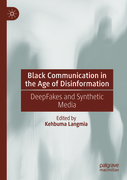
Black Communication in the Age of Disinformation: DeepFakes and Synthetic Media
Cham: Palgrave Macmillan (2023), xxvii, 208 pp.
"Current developments in technology, such as facial recognition, have already disproportionately affected people of color, especially people of African descent. The rise of DeepFakes and other forms of Fake News online has brought a host of new impacts and potential obstacles to the way that Black c
...

The Problem with Pictures: Source Analysis and Fact-Checking in a Time of War
Journalism Research, volume 5, issue 2 (2022), pp. 172-182
"Day in, day out, we journalists receive images from combat zones in Ukraine, without knowing whether they are authentic or have been manipulated. It is our job to find out, conducting analysis that takes both time and basic knowledge of image forensics. There are many testing tools and platforms fo
...
The detection of political deepfakes
Journal of Computer-Mediated Communication, volume 27, issue 4, zmac008 (2022), 13 pp.
"In this article, a theoretical model on the detection of deepfakes by ordinary citizens is introduced. The authors conducted three studies in which deepfakes with political content were presented. The deepfakes showed UK’s Prime Minister Boris Johnson or Barack Obama. In the deepfake videos, the
...

Weaponised Deep Fakes: National Security and Democracy
International Cyber Policy Centre Australian Strategic Policy Institute (ASPI) (2020), 18 pp.
"Any technology that can be used to generate false or misleading content, from photocopiers and Photoshop software to deep fakes, can be weaponised. This paper argues that policymakers face a narrowing window of opportunity to minimise the consequences of weaponised deep fakes. Any response must inc
...

Digital Democracy
International Reports (Konrad-Adenauer-Stiftung), volume 36, issue 1 (2020), pp. 1-68

Desinformation aufdecken und bekämpfen: Interdisziplinäre Ansätze gegen Desinformationskampagnen und für Meinungspluralität
Baden-Baden: Nomos (2020), 217 pp.
"Was macht Desinformation im deutschsprachigen Internet aus? Wie wirkt Desinformation? Wie kann sie mithilfe technischer Mittel erkannt werden? Was kann und könnte mit regulatorischen und rechtlichen Maßnahmen gegen Desinformation getan werden? Aus den Erkenntnissen von Journalistik, Medienpsychol
...

Artificial Intelligence and Disinformation: How AI Changes the Way Disinformation is Produced, Disseminated, and Can be Countered in Security and Human Rights
Security and Human Rights, volume 29, issue 1/4 (2020), pp. 55-81
"This article explores the challenges and opportunities presented by advances in artificial intelligence (AI) in the context of information operations. The article first examines the ways in which AI can be used to counter disinformation online. It then dives into some of the limitations of AI solut
...

Deepfakes & Disinformation
Potsdam: Friedrich Naumann Foundation (2020), 31 pp.

The State of Deepfakes: Landscape, Threats, and Impact
Amsterdam: Deeptrace (2019), 20 pp.
"Our research revealed that the deepfake phenomenon is growing rapidly online, with the number of deepfake videos almost doubling over the last seven months to 14,678. This increase is supported by the growing commodification of tools and services that lower the barrier for non-experts to create dee
...