
Filter
39
Featured
Free Access
35
Key Guidance
1
Quick Overview
2
Top Insights
2
Topics
Countering Hate Speech, Disinformation & Propaganda
13
Disinformation, Misinformation, Fake News
9
Content Moderation & Regulation: Social Media
6
Hate Speech Legislation & Regulation
4
Hate Speech, Hate Speech in Social Media
3
Digital Platform & Intermediaries Regulation
3
Internet / Social Media Law & Regulation
3
Freedom of Expression
2
Media Freedom, Press Freedom
2
Election Campaigns: Disinformation & Misinformation
2
Defamation Law & Regulation
2
Digital Divide, Digital Inequalities
1
Electoral Advertising, Political Advertising
1
Communication Rights
1
Chilling Effects (Discouragement of Legitimate Exercise of Legal Rights)
1
Censorship
1
Harassment & Intimidation of Journalists
1
Government Communication Strategies
1
Conflict-Sensitive Digital Technology Use & Social Media in Prevention & Transformation
1
Big Digital Platforms, Big Tech Companies
1
Cybercrimes
1
Digital Ethics, AI Ethics, Social Media Ethics, Data & Information Ethics
1
Deepfakes (Realistic-Looking Media Content that has been Modified, Generated or Falsified Using AI)
1
Gendered Disinformation
1
Health Disinformation & Misinformation
1
Media Literacy: Disinformation, Fake News, Hate Speech
1
Climate Change Communication, Climate Journalism
1
Self-Regulation of Media
1
Sensationalist Journalism, Yellow Press
1
Gender-Based Harassment, Intimidation & Violence
1
Good Practice Examples
1
European Union (EU)
1
United Nations Peacekeeping Operations
1
Safety of Journalists: Law & Public Policies
1
Election Reporting
1
Media Law & Regulation
1
Criminal Law & Criminal Prosecution
1
Populism
1
Election Monitoring
1
Research Methods
1
Discrimination
1
Language
Document type
Countries / Regions
Authors & Publishers
Media focus
Publication Years
Methods applied
Journals
Output Type

Online Content Regulation in the Asia-Pacific: Limiting Civil Society’s Capacity to Hold Governments Accountable
Bangkog: Asia Centre (2024), v, 37 pp.
"Governments have updated penal codes and national security laws, enacted fake news and cybersecurity laws as well as laws that govern internet service providers and technology companies. These laws have widely been used to block and remove online content that call out blind spots in government poli
...
Most "Fake News" Legislation Risks Doing More Harm than Good amid a Record Number of Elections in 2024
Technology & Innovation (CNTI) Center for News (2024), 18 pp.
"Legislation targeting “fake news” — a contested term used to reference both news and news providers that governments (or others) reject as well as disinformation campaigns — has increased significantly over the last few years, particularly in the wake of COVID-19. This study finds that even
...

Mapping Lies in the Global Media Sphere
London; New York: Routledge (2024), 224 pp.
"This volume addresses the concept of “(in)nocent lies” in the media – beyond the concept of misleading information online, this extends to a deliberate effort to spread misinformation, disinformation and conspiracy theories – and proposes a critical approach to tackle the issue in related i
...
Censorship from Plato to Social Media: The Complexity of Social Media's Content Regulation and Moderation Practices
Cham: Springer (2023), xiv, 189 pp.
"In many countries, censorship, blocking of internet access and internet content for political purposes are still part of everyday life. Will filtering, blocking, and hacking replace scissors and black ink? This book argues that only a broader understanding of censorship can effectively protect free
...
Chilling Legislation: Tracking the Impact of “Fake News” Laws on Press Freedom Internationally
Washington, DC: Center for International Media Assistance (CIMA) (2023), 20 pp.
"The proliferation of misinformation, disinformation, and mal-information (MDM) poses serious challenges to democracy, public safety, and national security. Conversely, these very worries could be used as a front for unjustified ends. There is a global trend toward legislation that may risk infringi
...

The Big Chill? How Journalists and Sources Perceive and Respond to Fake News Laws in Indonesia and Singapore
Journalism Studies, volume 24, issue 14 (2023), pp. 1819-1838
"Media freedom has deteriorated across the world over the past 15 years with populist leaders attacking journalism in both democratic and repressive states. Since the rise of online misinformation and disinformation, concern is growing that governments are using fake news language and related laws t
...
Social Media 4 Peace: Local Lessons for Global Practices
Paris: UNESCO (2023), 69 pp.
"The three countries [Bosnia and Herzegovina, Indonesia, and Kenya] provide evidence of online hate speech and disinformation affecting human rights offline. The evidence is not comprehensive yet clear enough to raise serious concerns. Online gender-based violence is also reported as critical in the
...
Platform Problems and Regulatory Solutions: Findings from a Comprehensive Review of Existing Studies and Investigations
Quick Overview
Paris: UNESCO; Research ICT Africa (2023), 17 pp.
"The proliferation of hate speech and disinformation on online platforms has serious implications for human rights, trust and safety as per international human rights law and standards. The mutually-reinforcing determinants of the problems are: ‘attention economics’; automated advertising system
...

Brazilian Fake News Bill: Strong Content Moderation Accountability but Limited Hold on Platform Market Power
Javnost: The Public, volume 30, issue 2 (2023), pp. 253-267
"This article analyses the Brazilian PL 2630, so-called “fake news bill,” according to platform regulation approaches focused on speech, data, and market power. This law project was introduced in 2020 with the objective to fight disinformation campaigns in digital platforms such as social media
...
Regulating Disinformation on Twitter and Facebook
Griffith Law Review, volume 31, issue 4 (2023), pp. 513-536
"The spread of disinformation in recent years has caused the international community concerns, particularly around its impact on electoral and public health outcomes. When one considers how disinformation can be contained, one often looks to new laws imposing more accountability on prominent social
...
The Alternative Truth Kept Hidden From Us: The Effects of Multimodal Disinformation Disseminated by Ordinary Citizens and Alternative Hyper-Partisan Media. Evidence From the US and India
Digital Journalism (2023), 22 pp.
"The affordances of social media potentially amplify the effects of disinformation by offering the possibility to present deceptive content and sources in credible and native ways. We investigate the effects of two aspects related to the dissemination and modality of digital disinformation: (In)auth
...
Regulating misleading political advertising on online platforms: An example of regulatory mercantilism in digital policy
Policy Studies, volume 45, issue 5 (2023), pp. 730–749
"Since its Joint Communication on Hybrid Threats, the EU has publicly recognized the risks to its security posed by non-traditional means aimed at undermining its legitimacy. The propagation of disinformation including misleading political advertising serves as a key example of how the Commission’
...
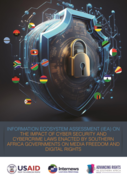
Information Ecosystem Assessment (IEA) on the Impact of Cyber Security Cybercrime Laws enacted by Southern Africa Governments on Media Freedom and Digital Rights
Advancing Rights in Southern Africa (ARISA); Internews; USAID (2023), 633 pp.
"In 2023, Advancing Rights in Southern Africa (ARISA) through its consortium partner, Internews, undertook the most comprehensive review yet of laws affecting media practice and the freedom of expression, including cyber laws, penal codes, constitutions and acts of parliament, in the sixteen Souther
...
Artificial Intelligence and Disinformation: State-Aligned Information Operations and the Distortion of the Public Sphere
Vienna: OSCE Representative on Freedom of the Media (2022), 28 pp.
"In light of the role played by state-aligned actors, the private sector and lawmakers in countries with strong democratic institutions should adopt policies that mitigate the ability of state actors to manipulate AI and weaponize communication platforms. Efforts to combat disinformation must recogn
...
Regulation of Harmful Content Online in Bosnia and Herzegovina: Between Freedom of Expression and Harms to Democracy
Sarajevo: Mediacentar; UNESCO (2022), 108 pp.
"The study specifically focuses on five types of harmful content: a) hate speech and hate narratives; b) denials of war crimes and glorification of war criminals; c) ethno-nationally and/or politically biased media reporting; d) disinformation; and e) attacks, threats and smear campaigns against ind
...
User empowerment against disinformation online
Strasbourg: European Audiovisual Observatory (2022), 66 pp.
"This publication describes the many ways in which public authorities and private enterprises empower users against disinformation online. The first chapter sets the scene by discussing relevant concepts, such as mis-, dis- and malinformation, empowerment, and media literacy. It further discusses th
...
Protecting the truth: Peace operations and disinformation
Berlin: Center for International Peace Operations (2022), 18 pp.
"This study discusses how and to what extent peace operations are affected by digital disinformation and how international organisations (UN, EU, OSCE and NATO) as mandating bodies for peace operations have responded to limit the effect of disinformation or even prevent it. Based on this assessment
...
National Regulatory and Self-Regulatory Framework Against Hate Speech and Disinformation: Factsheet Bosnia and Herzegovina
Lubljana; Sarajevo: South East European Network for Professionalization of Media (SEENPM); Peace Institute; Mediacentar (2021), 29 pp.
"The legislative framework for the regulation of hate speech in BiH is fragmented and unaligned with European standards, and there are few cases of its processing. Ways to combat disinformation mainly rely on self-regulatory frameworks and fact-checking platforms, and there are no comprehensive stra
...
Fighting Fake News: A Study of Online Misinformation Regulation in the Asia Pacific
Melbourne: La Trobe University (2021), xvi, 117 pp.
National Regulatory and Self-Regulatory Framework Against Hate Speech and Disinformation: Factsheet Montenegro
Ljubljana: South East European Network for Professionalization of Media (SEENPM); Peace Institute; Montenegro Media Institute (2021), 19 pp.
"Competent institutions should react in case of spreading hate speech and introduce appropriate measures to combat the spread of disinformation, which would serve as a middle ground between arresting those who spread disinformation and a too passive approach to this problem. In addition to this, the
...
