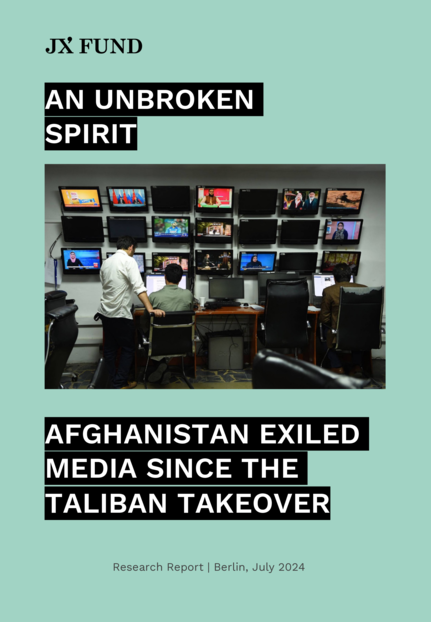
An unbroken spirit: Afghanistan exiled media since the Taliban takeover
Top Insights
Berlin: JX Fund (2024), 44 pp.
Contains graphs, bibliogr. pp. 41-44
"A large portion of independent media has relocated to United States of America, Canada, and European countries such as Germany, France, UK, Ireland after the Taliban took over. The teams of many of these outlets operate in a hybrid model with editorial leadership in exile and staff members and freelancers in Afghanistan. Just over half of Afghan exiled media (57%) were founded in Afghanistan before the Taliban took over, but others (42%) were established in exile after August 15, 2021. Exiled media publish their content in multiple languages, including both the official languages of Afghanistan: Pashto and Dari (Farsi). Out of 47 media surveyed, 35 also publish their content in English. Afghan women journalists have founded several media outlets spanning various platforms, including online publications, radio and television channels, social media platforms, and podcasts. Through these outlets, they amplify the voices of Afghan women and shed light on the challenges they face under Taliban rule. In exile, ethnic, religious, linguistic, and political affiliations continue to influence the content and ownership of some media outlets, with direct consequences on their credibility.
Afghan exiled media mostly aim for nation-wide coverage (90%). Only 10% of exiled media focus on regional coverage. Media consumption in Afghanistan has shifted towards exiled media. In addition, since the Taliban takeover, audiences increasingly relied on the internet, particularly social media platforms, to access information and entertainment programs. The study reveals that Facebook, X, and YouTube are the most popular social media platforms for exiled media outlets – both for audiences to consume content and interact with publishers. Television still stands as the predominant broadcasting platform in Afghanistan, with urban areas exhibiting a higher prevalence of household TV ownership compared to rural regions. Television coverage extends to nearly 40 percent of Afghanistan’s population. At least 12 Afghan TV exiled projects are accessible via satellite, web, social media, apps and streaming platforms.
Fact-checking information coming from on-the-ground sources is becoming harder. The Taliban severely restricted information flows. Most Afghan exiled media rely on citizen journalism and anonymous sources. Lack of financial sustainability is a major concern. Afghan exiled media have lost their previous funding opportunities and need to cover budget gaps from international organizations or other philanthropic sources." (Executive summary, page 3)
Afghan exiled media mostly aim for nation-wide coverage (90%). Only 10% of exiled media focus on regional coverage. Media consumption in Afghanistan has shifted towards exiled media. In addition, since the Taliban takeover, audiences increasingly relied on the internet, particularly social media platforms, to access information and entertainment programs. The study reveals that Facebook, X, and YouTube are the most popular social media platforms for exiled media outlets – both for audiences to consume content and interact with publishers. Television still stands as the predominant broadcasting platform in Afghanistan, with urban areas exhibiting a higher prevalence of household TV ownership compared to rural regions. Television coverage extends to nearly 40 percent of Afghanistan’s population. At least 12 Afghan TV exiled projects are accessible via satellite, web, social media, apps and streaming platforms.
Fact-checking information coming from on-the-ground sources is becoming harder. The Taliban severely restricted information flows. Most Afghan exiled media rely on citizen journalism and anonymous sources. Lack of financial sustainability is a major concern. Afghan exiled media have lost their previous funding opportunities and need to cover budget gaps from international organizations or other philanthropic sources." (Executive summary, page 3)
1 EXECUTIVE SUMMARY, 3
2 SOCIAL AND POLITICAL BACKGROUND, 4
History of Afghan Media Development -- Regulatory and Administrative Media Repressions
3 AFGHANISTAN MEDIA: SECTOR OVERVIEW, 11
Audience Trends -- Media Facts and Figures: Origins, Profiles, Ownership -- The Impact of Ethnic Diversity -- The role of television -- Women and Media
4 CHALLENGES: A NEW START IN EXILE, 27
Situation in Key Countries -- Sector Finances: Rising Costs with High Donor Dependency -- Organizational Structure
5 CHARTING THE PATH AHEAD, 31
6 APPENDICES, 33
Approach and Methodology -- Exiled Media Dashboard: Concept Overview -- Media Case Studies: EYE Media Group (AMU TV), Madanyat Media, Wesal TV, Zan Times -- Sources and Bibliography
2 SOCIAL AND POLITICAL BACKGROUND, 4
History of Afghan Media Development -- Regulatory and Administrative Media Repressions
3 AFGHANISTAN MEDIA: SECTOR OVERVIEW, 11
Audience Trends -- Media Facts and Figures: Origins, Profiles, Ownership -- The Impact of Ethnic Diversity -- The role of television -- Women and Media
4 CHALLENGES: A NEW START IN EXILE, 27
Situation in Key Countries -- Sector Finances: Rising Costs with High Donor Dependency -- Organizational Structure
5 CHARTING THE PATH AHEAD, 31
6 APPENDICES, 33
Approach and Methodology -- Exiled Media Dashboard: Concept Overview -- Media Case Studies: EYE Media Group (AMU TV), Madanyat Media, Wesal TV, Zan Times -- Sources and Bibliography