
Filter
20
Featured
Free Access
17
Top Insights
1
Topics
Taliban
15
Media Freedom, Press Freedom
10
Extremist & Terrorist Digital / Social Media Presence
6
Press Freedom & Communication Rights Violations
5
Authoritarian Regimes: Media Systems & Landscapes
3
Female Journalists & Media Workers
3
Islamist Communications & Media
3
Authoritarian Regimes: Government Communication Strategies
2
Violence Against Journalists & Media Personnel
2
Self-Censorship
2
Extremist & Terrorist Communication Strategies and Media
2
Information Warfare, Psychological Warfare
2
Twitter & Microblogs
2
Disinformation, Misinformation, Fake News
2
Safety of Journalists, Safety Risks of Media Workers
2
Access to Media & Information
1
Access to Public Information, Freedom of Information, Right to Information
1
Digital & Social Media Use: Youth
1
Censorship
1
Harassment & Intimidation of Journalists
1
Killings of Journalists & Media Personnel
1
Storytelling
1
Traditional Music
1
War Propaganda, Propaganda in Conflicts
1
Digital Platforms & Intermediaries
1
Facebook
1
Countering Hate Speech, Disinformation & Propaganda
1
Indigenous Communication
1
Journalists Dealing with Risks & Threats, Resilience & Wellbeing of Media Workers
1
Working Conditions of Journalists & Media Personnel
1
Local Communication & Media
1
Media Landscapes, Media Systems, Media Situation in General
1
Media Law & Regulation
1
Media Capture, Vested Political & Other Interests in the Media
1
Propaganda
1
Emotions in the Media, Emotional Functions & Messages of Media
1
Jihad
1
Language
Document type
Countries / Regions
Authors & Publishers
Media focus
Publication Years
Methods applied
Journals
Output Type

Deprived and Silenced: The Taliban and Suppression of Access to Information
Potsdam: Friedrich Naumann Stiftung (2024), 16 pp.
"Before the Taliban‘s return in 2021, Afghanistan had made notable strides in promoting transparency and civic engagement through progressive laws governing information access. These landmark measures, praised internationally, represented small but significant steps toward strengthening the countr
...
Intimidation, Repression and Censorship: The Status of Access to Information and Freedom of Expression in Afghanistan
Rawadari (2024), 26 pp.
"The Taliban have revoked and suspended laws that included the right to access information and freedom of expression, and currently there is no effective legal mechanism to protect media outlets and journalists against interference and intimidation. This has led to widespread violation of the right
...
Freedom of Afghan Media: Challenges facing Afghan journalists in Afghanistan and abroad
Journalists for Human Rights (JHR) (2024), 38 pp.
"Erosion of Media Freedom in Afghanistan: Since the Taliban regained power in August 2021, media freedom in Afghanistan has drastically declined. Over half of the country's media outlets have closed, leading to widespread unemployment among journalists. The Taliban's media policies enforce strict ce
...
Media Freedom in Afghanistan
United Nations Human Rights (2024), 26 pp.
"This report examines the state of media freedom in Afghanistan for the period from 15 August 2021 to 30 September 2024. Under the government of the Islamic Republic of Afghanistan, the media sector grew exponentially in the country, leading to the broadening of media platforms and greater access to
...
Understanding and Addressing Mis-/Disinformation in the Afghan Media Ecosystem
Internews (2024), 21 pp.
"This report summarizes Internews’ six-month social media monitoring research conducted in 2023 that aimed to better understand the online mis- and disinformation environment in Afghanistan. [...] The first phase of the study revealed key aspects of Afghanistan's digital information landscape. The
...
Länderkurzinformation Afghanistan: Informationslage
Nürnberg: Bundesamt für Migration und Flüchtlinge (2024), 6 pp.
"Die beschriebene Quellenlage stellt auch für die Länderanalyse eine Herausforderung dar. Afghanische Medien geben einen guten Überblick darüber, wie die Taliban sich präsentieren möchten. Auch neue Verordnungen und Erlasse der Zentralregierung sind so nachvollziehbar. Dies gilt jedoch nicht f
...
Decoding Social Media’s Role in Taliban 2.0 and its Implications for Afghan Youth
Honolulu: East-West Center (2024), 8 pp.
"The Taliban retook control of Afghanistan on Aug. 15, 2021 after two decades of fighting on the ground and manipulating narratives online, particularly on social media. Their tactical use of social media was more evident in 2021 when they were advancing their territorial gains and posting on social
...
Media Capture Strategies in an Islamic Authoritarian Context: The Case of the Taliban
Human Rights Institute (2023), 43 pp.
"This paper explores the Taliban government's media capture strategies since retaking the country on August 15, 2021, and how journalists and media outlets have responded to these strategies. In particular, it focuses on the Taliban government's approach to the media, given the recent political tran
...
Decoding Social Media’s Role in the Resurgence of the Taliban: A Literature Review
Kabul: Kashmir Research Information System Kardan University (2023), 22 pp.
"The study assesses the extent to which Taliban 2.0 utilised social media as a political mobilisation strategy and provides a response through discourse analysis and a literature review. The study results indicate that the tactical use of social media was more apparent in 2021 when they were promoti
...

The Digital Battlefield: The Taliban’s Case of Co-opting Social Media for Warfare and Governance
Tokyo: Toda Peace Institute (2023), 20 pp.
"This paper delves into the paramount significance of social media in contemporary warfare, shedding light on the critical need for effective measures to counter online radical narratives and prevent the spread of violent extremism. It explores how autocratic and repressive groups like the Taliban e
...
Between Shadows and Stories: Navigating the Journey of Afghan Journalists, from Aug. 15, 2021 to Aug. 15, 2023
Afghanistan's National Journalists Union (2023), 17 pp.
"The Afghan media landscape stands at a crossroads, navigating a landscape rife with challenges and uncertainties in the wake of the Taliban's resurgence. The post-Taliban era, marked by a thriving media sector with 160 television channels, 311 radio stations, 90 print newspapers, and 26 news agenci
...
The Evolution in the Taliban’s Media Strategy
Program on Extremism George Washington University (2022), 8 pp.
"In the mid-1990s, the Taliban took control of Afghanistan for the first time. They banned photography, TV, music, and all forms of entertainment. Soon after, the Taliban banned the internet in early 2001, and then-Foreign Minister Mawlavi Wakil Ahmad Muttawakil famously stated, “We want to establ
...
Afghan Media under the Taliban: Restrictions and Violations
Afghanistan Human Rights and Democracy Organization (AHRDO) (2022), 48 pp.
"[...] Since returning to power in August 2021, the Taliban has imposed a new media control regime, which has three key features: restriction, gender-discrimination, and repression with impunity. First, the Taliban has passed several media policies, imposing extreme constraints on press freedom and
...
Solidarity and Survival: The Story of South Asia. Afghanistan Country Report
International Federation of Journalists (IFJ) (2022), 5 pp.
"An independent media is essential to tell the world the complex unfolding story of Afghanistan. Journalists remaining in Afghanistan, as well as those who have left, desperately need support from the international community. There is need for solidarity and interventions on several fronts. The Afgh
...
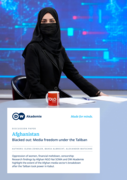
Afghanistan. Blacked Out: Media Freedom Under the Taliban
Bonn: Deutsche Welle DW Akademie (2022), 7 pp.
"Oppression of women, financial meltdown, censorship: Research findings by Afghan NGO Nai SOMA and DW Akademie highlight the extent of the Afghan media sector’s breakdown after the Taliban took power in Kabul." (Page 1)
The Pen Vs the AK-47: The Future of Afghan Media Under the Taliban
Politics and Public Policy Shorenstein Center on Media (2021)
"Written just prior to the Taliban's rapid takeover of Afghanistan, this new report from Shorenstein Center Fellow Samiullah Mahdi provides an overview of the media landscape in Afghanistan, and the threats to and opportunities for press freedom in the region." (Introduction)
The Fall of Kabul: When Platforms Enable Propaganda
Centre for International Governance Innovation, August 27 (2021)
"Social media companies face an increasingly urgent ethical dilemma about the use of their platforms by Taliban officials and supporters." (Introduction)
Social Media and Disinformation in War Propaganda: How Afghan Government and the Taliban Use Twitter
Media Asia, volume 47, issue 1-2 (2020), pp. 34-46
"This study examines disinformation and propaganda in war in the age of information particularly through social media. It analyzes Twitter's posts of the Afghan government and the Taliban, from January to March 2018. For understanding disinformation, 952 tweets of both parties were crosschecked with
...
Taliban Narratives: The Use and Power of Stories in the Afghanistan Conflict
Top Insights
London: Hurst (2017), xxxvi, 376 pp.
"Why has the Taliban been so much more effective in presenting messages that resonate with the Afghan population than the United States, the Afghan Government and their allies? This book, based on years of field research and the assessment of hundreds of original source materials, examines the infor
...

Analyzing Taliban Taranas (chants): An Effective Afghan Propaganda Artifact
Small Wars & Insurgencies, volume 22, issue 1 (2011), pp. 3-31
"This article describes and analyzes a little understood Afghan Taliban propaganda tool: chants or taranas. These melodic refrains effectively use historical narratives, symbology, and iconic portraits. The chants are engendered in emotions of sorrow, pride, desperation, hope, and complaints to mobi
...
